DARRIGO Dave
 From photo taken by Rick’s wife, Krista, probably behind Dragon Lady Comics in the alley north of Queen Street West in 1986 or 1987.
Dave Darrigo, a self-taught writer and publisher, was born November 1, 1954 in Toronto. He began his twin obsessions while still in high school and they would consume him over most of his life.
In 1968 and 1969, while in grades 9 and 10, he organized Sensational Comics Group with a neighbourhood friend Craig Bernhardt. The two boys shared the same passion for comic books and perhaps because they came from business oriented families – Dave’s father was an independent businessman and Bernhardt’s dad was a corporate executive – they tried publishing as well as writing and drawing. The teenagers published a magazine called Heroes and Rubber Cop, in which Dave created a character called “Rubber Cop” and Bernhardt contributed “The Heroes”. The first four issues were printed on the mimeograph of the company owned by Dave’s father. Each issue consisted of 16 to 20 pages plus the cover and had a print run of forty to fifty copies. Like youngsters at a lemonade stand they tried to sell their efforts, not just distribute them among admiring friends.
While Dave and Craig were publishing their comic books as a cottage industry, there appeared in Toronto the first comic book to have professional production values since the Toronto industry had collapsed in the late 1940s. Operation Missile was published by George Henderson, the owner of Memory Lane, a popular culture nostalgia shop on Markham Street in Toronto. The appearance of this well-executed title pushed Dave and Craig to improve the quality of their own product.
The influence of the production values in Operation Missile appeared in the fifth issue of Heroes and Rubber Cop. Printing moved from the mimeograph in Dave’s father’s office to a photo-offset press in a company in Marshalltown, Iowa. Craig had moved there as his family followed his father’s job. The periodical, with a print run of 200 to 250 copies, had a limited colour cover going a step further than Operation Missile which had a black and white cover. Since comic book shops had not yet appeared in any significant number, the two young entrepreneurs tried to sell it through mail order. They advertised in Comics Journal, a U.S. magazine, but had little success.
Initially, Craig and Dave maintained their connection in spite of Craig’s move, but, as one might expect, they drifted apart as time passed. In his new location Bernhardt became involved with two teenaged brothers and an older experienced cartoonist in his twenties who had already created cartoon stories, one of these being “The Stuntman”. Craig was so impressed by this story; he decided to commit Sensational Comics Group to publishing a magazine, Sensational Display, around it. The group added “The Leopard,” co-written by Craig and one of the brothers; penciled by the older cartoonist and inked by the other brother. The whole package was edited by one of the brothers and printed by the same Iowa company in a run of 200 to 250 copies again with a limited colour cover and a black and white interior. Dave only became aware of this enterprise when a package of the magazines (dated November 1969) appeared on his doorstep. This independent initiative on the part of the U.S. faction scuttled Dave’s own plans.
Just before Craig left for the U.S., Dave had met had Ron Hobbs in a variety store in a Toronto Plaza, where both were looking at comic books. Dave told Ron about his creative and self-publishing efforts. Ron confided that he was working on a character called “The Scavenger” who, according to Ron was a truly mysterious character. He was neither hero nor villain, his identity and motives were obscure. Dave had then asked Ron to join his partnership with Craig and had promised he would publish Ron’s story.
Dave planned a magazine, to be called Sensational Debut, to carry Ron’s story. He functioned as Ron’s editor for “The Scavenger”. Neither Sensational Debut nor “The Scavenger” reached publication. Sensational Comics Group, dragged down by the poor sales of Sensational Display, was forced to cease operations at the end of 1969. The whole episode left Dave with an underlying sense of having failed Ron and a determination to see Ron’s work published in the future. This determination would play a significant role twenty years later in the creation of “The Snake”.
After the demise of Sensational Comics Group, Dave and Ron extended their connections in the Toronto cartooning community. They joined an informal comics club started by Ronn Sutton who was publishing a fanzine Whirlwind. The group gathered in Sutton’s house where, Darrigo and Hobbs met Ron Kasman who has since established himself as a writer, letterer, painter and cartoonist. Dave, Ron Hobbs and Ron Kasman would eventually partner to produce “The Snake”.
In 1970, Dave, at 16 years old, quit grade 10 and left high school in order to write crime and spy fiction. He supported himself by working in his father’s business while he honed his writing skills. It was a good time to enter the field. Canadian writers were beginning to have success in the American dominated crime/thriller genre. Hugh Garner was writing police procedurals centred on Toronto Police Inspector Walter McDurmont. James Henderson’s spy thriller from this period, Copperhead continues to be held in high regard. Dave completed a novel We Stand on Guard which featured a pair of Mounties, one Anglophone one Francophone, working in the Intelligence Division in Ottawa, but he could not find a buyer for it. He attempted several other stories involving these two characters but eventually set the idea aside and focused on a Toronto private eye. He completed another novel, Blizzard, but it as well found no publisher. He attempted a U.S. private eye novel and made it more sexually explicit. “Tony Bravado” emerged. He was a trouble shooter for a luxury resort called “Eden”. Dave formulated the elements for “Eden” but in his mind the “Bravado character remained underdeveloped.” He set it aside for the time being.
About this time, two major influences entered Dave’s life. One was Will Eisner and his creation “The Spirit” which opened Dave’s eyes to the cinematic elements in cartoon art “I never thought I’d see in two-dimensional form”. Eisner’s later stories also showed Dave that intelligence could enter the cartoon world. But this influence would only reveal itself when he moved from text to graphic novels.
The second influence led to Dave’s signature creation “Wordsmith.” Through 1968/1969 reprints of the 1930s and 1940s pulp magazine stories, Darrigo came across a group of heroes, “The Shadow”, “The Spider”, and “Doc. Savage,” that deeply appealed to him. Articles on these characters and their authors, written by Torontonian Don Hutchison, a pulp fan, collector and historian, began appearing in Capt. George’s Whizbang magazine published by the same George Henderson mentioned above. They led Dave to explore pulp stories, writers, illustrators and the companies which published them.
Dave recounts their effect upon him.
“At some time – some magical moment – during my formative years as a writer, it occurred to me that my study of the pulp magazine era – its heroes, villains, titles and publishers – was not properly founded. It became clear to me that the writers of these stories were more than just names … they were real people: people who were influenced by the social conditions, the politics and the technology around them.
Of course, I had read many brief biographies of these wonderful pulp scribes …. But it wasn’t until I put these people into the dark times in which they lived that I saw the tension and conflict that must have boiled inside some of them.
How could they write about adventures in darkest Africa or in the furthest reaches of the galaxy, when thousands of hungry people stood in Depression soup-kitchen lines outside their windows? How could they write about Wild West marshals tracking down desperados when fascist crooks like Mussolini and Hitler were holding entire countries to ransom?
* * * * * *
… these questions, and these judgments were the very source – the genesis – of Wordsmith. And the more questions I asked the more my imagination worked. Then, there was that magical moment when every writer says to themselves – Wait a minute. There’s a story in here somewhere.
I began in that room above the street. I saw the man at his typewriter. I heard the clattering keys. I looked over his shoulder and saw what he was typing. Then I merged into his mind. I was him now. I felt his sore back and tired butt. I felt his fatigue as he worked on his third story of the week. I looked at the page in the typewriter and suddenly I knew where the story was going, and how it would end. Then I told the writer to take a break. I told him to get up and stretch and go to the window and take a look outside. He did so. Then I saw the impoverished people standing in the street, lining up to get a meal at the charity soup-kitchen. And I heard the writer say to himself: This is crazy. I’m up here describing a scene on another planet for my story, and plotting how a space cop is going to catch an evil alien criminal, while those people down there are standing with holes in their shoes and wondering where their next meal is coming from.
I opened my eyes and returned to the present. … This idea wasn’t about a writer in 1935. It was about all writers. ‘Hell, it was about me!’”
“Afterword”157.
As with “Tony Bravado,” Dave was thinking of a short story, more likely a novel based on a pulp writer, but he set this idea aside until his writing skills were up to the task.
In 1979 at age 25, Dave left his father’s employ and became manager of Dragon Lady, a Queen Street West comic book outlet. On his own initiative he began publishing a monthly newsletter called the Dragon Lady Dispatch. He wrote news reports about the industry, promoted any stories related to Canadian talent present and past, edited contributions from store customers and staff and had it printed locally at a Queen Street West print shop. He was again involved in publishing tasks that he had first attempted in his teen years. Soliciting volunteers to draw cover illustrations for The Dispatch Dave helped aspiring cartoonists like Chester Brown who would become known for his Ed The Happy Clown series and the graphic history Louis Riel, Ty Templeton who cartooned Stig’s Inferno for Vortex Comics, and Dave Ross, creator of a futuristic world called “Avalon” which started as an animation project at Sheridan College. Both Dave Ross and Ty Templeton established themselves with the U.S. companies Marvel and DC. Darrigo’s early associates Ron Hobbs and Ron Kasman did Dispatch covers as well, but the most important cover artist for Dave would prove to be Rick Taylor.
Meanwhile, Dave had not forgotten his early commitment to see his friend Ron Hobbs published. In 1982 he came up with an idea that he thought would be well suited to Ron’s illustrative talents. “The Dandy” was another mystery man character: a shell-shocked World War 1 veteran whose schizophrenic personality made him a janitor at a high school by day and a tuxedo-dressed crime fighter at night. The vigilante style crime fighter convention was reversed. Instead of a gritty crime fighter with a rich sophisticate cover Dave created a sophisticate crime fighter with a menial worker cover.
Dave was 29 years old when he and Ron took a sample eight-page story of “The Dandy” to the 1984 Maplecon Convention in Ottawa. They presented it to Deni Loubert. She and her husband Dave Sim, of “Cerebus the Aardvark” fame, were the owners of Aardvark-Vanaheim Press in Kitchener. Deni was at the convention looking for new ideas. She liked “The Dandy” enough to consider giving the character a periodical of its own, but more was to come.
Dave also showed Deni, the idea about the 1930s pulp writer he had developed years earlier. The novel format was now gone and in its place was a series of graphic short stories called “Wordsmith.” Loubert was even more impressed with “Wordsmith.” Two of his ideas, one being no more than an outline, were accepted for tentative publication. Dave was ecstatic.
The euphoria did not last. Dave Sim, upon looking at “The Dandy,” rejected Ron’s illustrations. Without those illustrations the overriding reason behind doing the “Dandy” was scuttled. Dave felt that he had failed Ron for a second time. Ron himself turned to the Toronto film industry and would become a successful illustrator in that field. Furthermore, since Ron’s work didn’t appeal to Sim, Dave knew he had to search out another illustrator if “Wordsmith” was to be published. But who? Rick Taylor came to mind.
As a diversion from his elementary teacher work, Rick, in his early thirties, had begun, drawing “Blackboard Jumble’” a cartoon strip which took a humourous look at the trials of a school teacher. With the help of his cousin, Mel Taylor, he also tried his hand at a story “The Human Factor” which was eventually published in Peter Hsu’s Quadrant magazine.
Rick showed Dave copies of “Blackboard Jumble,” and Dave concluded that this teacher could tell a story as well as illustrate covers, and invited him to collaborate on “The Big Bounce,” an aerial war story set in a future Africa. Dave wrote it as a tribute to the war comics he had read as a boy. For Rick “The Big Bounce” was a learning experience in which he developed the skills necessary for photo reference practice. It eventually appeared in Peter Hsu’s magazine, Quadrant, issue 6.
Dave now invited Rick to draw a four page “Wordsmith” episode he had written. Rick drew the episode and it was shown to Deni Loubert. Loubert and Sim decided to publish “Wordsmith”. The four page test was incorporated into Wordsmith no.1 August 1985.
Another problem arose. All was not well at Aardvark-Vanaheim. Loubert and Sim broke up both as spouses and business partners. Deni moved to Long Beach, California in the U.S.A., where she organized a new company called Renegade Press. While Cerebus the Aardvark and Journey remained with Dave and Aardvark-Vanaheim in Kitchener, all the other titles associated with Aardvark Vanaheim moved to the new company. Wordsmith by Dave and Rick, Black Zeppelin by Gene Day of Kingston, Silent Invasion by Michael Cherkas and Larry Hancock of Toronto, and Neil The Horse by Arn Saba also of Toronto, became the new company’s foundation. Ironically this Californian company began life based entirely on the creations of southern Ontario cartoonists, writers and illustrators, while Journey, the title left to Aardvark-Vanaheim, was by American cartoonist Bill Loebs.
“Wordsmith” became Dave’s most notable creation and certainly one of the more original concepts to come out of the 1970s/1980s. It described the real life activities and inner conflicts of “Clay Washburn,” a pulp writer living in depression era New York, and how they often influenced his stories. This series of events occurred in a continuous story arc across the twelve Wordsmith issues before its untimely demise. Rick brought to “Wordsmith” the photorealistic style he saw in newspaper strips like the “Heart of Juliette Jones” (Eliot Caplain and Stan Drake) , “Rip Kirby (Alex Raymond), and “On Stage” (Leonard Starr). It is possible to see in the characters in “Wordsmith” members of the staff of Dragon Lady and of the Toronto cartoonist/illustrator/writer community. Rick himself was the model for Clay Washburn while Dave was the model for Vince Gallo. Rick, becoming more comfortable with the photorealistic style, felt that by issue seven he had hit his stride. On the other hand, Dave thought “…we were in gear by issue #4 which I still feel is one of the best stories.”
Until issue 5, Wordsmith was a bimonthly publication. However, Rick’s teaching duties forced the team to reduce the frequency to quarterly issues. This proved not enough. With declining sales and the pressures of Rick’s teaching job, it became necessary to end the series. Dave had originally intended to portray the character’s life from 1935 to 1945. He shortened this period to 1942 when the U.S. entered the Second World War, and the series ended with “Clay Washburn” joining the army as a staff clerk in Washington. The series ended with issue 12, January 1988.
In 1990 Caliber Press in Michigan reprinted the entire Wordsmith series in two volumes. Later it reprinted the original twelve issues in a series of nine reprints.
Rick turned to illustrating short term projects that could be fitted around his teaching career. For Caliber Press he drew the four-part espionage series The Silencers, written by Mark Askwith, a number of covers and short stories for Caliber Presents, and his adaption of The Prisoner of Chillon and Oscar Wilde’s “Salome.” He also did a four edition story for DC’s Sandman Mystery Theatre series. After these, he moved on to watercolour then acrylic painting.
While working on “The Wordsmith” Dave’s thoughts turned back to “Tony Bravado.” As mentioned earlier, “Tony Bravado” had first been envisioned in 1980 as a series of novels. In 1984 Dave was approached by Nick Poliwko, a Sheridan College graduate and friend of Ron Hobbs, to do a story for a prospective periodical called Tour de Force. It was to be published by a group of artist/fans who were based in the offices of the Auto Trader newspaper. Dave resurrected “Tony Bravado” and partnered with Nick to do the story.
Through Nick, Dave met Steve LeBlanc, another member of the group. What Dave liked about Steve was that he preferred characters who were humans without special powers or costumes in an industry dominated by artists wanting to do superheroes. LeBlanc had previously cartooned his own stories and thought it would be interesting to illustrate another writer. Besides, he considered Dave “a nice guy.” They formed a partnership and in 1985 produced a graphic short story, “The Nazi Streets.” It was to appear in Tour de Force beside “Tony Bravado.” As is often the case in the comic book industry, the backers for Tour de Force faded away. “Tony Bravado” and “Nazi Streets” went into limbo. Dave’s partnership with Nick ended, but his partnership with Steve survived, and Steve drew pulp pinups for Wordsmith numbers 2 (October 1985) and 3 (December 1985).
In 1986, Peter Hsu wanted to expand his own company’s magazine line. Since Dave had established himself with Wordsmith, Peter approached him to come up with a concept for a new series. Instead of returning to “Tony Bravado”, Dave saw it as an opportunity to reconnect with Ron and the mystery man idea behind the “Scavenger”. He devised a new character which he thought suited Ron’s illustrative style. The hero would be called the “Snake.” Its character reached back to the old “Scavenger” concept and absorbed the influences that had later created “The Dandy.” The identity, background and personal ethics of this tough uncompromising crime fighter would still be shrouded in mystery but there would be a strong moral tone to the story.
Ron had not yet established himself in the movie industry and so he was ready to take on the project. They worked on it for the next year. Then another set back. With the black and white comics market crumbling Peter Hsu had to cut back his operations leaving the project without a publisher. Hobbs pressed on and finished illustrating the story and painting the cover. Hsu, for his part, completed the origin story of the villainess Madame Joy which was inserted as a flashback within the larger “Snake” story. In this way the insert which was a break from the main story line would also standout stylistically.
Without Peter as a publisher Dave and Ron now took the completed package to the Chicago Comic Con in an attempt to sell it to one of the publishers there. They received interest but no firm commitment. Dave was again left with an unpublished story into which his old friend and collaborator had put considerable effort.
In the summer of 1987 while the publication of the “Snake” was in doubt and Wordsmith was coming to an end, Dave showed Deni Loubert the “Tony Bravado” package which he and Steve LeBlanc had put together. She liked the script but disliked the illustrations. She asked Don Lomax (Viet Nam Journal etc.) to do a sample. She was not satisfied with this sample either. She then found a Los Angeles animator. He was acceptable to both but decided not to take the job. Throughout this search for an illustrator, Dave and Steve did other projects like “The Reformed Five” (unpublished), and “Blitzbuster,” a homage to the Canadian comics of the 1940s. It later appeared in Gideon Steinberg’s Canadian Comic Cavalcade. They worked on “Ali Baba: Prince of Thieves”, a project of James Waley who was also a Sheridan College graduate and had been founder/publisher of Orb Magazine. This project eventually appeared in two issues published by Gauntlet Comics, an imprint of Caliber Press.
In January 1988, the same month in which the last Wordsmith issue appeared, Deni, still looking for an illustrator for “Tony Bravado” sent Dave photocopies of the work of Louis Paradis, a Quebeçois illustrator who had sent samples of his illustrations to her. Paradis was asked to do two test pages for “Tony Bravado.” Although his pencils and layouts were not what Dave and Deni wanted, his inking produced the slick style they were looking for. Could the combination of LeBlanc’s layouts and pencils and Paradis’ inks do the job? They did a test poster/advertisement. Deni was pleased with the result. Finally, two years after Dave had presented the concept to Deni. “Tony Bravado.” had an illustration team.
Now Renegade Press became caught in the same black and white comic book market crash that caused Peter Hsu to drop “The Snake” project. Renegade Press reduced its titles but Deni remained committed to “Tony Bravado”. In the fall of 1988 contracts were signed by the three partners. Deni was to produce four issues, but by the summer 1989 she was no longer handling Renegade’s business affairs full time.
There were also creative problems. The team of Steve LeBlanc and Louis Paradis was heading for a separation. Steve wanted another inker. Years later he would reflect that a lot of the illustration team’s problem was his own difficulty establishing the look of the character. With the completion of the work on issue 2, Dave and Steve paid Louis and released him from the partnership without consulting Deni. When she was finally told, Deni countered she was obligated to publish only the two issues that Louis had inked. Dave and Steve acquiesced to Deni’s withdrawal, but they continued to work on issue three. All of this occurred while Tony Bravado Trouble-Shooter issue 1, planned for an August 1988 release, was still waiting to be released. Finally in December 1988 it reached the stores.
Dave was faced with a dilemma. He was looking for a publisher for “The Snake,” and would soon be without a publisher for Tony Bravado issue 3. He decided to return to the publishing business. In October 1989, he moved to Brantford, Ontario where his brother lived and they formed a partnership. Once he had committed himself, Dave began thinking ahead. He would organize an enterprise called Diamond Press. One arm would be Special Studio. It would look after the two current projects plus future endeavors in the periodical field. Another arm would be Iroquois House. It would produce illustrated text and graphic books of a historical and educational nature to be marketed principally to school libraries. For the moment however, the focus had to be the rescue of “Tony Bravado” and “The Snake.”
Deni had not only opted out of Tony Bravado Trouble Shooter issue 3. She was having trouble releasing Tony Bravado Trouble-Shooter issue 2. It had been scheduled for March 1989 release. In late June, Deni announced that Renegade’s operations were being suspended but that Tony Bravado issue two would now be released mid July 1989. July passed but no issue two appeared. Then Deni called Dave and told him that she couldn’t pay for the printing and that issue 2 was being held by Preney Press. Dave paid the printing bill and Special Studio became the defacto publisher of Tony Bravado no.2 even though the Renegade logo still appeared on the cover. Tony Bravado: Troubleshooter issue 2 along with a promotional booklet published for retailers finally appeared in October 1989.
The Snake no. 1 also appeared on the stands in December 1989. As Dave had expected, The Snake proved to be an excellent seller. Although work on The Snake no. 2 was underway – the plot was written and Ron had painted the cover and begun the illustrations – it was never published. Ron’s increasing work load as a story board illustrator in the Toronto film industry left him with no time to complete it and so The Snake disappeared from the Special Studio line-up.
About this time Dave met Peter Grau. Strangely enough, the two had never crossed paths when Dave was intimately connected with the Toronto cartoonist community and working for the Dragon Lady. Only after Dave was living in Brantford did Peter mail samples of his work to him. Dave was “amazed at its professional quality.” He arranged to meet Peter at Dragon Lady while he was on a visit to Toronto, and Peter was added to the Special Studio roster.
Dave had discovered that Now Comics in Chicago was looking for a new creative team for their “Green Hornet” periodical. In an effort to support his own Special Studio enterprise, Darrigo decided to seek work at Now for himself and Peter as a team. He sent the company samples of his writing and Peter’s illustrations. The publisher phoned and asked to meet them as potential recruits. Excited, Dave and Peter went to Chicago but things did not work out as planned. Dave became a writer for “The Green Hornet” but Peter wound up a penciller on a new series called “Super Cops.” Both were soured by their experiences. Dave was not paid for his work and Peter only partially paid for what he did. At the same time, a rift between Dave and his brother opened as Dave devoted time to Now projects that his brother thought should be devoted to Special Studio interests. The partnership between the brothers dissolved and Dave continued Special Studio as a single proprietorship.
Steve LeBlanc finished Tony Bravado: Trouble Shooter nos. 3 and 4, and although there were plans to continue the periodical it ended with this issue. The periodical ended but “Tony Bravado” stories continued with Peter Grau taking over illustration duties. The “Fox Hunt” appeared as a backup story in Piranha Is Loose no. 2, March 1991. The final story “Gambling with Hercules” appeared in The Detectives no. 1, April 1993, published by Alpha Productions a U.S. company. Steve LeBlanc continued to have a soft spot for “Tony Bravado” and gave him a cameo role in “Code Name: Pearl,” a story that appeared in LeBlanc’s self-published graphic magazine Turista Menu in 2007.
As Special Studio was being organized to publish the Snake and Tony Bravado, Dave and Rick Taylor reunited with the intention of creating a trilogy of comic books called Heroes From Wordsmith. Throughout the original Wordsmith series, Dave and Rick had injected excerpts from the stories that its hero “Clay Washburn” was supposed to be writing. The idea behind Heroes From Wordsmith was to take three of these excerpts and expand them into full length stories. The first issue appeared on the stands May 1990 but did not sell well so the trilogy was never completed. This was the last effort of the Darrigo/Taylor partnership.
Piranha Is Loose no. 1 was issued January 1991. Dave created the character specifically for Grau to illustrate after Grau quit Now Comics. He modeled “Piranha” on modern pulp characters such as the “Executioner” and the “Death Merchant.” To put it in Dave’s words he was looking for “a vigilante that took no prisoners in his war on criminals.” Dave considered Peter Grau’s art work in Piranha to be the best he ever published, but sales were disappointing and the magazine was discontinued after the second issue dated March 1991.
As Piranha Is Loose ended, Black Scorpion no. 1, dated April 1991 began. While writing the “Green Hornet” stories for Now Comics, Dave had gotten to know Ron Fortier based near Boston in the U.S. Fortier had written the first twelve issues for the title and Darrigo had written issues 13 and 14. After issue 14 the “Green Hornet” was discontinued and both Dave and Ron were left unpaid. In reaction, Dave conceived the idea of a black man in a “Green Hornet” type role and called him “Black Scorpion.” Fortier created the hero’s sidekick “Dart.” This was done very deliberately by Darrigo and Fortier as payback for their shabby treatment by Now’s publisher. Peter Grau dealt out his own revenge. The villain in Piranha 2 bears a striking resemblance to this same publisher.
For Black Scorpion, Dave wrote the opening stories for issues one and three and the second story for issue 2. Fortier wrote the opening story for issue two and the second stories for issues one and three. They assumed a common pseudonym, “George Stryker” for the writer. The illustrators for the stories included Peter Grau, who also painted the covers for two issues, Steve LeBlanc, Scott Dutton of Calgary, and two Americans, one being Brian Chin of San Francisco.
Black Scorpion was intended to fill the gap left by the demise of The Snake which had sold well, but Black Scorpion’s sales were quite disappointing. This surprised Dave since both were based on the masked mystery man motif. He wondered if the character being a black man was the cause, but it could have been that the “Black Scorpion” was simply too close to the “Green Hornet” in story and style to excite the kind of interest that the fascinating “Snake” character attracted. The “Green Hornet,” a contemporary of “Superman” and “Batman,” has, itself, had considerable difficulty gaining viability. After a few attempts by several companies to launch the “Green Hornet” in comic books, the character disappeared from the newsstands in 1967. NOW Comics reintroduced the character in 1989. The series lasted 14 issues into 1990. In 1991. NOW which had gone bankrupt was purchased by General Learning and a new “Green Hornet” appeared. With the new company’s greater resources, that “Green Hornet” lasted forty issues till that company went bankrupt in 1994. In 2010, yet another company Dynamite Entertainment took over the “Green Hornet” franchise and began another series of “Green Hornet” periodicals which are still being published in 2013.
Special Studio was a niche player specializing in crime-suspense comics. However, three titles that were like nothing else in the Special Studio stable also appeared. The Champion was a gothic fantasy about knights and dragons, written by American Doug Moench and illustrated by Canadian Dan Day of the remarkable Day family. It had been published in a shortened version in Epic Illustrated in 1982. The Special Studio edition with an original Dan Day cover was the first time the story had been printed in its entirety. The Dreams ‘n Schemes of Colonel Kilgore described the satiric-fantasy adventures of a coastal artillery officer during World War 2. It had been written and drawn by San Francisco cartoonist Brian Chin, who also worked on “Black Scorpion.” Renegade Press had published four segments of these adventures in 1988 before cutting the title. In 1991 Dave, who liked the character, began reprinting those segments. His intention was to continue the series using new work from Chin but Special Studios dissolved before this plan could be carried out. The quirky Modern Pulp no.1, January 1991 was developed by Joe Zabel famous for his work on the U.S. comic book, American Splendor. The first story dealt with a female counter-espionage agent. The second was a crime story set in the future.
Special Studio ended early in 1994. Although its existence was brief, Dave, through Special Studio, pursued the path he had envisioned for Sensational Comics so many years earlier. He had created a platform for black and white comic books and their artists using North American talent and serving a North American audience. But like so many companies with small capitalization it could not survive long enough to secure those achievements.
After the demise of Special Studio, the writer/illustrator team of Darrigo and Grau initiated one last effort, a periodical series called Atomic Overdrive that would be published by Caliber Press in Michigan. Dave had moved back to Toronto in April 1994. Peter had finished his assignments for Valiant, a New York comic book company. Both were ready for a new venture.
Dave designed the stories in Atomic Overdrive to catch the essence of 1950s teen and perhaps some adult, preoccupations and fantasies, hotrods /car racing, teen romance, monsters/aliens, music, the cold war, and a distrust of authority. For the two issues that appeared, Peter Grau illustrated all but one of the stories, painted the covers and was responsible for writing the lyrics and incorporating the pop music lines.
In the first issue, both stories were about a monster called the “Glowwalker” or “Resurrector”, a man brought back to life through radiation. In the first story, the foreground was hot rods and racing mixed with teen romance. The background was the Frankenstein type creature who was a combination of healer and vigilante. The two themes touch throughout the story and finally come together in a climax in which the creature saves the girl and kills her attacker. The second story was basically the “Resurrector’s” origin story. Beginning with a cowboy bandit, in a souped-up black Mercury, robbing gas stations, it morphs into a son stealing money to support his father’s efforts in creating the “Resurrector”. In the climax the genre is again turned upside down and the creature is portrayed as a saviour more compassionate than the humans around him.
Issue 2 contained three independent stories. The first story, drawn by Grau, returned to hotrods and teen romance but this time combined them with an alien menace. The second story, illustrated by Torontonian Paul McCusker, combined the science fiction and western genres. The third story, again drawn by Peter Grau, returned to the “Resurrector” this time involving him in espionage that involved communist spies and suggested questionable U.S. army practices. As in the stories of the first issue, the monster turns out to be more humane than the humans.
Issue 2, which seems to have been published in 1997, was the last for Atomic Overdrive. A third issue was planned but royalty problems with the publisher, apparently a common occurrence in the industry, caused both Dave and Peter to disassociate themselves from the company and to make a final break with the industry.
Dave’s career was a microcosm of the Toronto comic book revival of the 1970s and 1980s. As a teenager he was writing, drawing and publishing when the first revival Operation Missile appeared on the stands. Wordsmith appeared at the height of this revival when Toronto was home to a burgeoning community of creators producing original stories in publications ranging from mini to regular comic books. It stands along with Dave Sim’s Cerebus the Aardvark, Dean Motter’s ill-fated Mr. X, and The Silent Invasion by Cherkas and Hancock as one of the more remarkable creations of the height of the revival. The characters Dave created were also representative of a distinct preference most revival creators had for human rather than superhuman heroes. Special Studio emerged in the twilight of this revival and perhaps its dissolution was inevitable. For the most part the community disappeared some creators and creations moving on to other ventures, some being absorbed into the U.S. industry; only a few managing to continue following their visions.
There is another interesting link. Dave’s career bears a close similarity to that of Ted McCall who in the 1930s and 40s was the major force behind the Canadian adventure cartoon. One could call him, the Father of this genre in Canada. Both Darrigo and McCall began as authors who later moved into the graphic format. Both preferred to write about human rather than superhuman characters. Both began writing about Canadians in Canada, but later turned to international figures and situations. McCall moved from “Men of the Mounted” to “Robin Hood & Co.” and “Freelance.” Dave I have already discussed. Both initiated companies as a solution to the problems of distributing their work. Both saw those companies collapse and both left writing graphic stories to pursue other endeavors.
The experiences of these two individuals, each representative of their respective communities, suggest two constant features about Canadian cartooning, at least as it is practiced in Toronto and southern Ontario. First, there is preference for human rather than superhuman characters. This preference over two eras, is quite remarkable. From the mid 1940s when wartime Canadian comics ceased until the revival in the 1970s, Canadian youngsters digested a steady almost exclusive diet of superhero stories. One would have thought that the creators of the revival would have produced predominantly superhero characters but this was decidedly not the case. Why? The answer seems to be, there is an attitude predominant among Ontario, perhaps Canadian, creators that is opposed to the notion of the omnipotent hero, impervious to the outside forces around him.
Another feature shared by both is the initial impulse to write about Canadians in Canadian settings then turning to foreign or generic characters set in U.S. and other international settings. This arc across time seems to confirm that the problem facing revival cartoonists, writers and illustrators of adventure stories was the same as the problem faced by their predecessors in the 1940s. In the comic book industry, whose business model is low prices and high volumes, it is necessary for the creators of Canada to cater to a North American market, locating stories in American settings and giving the characters an American sheen. Even the iconic Cerebus the Aardvark included American figures like Hemingway. As Dave Sim once pointed out in a radio interview, “Cerebus the Aardvark” was more popular in Canada than in the U.S. but it was the U.S. market that produced enough sales to make his creation possible. For Canadians, the choices in the comic book industry seem to be, pursue your own vision as a cottage industry, or enter the field full time by becoming part of the U.S. entertainment machine or leave comic books altogether.
In this grim assessment there is now an escape clause – the graphic novel. With its much higher unit price, the graphic novel allows both creators and companies to be viable in spite of lower sale numbers. Looking at the current surge in graphic books being turned out by Canadian creators, Canadians may have found the business model that works for them.
EPILOGUE
“Black Scorpion” reappeared about ten years after Special Studio ceased to exist. A Toronto literary agent contacted Darrigo with the proposal to sell Special Studio properties to U.S. film/TV producers who were interested in independently created comic book characters. As a result, the Darrigo-Grau team (Paul McCusker helped with the lettering) created a four-page mini promotional comic of the “Black Scorpion” character but called it “Blue Scorpion” because T.V. now had a character called “Black Scorpion.” Unfortunately, the sale of Special Studio properties to Hollywood never materialized and so this promotion remains the only story of “Blue Scorpion.”
A project, “Stirling: NWMP” was launched under the Iroquois House banner. It was conceived in a format similar to what Ted McCall had used for “Men of the Mounted.” Louis Paradis was enlisted to do the illustrations and he did do some work on it. However, with English/French language problems between writer and illustrator, internal problems within Special Studio etc., the project was put on hold. Years later an Alberta-based association composed of ex-Mountie and civilian members approached Dave with a proposal to revive “Stirling” as an educational comic book. Dave teamed up with illustrator Paul McCusker to do the project but it collapsed due to creative differences between Dave and the association.
In 2010 both Dave Darrigo and Deni Loubert entered the Shuster Awards Hall of Fame for lifetime achievement.
WORK:
WRITER:
BOOK GRAPHIC ANTHOLOGY:
Content story black & white:
The Comic Eye, Ed., Mark Innes. Blind Bat Press, December 2007: “Burn Evil Comics Burn”. Illus., Ron Hobbs: 164-171.
BOOK GRAPHIC COLLECTION:
Content serial:
Wordsmith, Book 1. Illus., R.G. Taylor. Caliber Press. 1990. Periodical issues 1 to 6 collected.
Wordsmith, Book 2. Illus., R.G. Taylor. Caliber Press. 1990. Periodical issues 7 to 12 collected.
PERIODICAL GRAPHIC:
Content:
Essay text:
Heroes From Wordsmith. 1, May 1990: “Introduction To ‘The Big Bounce’”: 17-19.
The Snake, 1, Dec. 1989: “Twenty Years To The Snake”: 31-32.
Tony Bravado Trouble Shooter, 1, Aug.1988: “A Bit Of Background to Bravado”: 29-30.
Tony Bravado Trouble Shooter, 2, no date.: “The Private Eye At 65. A Report Card”: 24-25.
Tony Bravado Trouble Shooter, 3, Dec. 1989: “Trouble-Shooting for Tony Bravado”: 29.
Wordsmith, 1, Aug.1985: “Long Live The Pulps, Part 1.”
Wordsmith, 2, Oct. 1985: “Long Live The Pulps, Part 2”: 22.
Wordsmith, 12, Jan. 1988: “The Last Word.” Illus. Rick Taylor: 32.
Serial:
Black Scorpion, 1, Apr.1991: “Knight of Justice”. Illus. Steve LeBlanc: 1-16.
Black Scorpion, 2, July 1991: “Roar of the Lions”. Illus. Brian Chin: 1-16.
Black Scorpion, 3, Oct.1991: “Black Mailer’s Auction” Illus. Peter Grau: 1-16.
| Piranha Is Loose …: |
| 1, Jan.1991: “Silver or Lead.” Illus. Peter Grau. Let., Fred Fairfield: 1-32.
2, Mar. 1991: “Expedition Into Terror.” Illus. Peter Grau. Let., F. Fairfield: 1-22. |
The Snake no. 1, December 1989: “The Den of Madame Joy.” Illus. Ron Hobbs: 1-19; Peter Hsu: 23-30: 20-22.
| Tony Bravado Trouble Shooter … “…” … |
| 1, Aug.1988: “Dirty Jobs.” Pen., Steve LeBlanc. In., Louis Paradis: 1-28.
2, no date: “The Point Of No Return Part 1.” Pen., S. LeBlanc. In., L. Paradis. Let., Cindy lmes.1-23. |
| Tony Bravado Trouble Shooter …: “…” |
| 3, Dec. 1989: “The Point of No Return Part 2.” Illus. Steve LeBlanc: 1-25.
4, Mar. 1990: “The All American Nightmare.” Illus., Steve LeBlanc. 1-29. |
| Wordsmith …: “…” Renegade Press. Black & white. |
| 1, Aug.1985: “Chapter 1, Tough Men Tender Moments.” Illus. Rick Taylor “Chapter 2, “Deathtraps and Breadlines.” Illus. Rick Taylor
2, Oct.1985: “A Dash of Chaos, A Pinch of Order.” Illus. Rick Taylor. Let., Les Taylor 1- 21
3, Dec.1985: “File It Under P.” Illus. Rick Taylor. Let., L. Taylor: 1-21.
4, Feb.1986: “Jimmy Carter.” Illus. Rick Taylor. Let., Les Taylor:1-28.
5, May 1986: “Even Heroes Have To Take A Joke.” Illus. Rick Taylor. Let., Les Taylor: 1-25.
6, Aug.1986: “Haunted By Ghosts.” Illus. Rick Taylor 1-32.
7, Nov.1986: “Tis The Season To Be Jolly.” Illus. Rick Taylor. Let., L. Taylor: 1-21.
8, Feb.1987: “Romance and Real People.” Illus. Rick Taylor. Let., Les Taylor: 1-25.
9, May 1987: “The Cactus Express by Eric Redwood.” Illus. Rick Taylor: Let., Les Taylor: 1-32.
10, Aug. 1987: “Castles In Spain.” Illus. Rick Taylor. Let., Les Taylor: 1-32.
11, Nov. 1987: “H’Lo Joe, How Goes The Battle?” Illus. Rick Taylor. Let., Les Taylor: 1-32.
12, Jan. 1988: “Old Dogs and New Tricks.” Illus. Rick Taylor. Let., Les Taylor: 1-25. |
Story:
Blue Scorpion, no date: a promotional mini comic. Illus. Peter Grau: 1-4
Atomic Overdrive, 1, no date: “The Creature That Craved My Comet.” Illus. Peter Grau: 1-16. “Hot Rods And Zombies – One Of Our Zombies Is Missing.” Illus. Peter Grau: 17-32.
Atomic Overdrive, 2, no date: “They Want To Warp Our Minds.” Illus. Peter Grau: 1-13. “Kid Desperado in Ghost Riders For A Ghost Town.” Illus. Paul 0McCusker: 15-21. “Hot Rods = Cold War.” Illus. Peter Grau. 2332.
Heroes From Wordsmith. 1, May 1990: “Hunter Hawke: The Volcano Gun.” Illus., Rick Taylor: 1-16. “The Big Bounce.” Illus., Rick Taylor: 20-31. Previously appeared in Quadrant.
Piranha Is Loose, 2, Mar. 1991: “Tony Bravado Trouble Shooter: Fox Hunt.” Illus. Peter Grau: 23- 32.
PERIODICAL GRAPHIC ANTHOLOGY:
Content:
Story:
Canadian Comics Cavalcade, 1-1, Summer 1986: “Blitzbuster vs. the Earth-Cracker.” Illus. Steve LeBlanc: 8-13.
The Detectives, 1, Apr. 1993: “Tony Bravado Trouble Shooter: Gambling with Hercules.” Illus. Peter Grau: 30-38.
Quadrant, 1-6, no date. “The Big Bounce.” Illus., Rick Taylor: 1-16.
SOURCE:
Article book:
Wordsmith Book 1, Caliber Press, 1990: “Afterword”: 157 – 158. “Long Live The Pulps, Parts 1 & 2”: 159-160.
Article periodical:
Comics Interview, 39, 1986: “Dave Darrigo & Dave Ross, Part 1.” Interviewer, Paul Power: 20-27.
Comics Interview, 40, 1986: “Dave Darrigo & Dave Ross, Part 2.” Interviewer, Paul Power: 43-49.
The Snake, 1, Dec. 1989: “Twenty Years To The Snake”.
Tony Bravado: Trouble-Shooter, 1, Aug. 1988: “A Bit Of Background To Bravado”.
Tony Bravado: Trouble-Shooter, 3, Dec.1989: “Trouble-shooting For Tony Bravado”:29.
Wordsmith, 1, Aug. 1985: “A Note From The Publisher”, Writ., Deni Loubert.
Interview:
Conversations with Dave Darrigo.
Correspondence:
Dave Darrigo to Robert MacMillan
Steve LeBlanc to Robert MacMillan
Rick Taylor to Robert MacMillan.
 Cases of Sherlock Holmes, 1, May 1986:: “The Adventure of The Beryl Coronet”: 19.
 Cases of Sherlock Holmes, 2, July 1986: “The Adventures of the Dancing Men”: 26.
 Cases of Sherlock Holmes, 8, July 1987: “A Scandal in Bohemia”: 16.
 Cases of Sherlock Holmes, 15, Sept..1988.
 Aztec Ace, 1-4, July 1984.
 The Champion, March 1990: Front cover.
 The Champion, March 1990: Flight”, 27.
 Hyena In Petticoats, 2011: Front cover.
 Taddle Creek, XI-2, Summer 2008: “Grass Seed”: 12.
 Taddle Creek, XI-2, Summer 2008: “Grass Seed”: 16.
 Taddle Creek, XI-2, Summer 2008: “Grass Seed”: 17.
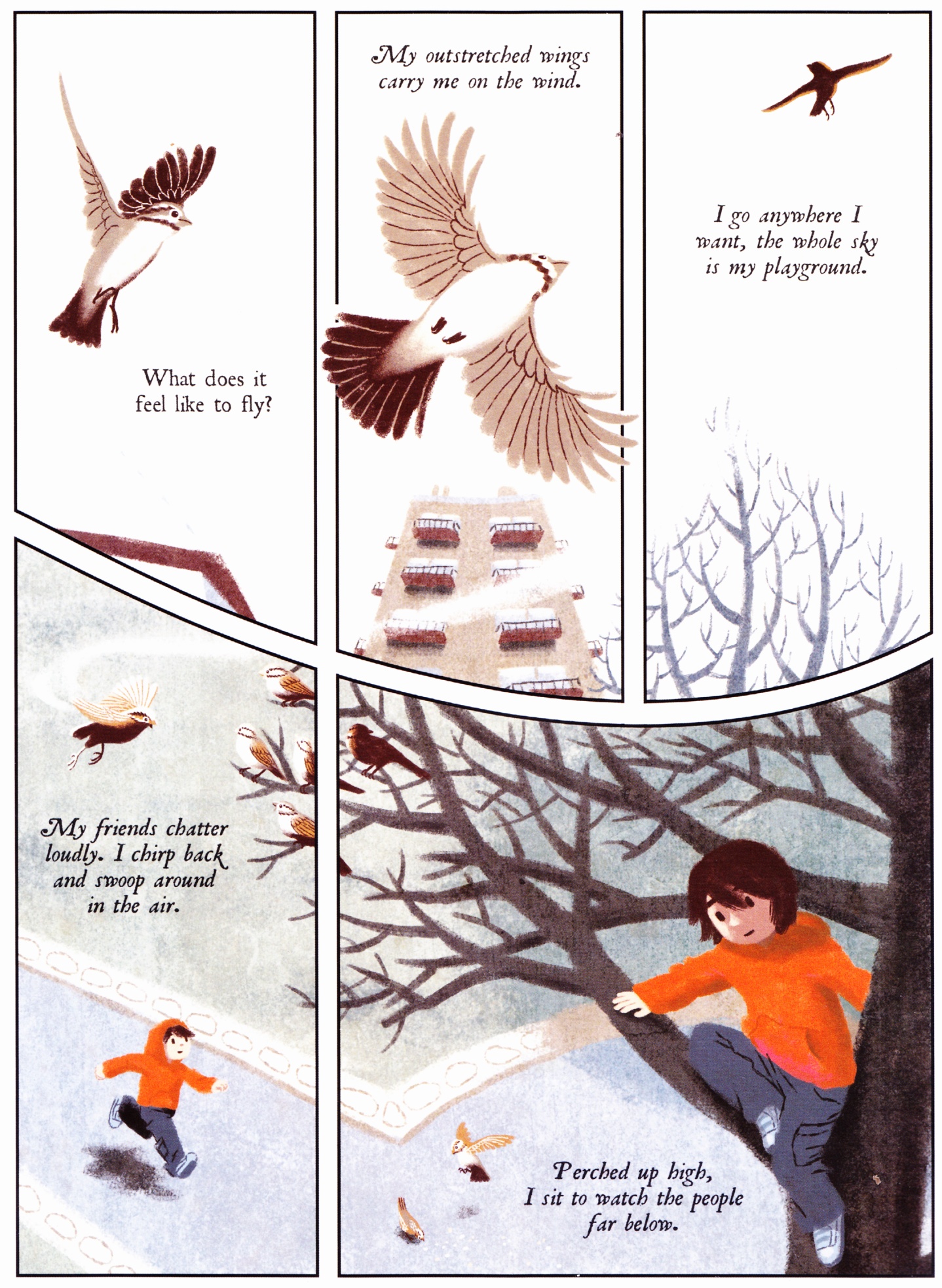 Taddle Creek, XVII-3, 33, Summer 2014: “Like A Sparrow”: 21.
 Photo by Ariel Borremans. Conundrum, 1, 2020: 48.
 Orb Magazine, 4, Nov./Dec., 1975: 33, Illustrator, Vince Marchesano,.
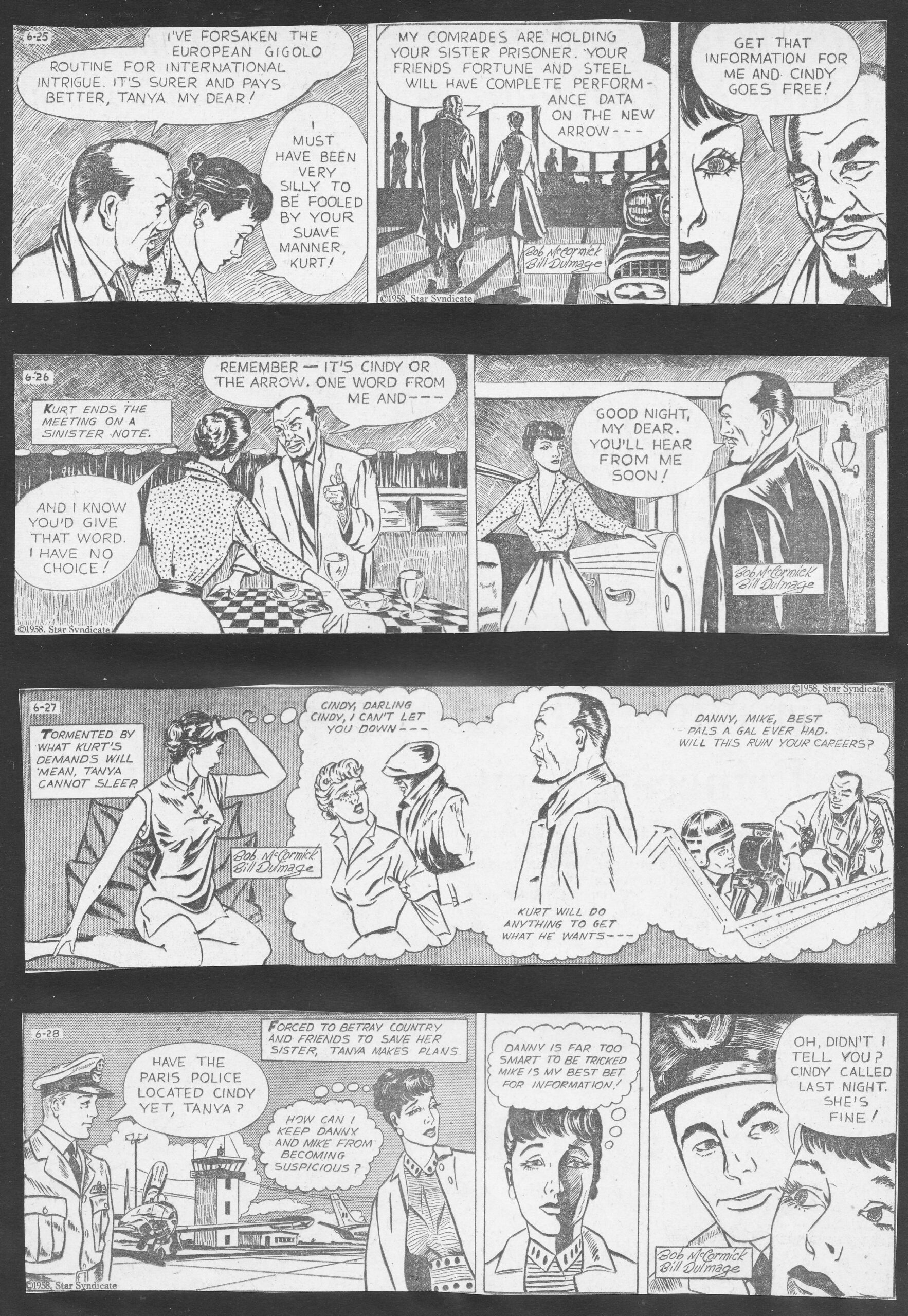
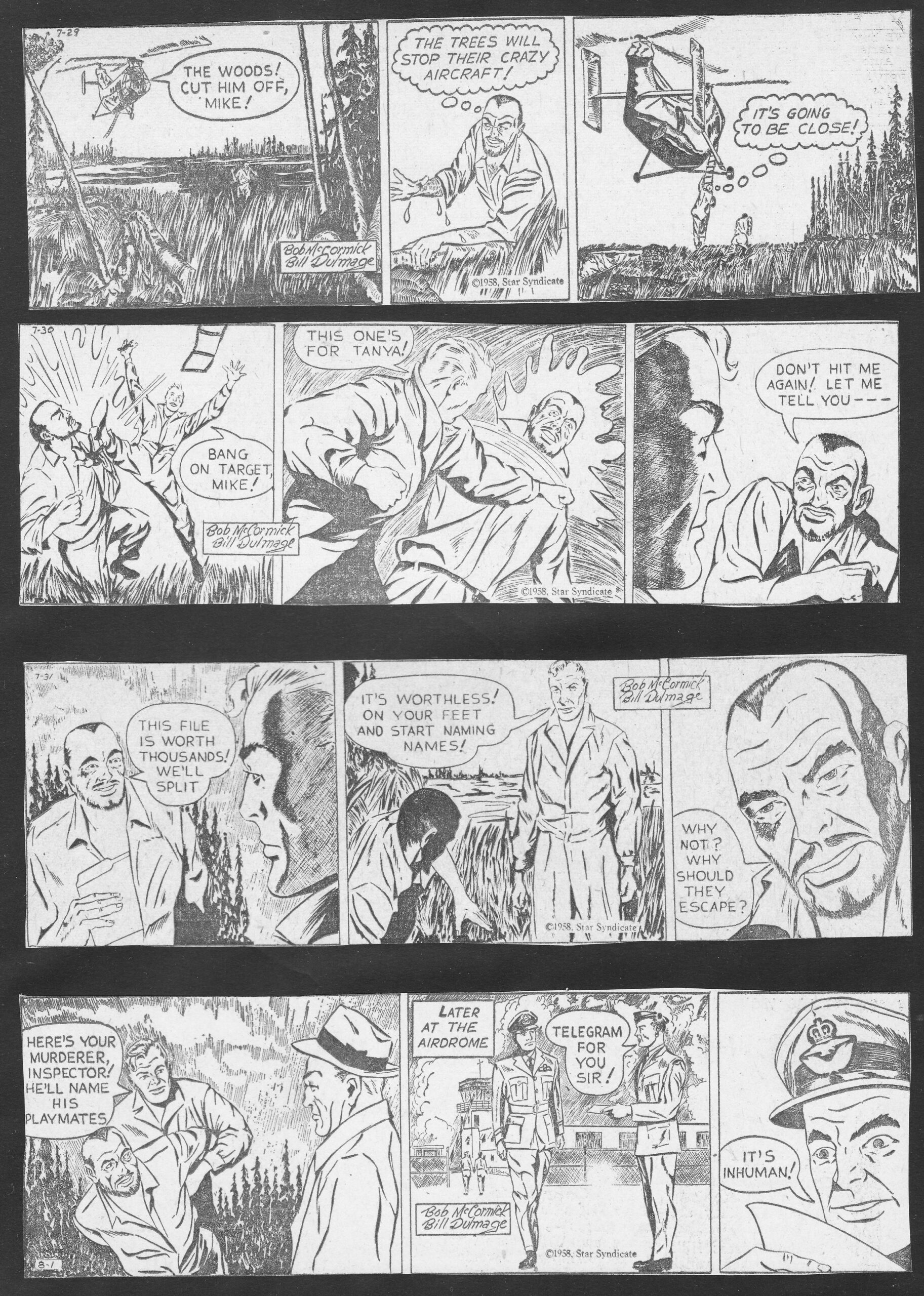
 Bob McCormick (standing) & Bill Dulmage, Expositor [Brantford], June 1958.
 Expositor [Brantford] June 1958.