CANADIAN COMIC BOOKS SYNDICATE
See BURST Karl.
CANADIAN COMIC BOOKS SYNDICATE
See BURST Karl.
CANADIAN COMIC BOOK CREATORS AWARDS ASSOCIATION
CANADIAN CHILDREN’S ANNUAL
CANADIAN CARTOON COMPANY
A company founded by Ben Lafontaine (LAF) to distribute his cartoons across Canada.
SOURCE:
Article book:
Portfoolio: 1989 in Canadian Caricature. Ed., Guy Badeaux . Writ., Charles Gordon. Macmillan of Canada, 1989: “Ben Lafontaine”: 211.
CANADIAN BROADCASTING CORPORATION
In 1970, the CBC’s animation unit released its first feature Abracadabra.
AWARD:
Oscar animation:
1981: Crac. Dir., Fédéric Back.
1987: The Man Who Planted Trees, Dir., Fédéric Back.
SOURCE:
Article book:
The World History of Animation. Writ., Stephen Cavalier. University of California Press, 2011: 17.
Article periodical:
Shift, July 1997: “The Great Animation Conspiracy”: 41.
CANADA
The only evidence for this full page coloured cartoon panel portraying vignettes from the history of Canada is contained in a scrap book, I came across. Unfortunately the features were clipped so that no newspaper name appeared.
From the feature itself, we can see it was published at least from August 21, 1965 to October 22 1966. It was a Canadian Centennial project since below the main panel, was a secondary feature called “Centennial Notes” which was divided into two panels, one announcing a community event and the second telling communities to inform the author about their events. The creator was John E. Lewis, but the name is the only information to be found about him. From 21 August 1965 to 16 April 1966 The copy write was held by Info-Topix which appears to have been located in Toronto. After 16 April it was held by Ganes Productions Ltd. See GANES PRODUCTIONS LTD. Apparently the series was popular enough that high quality coloured prints of the first eight pages were offered for sale at $0.20 each or the set of eight for $1.25.
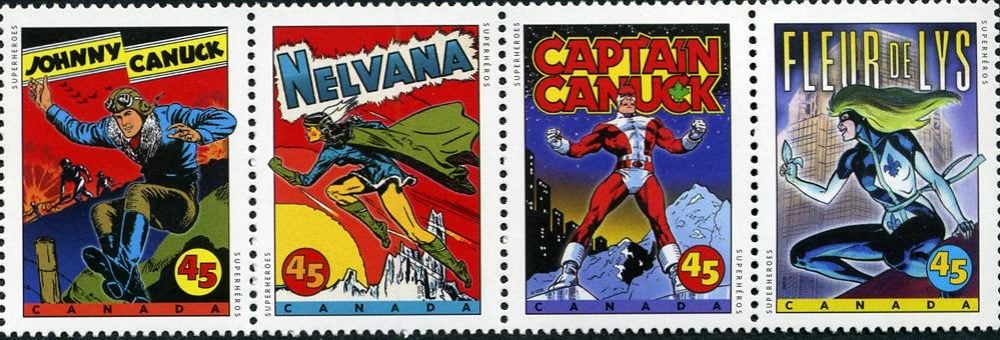
CANADA POST COMMEMORATIVE STAMPS
2 October, 1995, Honouring Cartoonists:
Canada Post issued commemorative stamps honouring Joe Shuster, Leo Bachle, Adrian Dingle, Richard Comely, Gabriel Morrisssette: cartoonists who worked in the comic book industry. Taking in reportage and ancilliary material this must be the single largest stamp release in the history of the Canada Post.
Robert MacMillan was working at the Hamilton Mail Processing Plant at the time and arranged a show of the stamps and some comic books. He invited Leo Bachle living in Toronto and Richard Comely living in Cambridge to come to the show. A snow storm prevented Leo from coming but Richard did make what turned out to be a very popular event among the management and employees.
Below is a list of the material that was associated with this commemorative issue.
Booklet stamp, 2 of each title:
Official First Day Cover:
Canuck for Canada and 1 – Dick Tracy, 1 – Alley Opp, 1 – Nancy, 1 – Li’l Abner, 1 – Terry and the Pirates, 1 – Prince Valiant for United States.
Booklet of post cards, each booklet containing 5 post cards each showing an enlarged picture of each of the 5 stamps.
Advertising:
Canada Post. Canadian Stamps … Worth Collecting. July 1995 – December 1995. Plastic Sheets featuring stamps.
Book:
Contest Entry Form:
Super Hero Search Contest. Done in conjunction with YTV.
Game:
Kit:
Letterhead:
Magazine:
Merchandise, Tee shirt:
Newspaper:
“Superheroes make super stamps.” Canadian Press. Brantford Expositor. 3 Oct. 1995: A1.
“Comic-book heroes to find fame again – on new stamps.” Writ., Henry Mietkiewicz, Toronto Sunday Star. 26 Aug. 1995: A1, A27..
Packs:
Booklet, 1 OFDC and special mounts.
Poster:
Press Release:
5 April 2017 Honouring Illustrators:
Canada Post issued stamps honouring Will Davies, Blair Drawson, Gerard Dubois, James Hill and Anita Kunz.
Issue included:
CANADA JACK
A character created by George Menendez Rae first appeared in Canadian Heroes 1- 5, March 1943 published by Educational Projects Inc. of Montreal. “Canada Jack” was probably inspired by the editorial cartoon character “Jack Canuck” originating the late nineteenth century
“Canada Jack” was athletic, an excellent horseman, a gymnast and a jiu-jitsu expert all of which gave him more than enough talents to combat the enemies of Canada. His costume like most Canadian hero costumes of the time was simple and practical, in this case a tank top with a Maple Leaf and the words “Canada Jack” on the chest, and gym pants with the inevitable strip down the side. Apparently Halperin insisted that “Canada Jack” remain realistic in order to be in line with the company’s educational mandate. This injunction seemed hardly necessary as the majority of the creators of Canadian wartime heroes kept them quite realistic. One feature that made “Canada Jack” distinctive if not unique was that virtually all of his adventures occurred in Canada where he fought spies and saboteurs, arsonists and black marketers. Not all adventures involved combat. “Canada Jack” and the big show is a story of how to raise money for the war effort
He was assisted by group of fictional youngsters called the “Canada Jack Club”, which tied in quite closely with the real life “Canada Jack Club” for Canadian Heroes fans.
As with many cartoon heroes, as the war ended, Rae apparently found it difficult to create a new roll for “Canada Jack”. Should he be an outdoors man or should he be a detective? Unfortunately Educational Projects ceased operations before this could be resolved.
In 2013, Bevan Thomas and the Cloudscape Comics Society of Vancouver created “Canada Jacques” or “Jacques De Canada” a homosexual hero. They linked him to “Canada Jack” in a way that it is doubtful Rae would have approved. Although described in an appendix in Epic Canadiana v. 1, essentially in the way that Rae created him, the group added that he belonged to the “Allied Enigmas”, their creation, and that he was a homosexual who committed suicide when this characteristic was revealed. Also see Johnny Canuck for information about how they linked that character into their universe.
Yet another “Jack” incarnation, this time called “Dominion Jack” was created by Jack Briglio and Ron Salas also in 2013. The name is different from “Canada Jack” but not as much as one might think. The original name for Canada was “The Dominion of Canada. Other aspects of “Dominion Jack” remain consistent with “Canada Jack”
MEDIUM:
BOOK GRAPHIC ANTHOLOGY: Published by Cloudscape Comics Society. Black & white interior.
Content:
Character description:
Epic Canadiana, v.1. Ed., Bevan Thomas. 2013: “Canada Jack”: 125.
Story:
Epic Canadiana, v.1. Ed., Bevan Thomas. Cloudscape Comics Society, 2013: “Canada Jacques: Hero
Play.” Writ., Bevan Thomas. Illus., Ksenia Kozhevnikova: 95-115.
PERIODICAL GRAPHIC ANTHOLOGY: Published by Educational Projects Inc. Colour cover. Black & white interior.
Content Serial:
| Canadian Heroes…: “Our Fiction Feature: Canada Jack….” Car., George M. Rae unless otherwise noted: …. |
| 1-6, Apr. 1943: “….”: 59-64.
2-3, July 1943: “…in The Big Show”: 50-55. 2-6, Oct. 1943: “… Kidnapped”: 53-58. 3-1, Nov./Dec. 1943: “…”: 50-55. 3-3, Feb. 1944: “… in Building A Mighty Nation”: 35-41. 3-4, March 1944: “…Talk Means Trouble”: 37-41. 3-5, April 1944: “…”: 59-64. 3-6, May 1944: “…”: 49-53. 4-1, June 1944: “… The Tough Guys”: 22-26. 4-2, July 1944: “… Rehabilitation”: 33-37. 4-6, January 1945: “… The Clean Up”: 41-45. 5-1, February 1945: “. . .”: 49-53 5-3, June 1945: “. . . ”: 54-58. 5-4, July 1945: “…” Car., Dez: 38-42.* 5-5, September 1945: “…Treasure Hunt”: 39-43. |
*One of the very few if not the only “Canada Jack” not done by George M. Rae.
SOURCE:
Article book:
Guardians of the North: The National Superhero in Canadian Comic-Book Art, Writ., John Bell. National Archives of Canada, 1992: “Canada Jack”: 13-17. A catalogue for the exhibit of the same name.
Epic Canadiana, v.1. Ed., Bevan Thomas. Cloudscape Comics Society, 2013: “Canada Jack”: 125.
Article newspaper:
Globe and Mail, 23 Oct.1982: “Whatever Happened to …?” Writ., Peter Harris: Fanfare 7.
Toronto Star, 1 Feb. 192: “The Great Canadian Superhero.” Writ., Henry Mietkiewicz: J1.
GALLERY:
 “The Big Show.” Car., George M. Rae. Canadian Heroes, 2-3, July 1943: 50.
Notice how this fictional story coincides with the suggestion in the “Canada Jack Club” that members could organize a circus to raise money for the war effort. It is a good example of how Educational Projects integrated the fictional Canada Jack with the real life Canada Jack Club and put both in service of the war effort.
 “Rehabilitation.” Car., George Rae. Canadian Heroes, 4-2, July 1944: 33.
A example of how Educational Projects blended the fictional “Canada Jack” stories with the real life “Canada Jack Club.”
 “The Clean Up.” Car., George M. Rae. Canadian Heroes, 4-6, January 1945: 45.
 “No title.” Cart., George M. Rae. Canadian Heroes, 5-3, June 1945: 58.
Perhaps the only story among the wartime cartoon stories that deals with art stolen by the Nazi.
 No title. Car., Dez. Canadian Heroes, 5-4, July 1945: 41.
One of the very few if not the only Canada Jack story not done by George M. Rae.
 “Treasure Hunt.” Car., George M. Rae. Canadian Heroes, 5-5, September 1945: 42.
 “Treasure Hunt.” Car., George M. Rae. Canadian Heroes, 5-5, September 1945: 43.
The three examples above show how the authors of “Canada Jack” were fluctuating between an outdoor character and a detective type character.
CANADA JACK CLUB
The Canada Jack Club was an unusual invention. In the comic book it was a group of youngsters who assisted “Canada Jack” in his wartime efforts. It was also a club the readers of Canadian Heroes could join and receive a membership card, badge and secret code. But the club went beyond that. It also gave out Honour Certificates to those members who engaged in citizenship efforts. These individuals who submitted their activities were also featured in the Canadian Heroes. Also a “Fellow Members” page appeared in Canadian Heroes in which drawings of members plus their names and addresses were featured. Clearly this club went beyond the simple dictates of business. It was obviously part of Halperin’s objective to guide children to be good citizens through education and to create bonds among like minded individuals.
Canadian Heroes vol. 2, no. 3, July 1943 introduced us to “Canada Jack Club”.
Editorial . . .
CANADA JACK CLUB
“ On page 49 of this issue we announce the formation of a “Canada Jack Club” which will be open to every boy and girl reader of CANADIAN HEROES. The “Canada Jack Club” is not just another club where one attends meetings whenever one wishes, or where one may do whatever one wishes at one’s own convenience without regard to other people concerned. On the other hand the “Canada Jack Club” will have no regimentation or iron-handed discipline.
The “Canada Jack Club” is a voluntary means whereby young Canadian boys and girls, whether they belong to the Scouts or the Guides or the Junior Red Cross, or whether they live in isolated country areas where the child population is too small for such organized groups, it is for all young Canadians, no matter where they live, who want to get together and “do things” for the war effort.
YOU will decide what you want to do – have a circus and raise money for war savings certificates, collect salvage in your district, run errands for the Red Cross, pick up books and magazines for the armed forces, or whatever else YOU think you should do. If YOU want the aid or assistance of the Editors of CANADIAN HEROES you may fell free to write us whenever you wish – we will always be happy to hear from you and co-operate with you in your activities.
Get your friends together and join the “Canada Jack Club” today.”
Canadian Heroes, 2-3, July 1943:49. Inside front cover.
Each member got a membership card, badge and secret code book with which he or she could read secret coded messages in Canadian Heroes. Each member could share in club activities and were invited to send in accounts of services performed. If their service was selected for publication they were made an “Honour Member” and given a “Certificate of Merit”.
MEDIUM:
PERIODICAL GRAPHIC ANTHOLOGY: Published by Educational Projects Inc. Colour covers. Black & white interiors.
Content:
Introduction:
Canadian Heroes, 2-3, July 1943: “Editorial: Introduction of Canada Jack Club”: Inside front cover.
Advertisement:
| Canadian Heroes…: “…” No author identified: … |
| 2-3, July 1943: “Now Every Boy And Girl Can Join The Canada Jack Club”: 49.
2-6, Oct. 1943: “Have You joined the CANADA JACK CLUB yet?”: 17. 3-1, Nov./Dec. 1943: “Join the CANADA JACK CLUB now!”: 48. 3-3, Feb. 1944: “Join Now!”: 52. 3-4, March 1944: “Are YOU wearing the badge of the CANADA JACK CLUB?”: 50. 4-1, June 1944: “Enroll now in the Canada Jack Club.”: 46. 4-2, July 1944: “Join The Canada Jack Club Now!’: 23. 5-4, July 1945: Join The Canada Jack Club and be eligible for an Honour Certificate.” 44. |
Game & contest:
| Canadian Heroes…: “…” No author identified: … |
| 3-3, Feb. 1944: “Contest Winners”: 52.
3-5, April 1944: “A new GAME CONTEST in CODE”: 42. 3-6, May 1944: “Your YKHKQNEJC Contest in Code”: 16. 4-1, June 1944: “Contest Winners”: 44. 4-1, June 1944: “It’s Fun It”s Easy Win A Prize”: 46. 4-2, July 1944: “Code Contest Key No. 8”: 23. 4-6, Jan. 1945: “Your New Contest”: 40. 5-1, Feb. 1945: “The Winner of the Funniest Animal Contest is Alex Otten, Kingston. Ont.: 56. 5-3, June 1945: “The winner of the ‘Articles In The Picture’ contest is Jack Miller, St. John N.B: 61. 5-4, July 1945: “The winner of the ‘Name This Animal Contest’ George Franks, Toronto: 45. |
Honour Roll:
| Canadian Heroes…: “…” No author identified: … |
| 2-6, Oct. 1943: “True Stories Of Our Honour Members.”:16.
3-1, Nov./Dec. 1943: “True Stories Of Our Honour Members: Eric MacDonald, Hull Quebec.” 47. 3-3, Feb. 1944: Our Honour Roll, Julia Christie: 51. 3-4, March 1944: “Our Honour Member for this month is Norman Browne Montreal Quebec.” 49. 3-5, April 1944: “Our Honour Member for this month is Winston Kent, Simcoe Ontario”: 41. 3-6, May 1944: “This Month’s Honour Member is Harold Crawford Roslin Ontario.”14. 4-2, July 1944: “This Month’s Honour Member is Bernice Brown, Verdun Quebec.”: 22. 4-6, Jan. 1945: “Honour Member: Joyce Lambert, Collingwood Ontario”: 39. 5-1, Feb. 1945: “Honour Member: “Chuck Flader, Vancouver B.C”: 55. 5-3, June 1945: “Honour Member: Buddy Craig, Leaside Ontario”: 61. 5-5, Sept. 1945: “This Month’s Honour Member: Lauchie Cameron, Dartmouth, N.S.”: 60. |
Other Members:
| Canadian Heroes…: “…” No author identified: … |
| 4-1, June 1944 “Meet Some More Of Our Active Members”: 45.
4-2, July 1944: “Fellow Members of the Canada Jack Club”: 24.
|
| Canadian Heroes …: “Fellow Members.” No author identified: …: | ||
| 3-6, May 1944: “…”: 15.
4-6, January 1945: “…”: 38. 5-1, February 1945: “…”: 54. |
5-3, June 1945: “…”: 62.
5-4, July 1945: “…”: 43. |
5-5, September 1945: “…”:
60-61. Photos of the members rather than drawings appear. |
SOURCE:
Periodical graphic:
Canadian Heroes, 2-3, July 1943:Inside front cover..
GALLERY:
 Canadian Heroes, 3-1, Nov./Dec. 1943: 47.
 Canadian Heroes, 4-2, July 1944: 22.
 Canadian Heroes, 4-6, January 1945: 39.
 Canadian Heroes, 5-3, June 1945:62.
CAMERON Stewart
From a letter to his father during World War 2: “I could be a hell of a lot more help to this country by doing cartoons than fucking around with a rifle” The Hecklers: 232.
Stew Cameron was a cowboy at heart but a cartoonist by profession. Throughout his life, he gave the gift of his remarkable talent and humour in a series of delightful cartoons depicting the cowboy way of life.
Stewart Cameron was born in 1912 in Calgary and it is no coincidence that the year marked the beginning of another Alberta institution, the Calgary Stampede and Exhibition. Stew grew up in Calgary and began demonstrating his amazing talent to draw cartoons at an early age. By the time he was in high school, he was submitting his drawings to the Calgary Herald, and was recognized as an up-and-coming young artist. Stew went on to study art at Mount Royal College and such was his talent that he was offered a job at the newly created Disney Studios in Hollywood. He went to Hollywood in January 1936 and worked at Disney Studios on Snow White and the Seven Dwarfs.
He returned to Calgary in June 1936, and took a job at the Herald as their full-time editorial cartoonist. The Social Credit Party had recently come to power and its leader, Premier William Aberhart, was a caricaturist’s dream. Big and blustery “Bible Bill” Aberhart and his sometimes-questionable right wing policies became the regular butt of Stew’s cartoons. His artistic attacks on Aberhart were not well received by the Social Credit faithful, many of whom threatened Stew with physical injury. It got to the point that Cameron had to leave the Herald building by the fire escape to avoid confrontation at the main entrance. The political passions reached their zenith when unknown attackers bombed Cameron’s house. Stew was not in the house at the time, and the bombers probably knew that, but their message was clear: leave Aberhart alone! Undeterred, Stew continued to use his mighty pen to skewer the Premier and his Social Credit policies. In spite of Stew’s cartoons, William Aberhart was re-elected Premier in 1940. But, even as Stew continued to attack Aberhart’s policies, the world’s attention was drawn elsewhere.
World War II had broken out. Stew strongly supported the war effort in the face of Social Credit’s lukewarm commitment but he was prepared to offer more than his pen when it came to offering support. He enlisted in the Canadian Army in 1942 and served throughout the war as a foot soldier doing some cartoons for military publications. When he returned to Calgary and the Herald after the war, Cameron found that things had changed. His favourite subject, William Aberhart, had passed away and the Social Credit Party had adjusted many of its more extreme policies. In 1947, he took a job at the The Province in Vancouver. When his health began to fail in 1949, he returned to his beloved Calgary. There he finished out his days doing freelance work and publishing collections of his cartoons.
He died in Calgary in 1970.
The following quote is from Ken Mather who researched and wrote about Western Canadian history for 32 years.
“As a young student, Stew had spent his summers running his own pack-string in the Rockies, west of Calgary. He came to know the pack trails of the foothills and mountains like his own backyard. In the process he developed a friendship and, above all, a respect for the ranchers and the working cowboys who made their home in the rugged backcountry of the foothills. Stew loved the daily work with horses and his knowledge of the capabilities and personalities of horses grew along with his artistic ability to draw them. His drawings show knowledge of every muscle and contour of the working cow horse. It is not surprising then that his love for the country and personalities found its natural expression in cartoons as he faithfully and humorously portrayed the cowboys, the horses and, of course, the “dudes.” The adventures and misadventures of day-to-day life on the trail were Stew’s favourite subjects. Among these early gems are his delightful series of drawings about his first and favourite horse, Count Von Krut otherwise known as “The Strawberry Roan.” These early cartoons sat in his files for years as his attention was focused elsewhere, on the political life of Alberta. But they were never forgotten, nor were Stew’s love for the cowboy and his way of life.
Stew’s early interest in the cowboy had continued when he was at the Calgary Herald. His cartoons of the Calgary Stampede show a unique insight into rodeo and the rodeo cowboy’s life that has seldom been duplicated. His attention to detail is amazing and sometimes a close examination of the background in his cartoons tells us as much as the subject in the foreground. Stew found the professional rodeo cowboys as rugged and genuine as the tough working cowboys of his youth and, with his keen eye and irrepressible sense of humour, his cartoons told their story.
A large selection of his early pack string cartoons, along with some of his best cartoons of the Calgary Stampede, were collected by his family and published in 1972 in four thin books, What I Saw at the Stampede, Let the Chaps Fall Where They May, Weep for The Cowboy, and Pack Horse in the Rockies (Dudes, Denims and Diamond Hitches). These contain some of the best of Stew’s cowboy cartoons and represent a lasting chronicle of cowboy life in the 1930s and 1940s that would make any artist proud. Unfortunately, by the time of their publication, Stew Cameron had passed over the Great Divide. But his legacy lives on as one of the true recorders of Western heritage.”
WORK:
CARTOONIST:
BOOK GRAPHIC COLLECTION:
Content panel &Cover book front:
Let The Chaps Fall Where They May. Cameron Cartoons, no date.
Weep for the Cowboy. Cameron Cartoons, no date.
FOLIO:
Content panel & Envelope front :
Pack Horse In The Rockies. Cameron Cartoons, 1955.
SOURCE:
Article book:
The Hecklers. Writ. & Ed.., Peter Desbarates & Terry Mosher. McClelland & Stewart Ltd., 1979: “Cameron”: 231-232.
Canadian Cowboy Country, 2003: “Stewart Cameron The Late Great Cowboy Cartoonist” Writ., Ken Mather.
GALLERY:
