CAM
See CARDOW Cameron
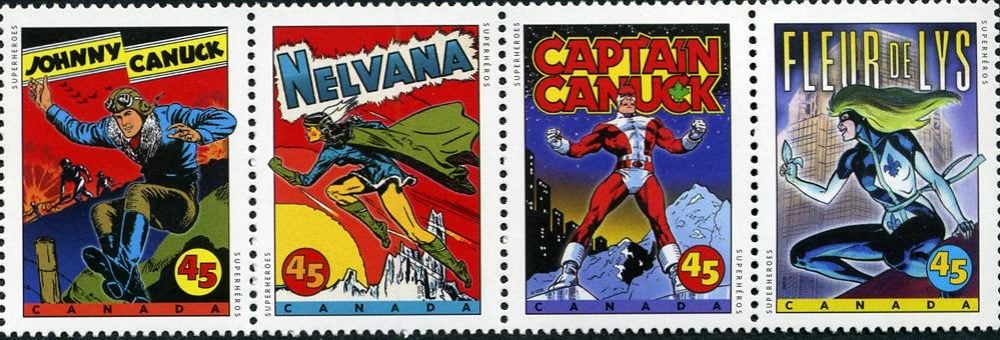
CAM
See CARDOW Cameron
CALLAN Les
 Les Callan, circa 1940’s. The Maple Leaf Forever, 1987: 21
“Unlike some cartoonists, who were in the position of having ideas supplied to them, I always came up with my own. But for the life of me, I still don’t know where those thousands of ideas came from.” They just happen somewhere in the back of your mind” About editorial cartoons. The Hecklers: 231.
Born in 1905 in Ignace Ontario a village on the CPR line west of Thunder Bay. His father was the station agent.
While working for the CPR in the day, at nights he studied art through a correspondence course. In 1926 he studied for two years at the Chicago Academy of Art, working for Canadian Pacific Railway in the summer and attending classes in the winter. He then moved to Winnipeg where he did freelance work for the Winnipeg Free Press, until he got a job as a cartoonist with the Vancouver Sun. and remained there until 1937 when he went to work for the Toronto Star.
In 1942 He joined the Canadian Army artillery as a lieutenant, then moved to army public affairs in 1943 and began drawing cartoons for army’s newspaper The Maple Leaf Northwest Europe Edition 1944-1945. Under the title “Monty and Johnny” he drew events from the D-Day invasion through France Belgium and Holland to VE-Day, recording both what he saw and humourous stories related to him by Canadian soldiers along the way.
“I remember visiting a unit at rest that had been involved in a particularly difficult battle with many wounded and killed. After talking with the men I found that I had gleaned enough ideas for a week. As it happened I met the Colonel of that regiment some time later. As I started to salute he stopped me. ‘Never mind that Callan give me your hand. You did more for the morale of our outfit than anything I could think of and I want to thank you.’ It’s that kind of recollection that made the whole thing worthwhile.” The Maple Leaf Forever, 1987: 21.
After the war he returned to the Toronto Star as its editorial cartoonist. In a 14 May 1957 article it was said of him: “Throughout his career Callan has made it a rule to poke fun or criticism at a person’s policy but never to hurt the person himself.”
In 1961, Callan left the Star and Duncan Macpherson quoted in The Hecklers makes it clear it was not a happy departure. “They just pretended that he [Callan] didn’t exist any longer… after twenty-five years. That’s why I’ve never joined the staff of the paper to this day. It’s a pretty cold-blooded business.” [148]
After leaving the Star, Les did free lance work on children’s books and for other publications.
In 1963 he ran for the Ontario Legislature as a Liberal candidate for Scarborough North but was unsuccessful. He and his wife moved to Vancouver in 1973 There he died 30 September 1986.
WORK:
CARTOONIST:
BOOK GRAPHIC COLLECTION:
Content panel humorous & Cover book front:
Normandy and on. Longmans Green and Co., Oct.1945.
PERIODICAL TEXT:
Content editorial cartoon:
Star Weekly Magazine, 5 July 1958: 47. Black & white.
SOURCE:
Article book:
Normandy and on, Oct. 1945 “Introduction.” Writ., Les Callan..
The Hecklers. Writ. & Ed.., Peter Desbarates & Terry Mosher. McClelland and Stewart Ltd., 1979: 117, 148, 228.
The Maple Leaf Forever: The Story Of Canada’s Foremost Armed Forces Newspaper. Writ. & Ed., Barry D. Rowland & J. Douglas MacFarlane. Natural Heritage/Natural History Inc. 1987.
The Maple Leaf Scrapbook: Souvenir Book printed in Belgium at cost price to forces overseas, no editor, Belgique: No. 3 Canadian P.R. Group, no date: 12 -16.
Article newspaper:
“20 Years With Star, Les Callan Is Tonight’s Guest on Tabloid.” Toronto Star, 14 May 1957:29.
“Les Callan cartoons Troops In Normandy.” Toronto Star, 3 November 1945
“Les Callan Star cartoonist for 24 event-filled years.” Writ., Kevin Donovan. Toronto Star, 4 October 1986: A16.
GALLERY:
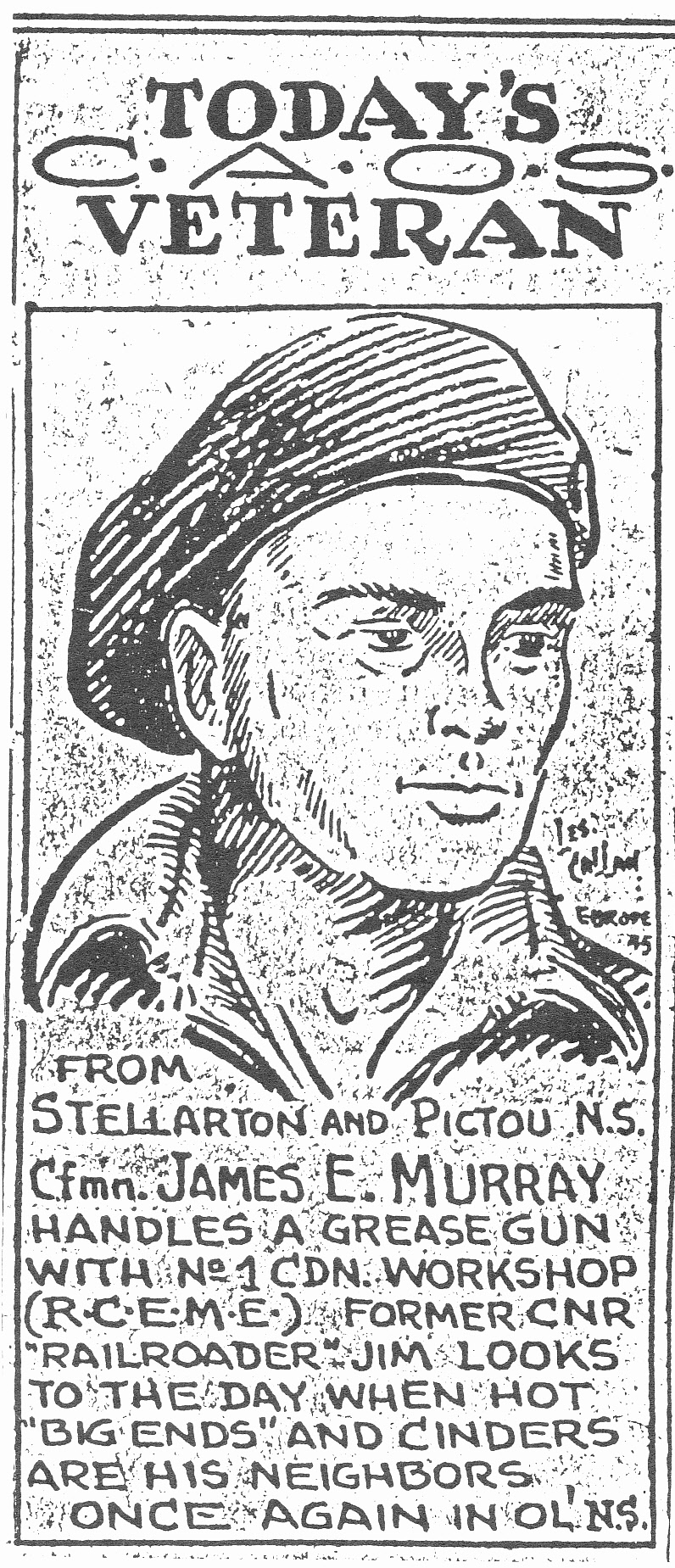


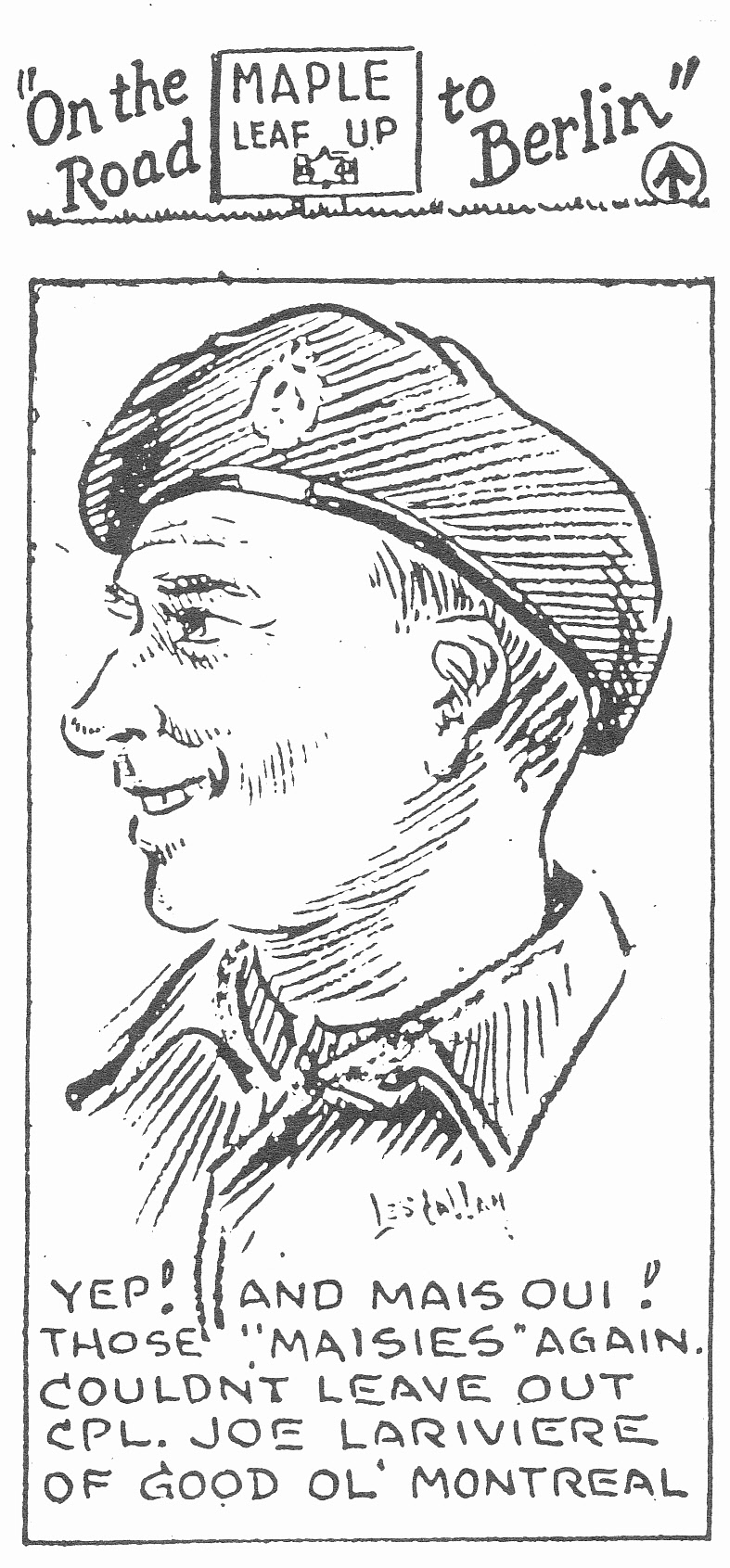 The Maple Leaf Forvever, 1987: 39.
CALLAHAN
A bowler hatted detective created by Bert Bushell for Maple Leaf Comics.
SOURCE:
Article newspaper:
Globe and Mail, 23 Oct.1982: “Whatever Happened to …?” Writ., Peter Harris: Fanfare 7.
CALLAGHAN Patrick
WORK:
CARTOONIST:
BOOK GRAPHIC ANTHOLOGY:
Content editorial cartoon:
Caricature . Cartoons Canada. Ed., Terry Mosher. Linda Leith Publishing, 2012: 81.
CALGARY EYE OPENER
Founded by Robert (Bob) Edwards, this paper nurtured cartoonists like Donald McRitchie and Charles H. Forrester.
SOURCE:
Book:
Eye Opener Bob. Writ., Grant MacEwen. The Institute of Applied Art Ltd., 1957.
Article book:
The Hecklers. Writ. & Ed.., Peter Desbarates & Terry Mosher. McClelland & Stewart Ltd., 1979: 82.
CALDER Jack
Jay McKeller was the pen name for Jack Calder of Anglo-American Publishing Co.
Calder was born 1902 in Edinburgh Scotland. He came to Canada in February 1910 at the age of seven years. He was apparently Harold Sinnott’s brother-in-law and according to one employee was definitely the boss at Anglo-American.
The “Purple Rider” was one of his creations. Although at first appearance it looks like he was copying “Red Ryder” in fact he inspiration came from Zane Grey’s Riders Of The Purple Sage. Another of his ideas was “Terry Kane” and he co-created “Sooper Dooper” with Les Gilpin.
SOURCE:
Interview:
Ed Furness Nov. 27, 1985.
CAL
The moniker of someone contributing cartoons to Bell Features.
WORK:
CARTOONIST:
PERIODICAL GRAPHIC ANTHOLOGY:
Content :
Page of panels, humorous:
Active Comics, 19, no date: “Goofy Tales”: 56.
Story:
Active Comics, 22, no date: “Oolay The Eskimo”: 52.
CAHN Rena
WORK:
ILLUSTRATOR:
BOOK GRAPHIC ANTHOLOGY:
Content story:
Toronto Comics v. 2. Ed., Steve Andrews et al. Toronto Comics Anthology, May 2015: “The Monster Artist.” Writ., Yi-Suing Oliver Ho: 130-141.
CAHÉN Oscar
 Oscar Cahén with his wife Mimi and son Michael. P11 Painters Eleven: 2010: 137. Maclean’s Magazine, 25 Oct. 2004: 62.
“Cahén’s early death may well have robbed Canada of its potentially greatest painter.” Paul Duval, Four Decades: The Canadian Group of Painters and Their Contemporaries1930-1970: 139.
“One of the last of Oscar Cahen’s illustrations for Maclean’s appears on pages 10 and 11 of this issue. Like the artist himself, it has gayness and spontaneity, as well as a sureness of touch that stamps it as a work of an extraordinary illustrator. It was one of the last jobs that Oscar did for us. He was killed in an automobile crash on November 26, 1956. Oscar was not only one of Canada’s best and best known illustrators; he was a gallery painter of international renown. In his ten years of association with Maclean’s he did hundreds of covers and illustrations using half a dozen styles and techniques. He also painted and exhibited scores of important oils, one of which hangs in the National Gallery at Ottawa. As a member of Toronto’s newly formed Painters Eleven, whose work recently went on exhibit in New York, he had established himself in the forefront of serious Canadian painters. His loss, therefore, is a great loss to all of Canada. And even if he hadn’t been able to paint a lick, all of those who knew and worked with him in this office would still miss him very much.” Maclean’s, 5 January 1957: “In The editor’s confidence: Oscar Cahen”.
Oscar Cahén is included here because he was not only considered one of Canada’s foremost fine artists but also considered one of Canada’s outstanding illustrators.
Born 1916 in Copenhagen, Denmark and grew up in Berlin in the 1920’s.
Oscar’s father Fritz Max Cahén worked in senior levels of government, wrote plays and was a journalist in pre Nazi Germany. In 1932, sixteen year old Cahén enrolled in Kunstakademie, Dresden’s State Academy for Applied Arts but this was short lived. As Adolf Hilter tightened his grip on Germany, Fritz had become active in the anti-Nazi underground. In 1933, he heard he was about to be arrested and so he and his family fled from Dresden to Prague. Here Fritz continued in his anti-Nazi and espionage work. He left for New York in 1937 in order to write for a Czechoslovakia newspaper. While there he wrote a book Men Against Hitler, an account of his life in the anti-Nazi movement. Oscar was also in the resistance. On one occasion he illegally crossed the border into Germany to complete an arms deal brokered by his father. Apparently he also sold drawings to support the family.
By 1938, Oscar was teaching illustration and design at Rotter Art School in Prague. In 1939, just before war broke out, Oscar and his mother Mali fled to London England where she worked for the BBC broadcasting propaganda to Germany. Rather ironically, Oscar was caught up in a sweep of male refugees by the British authorities, and shipped to Canada as an enemy alien. He arrived in Montréal in July 1940 among 2000 predominantly German Jews who were classified as prisoners of war and wound up in concentration Camp N near Sherbrook Québec where he remained for 18 months. His release came about when Ben Turner, Art Director for The Standard, a weekend supplement published by the Star [Montréal], spotted him at work in a photo the newsmagazine had shot while taking pictures at the camp. Curious, Turner commissioned him to do some illustrations which led to him being hired and sponsored by Montréal impresario Collin Gravenor. Cahén remained loyal to The Standard throughout his life.
He quickly became a sought after talent by magazine art directors. He moved to Toronto in 1943 when he was hired as Art Director for Magazine Digest. He illustrated 38 covers for Maclean’s Magazine, and did illustrations for New Liberty, as well as maintaining his connection with The Standard. He was awarded the Montreal Art Directors’ Club “Plaque For Achievement” for his cover painting for Maclean’s 1 July 1952.
He continued to paint throughout this period. He exhibited with The Canadian Group of Painters. In 1952 he exhibited Ancient Throne in Hart House University of Toronto. In 1953, he and six other abstract painters showed their work in Simpson’s storefront windows. Later that year they were joined by four others and Painters 11 was born. “His impact upon his younger colleagues in Painters Eleven is difficult to exaggerate, and is frankly confessed by most of them.” (135)
On 26 November 1956, while driving he collided with a dump truck and was killed instantly. Note below that two of his illustrations appeared posthumously in Maclean’s.
WORK:
ILLUSTRATOR:
PERIODICAL TEXT:
Content essay:
Maclean’s 15 January 1951: “It’s A Tough Time To Be A Kid”. Writ., Sidney Katz: 14, 15.
Maclean’s, 1 June 1954: “what it’s like to See”. Writ., George Lafleur: 22-23.
Maclean’s, 7 July 1956: “When every woman looked like Regina Lee”. Writ., Blanche Howard: 21.
Content novella:
Maclean’s 8 December 1956: “This is the Story Of Olga”. Writ., John Cornish: 25, 26-27, 28-29, 30, 50, 54, 58, 60, 68, 72, 75, 80, 88, 94. Later published by Macmillan of Canada.
Content novella & Cover front:
Maclean’s, 16 Apr. 1955: “The Man With The Coat.” Writ., Morley Callaghan: 11, 12, 13, 14, 15, 16, 17, 18, 19, 81, 83, 85, 87, 88, 89, 90, 92, 94, 107, 111, 118, 119. This novella was expanded into The Many Coloured Coat, published by Macmillan of Canada.
Content story:
Maclean’s, 15 May 1951: “The White Pagan”. Writ., Ward Holm Tanzer: 19-20.
Maclean’s, 15 June 1951: : “Open Wide Excellency”. Writ., Lesley Holms: 1-11.
Maclean’s, 15 October 1952: “All the Fun of the Fair”. Writ., J. D. Peter: 14-15.
Maclean’s, 1 January 1953: “The Firing Squad”. Writ., Colin McDougall: 6-7.
Maclean’s, 1 April 1953: “The Bolshevik And The Wicked Witch”. Writ., J. N. Harris:
Maclean’s, 18 June 1953: “The Strange Death of Daddy Daniels”. Writ., B. M. Atkinson Jr.: 22-23.
Maclean’s, 15 August 1953: “Two Ways To Hook A Sucker”. Writ., James MacNamee: 18-19.
Maclean’s, 15 October 1953: “The Hangman in the Fog”. Writ., 10-11.
Maclean’s, 15 February 1954: “The Memory of a Sentimental Morning”. Writ., Ronald R. Smith: 22-23.
Maclean’s, 1 August 1954: “the best way to murder Aunt Maudie”. Writ., John I. Keasler: 18-19.
Maclean’s, 1 October 1954: “A Cage For The Bird Man”., Writ., David Stuart: 28-29.
Maclean’s, 15 February 1955: “The Baffling Case of Miss Shopishnok’s Cigarette Lighter”. Writ., Max Shulman: 22-23.
Maclean’s, 26, November 1955: “All For The Love Of Maria”. Writ., Ronald R. Smith: 16-17
Maclean’s, 22 December 1956: “How Can Santa Find Me?”. Writ., Mary Grannan: 20, 21, 22-23.
Maclean’s, 5 January 1957: “Mr. Benturian and the beautiful palimpseast”. Writ., Donald Heiney: 10, 11.
Maclean’s, 14 September 1957: “Mr. Benturian Buts A Jaguar”. Writ., 20-21.
Weekend, 3-25, 28 June1953: “How’s The Weather.” Writ., John Rhodes Sturdy: 10-11.
Content story & Cover front (Cover & content not usually related):
Maclean’s, 15 August 1950: “Some Violets Don’t Shrink”. Writ., Mort M. Horowitz: 10-11.
Maclean’s, 1 April 1951.: “… another sort of Anniversary”. Writ., John R. Sturdy: 19, 20.
Maclean’s, 1 November 1953: “Round Trip To Eternity’. Writ., André Maurois: 24-25.
Maclean’s, 15 December 1953: “A Gift For The Princess”. Writ., Mary E. Grannan: 20, 21, 22.
Maclean’s, 15 May 1954: “When the children went to war”. Writ., Pär Lagerkvist: 12-13.
Maclean’s, 15 December 1954: “The Rustler And The Reindeer”. Writ., Mary E. Grannan: 16, 17, 18, 19.
Cover front:
New Liberty, Dec. 1949.
| Maclean’s, …. | |||
| …, 1 April 1951.
…, 15 April 1953. |
…, 15 May 1953.
…, 1 February 1954. |
…, 15 June 1954.
…, 1 September 1954. |
|
SOURCE:
Book:
Oscar Cahén Writ., Grove Jaleen. Art Canada Institute/Institut de l’Art Canadien. 2015.
Oscar Cahén: Canada’s Ground Breaking Illustrator. Ed., Reed Roger T. Illustration House, 2011.
Catalogue accompanying exhibit October 1 – 30, 2011.
Article book:
Four Decades: The Canadian Group of Painters and Their Contemporaries1930-1970. Writ., Paul
Duval. Clarke & Irwin Ltd., 1972: 135-139, 141.
P11: Painters Eleven. Writ., Iris Nowell. Douglas & McIntyre, 2010: 133-157.
Article periodical:
Maclean’s, 1 August 1953: “Maclean’s congratulates its contributors and editors on winning the following awards”: 47.
Maclean’s, 5 January 1957: “In The editor’s confidence: Oscar Cahen”.
Maclean’s Magazine, 25 Oct. 2004: “Bringing Back Oscar.” Writ., Katherine Macklem: 59-64.
Maclean’s Magazine, 28 Sept. 2015: “The short wondrous life of Oscar Cahén.” Writ., Ken MacQueen: 56-58.
GALLERY:
 Maclean’s, 28 Sept 2015:58.
.
 P11 Painters Eleven, 2010: 139.
 Maclean’s, 25 Oct. 2004: 60.
CADIZ John
Born in Trinidad. In 1977 he migrated to Canada, where he worked as a graphic designer in Toronto. He designed cards, T-shirts, coaster mugs etc all based on the wildlife he saw around him. He produced two books of panel cartoons The Wilds of Canada and Lost In The Wilds of Canada.
WORK:
CARTOONIST:
BOOK GRAPHIC:
Content panel cartoon & Cover book front :
The Wilds of Canada. Doubleday Canada, 1995.
SOURCE:
Article book:
The Wilds of Canada. Doubleday Canada, 1995: Back cover..