CAPT. AL COHOL

CAPTAIN AL COHOL

The first issue of this four book series, designed to combat alcoholism in the Northwest Territories, appeared August 1, 1973. It was created by Art Sorensen, a former Journal northern correspondent turned government information officer, who worked a year mostly on his own time to craft the stories.

They revolve around a pale faced, fair haired hero who has a fatal weakness for alcohol. At the end of the series he is attending Alcoholics Anonymous. He fights various villains like Billy Vermin and the Ravenmen in fictional northern communities like Fish Fiord, using exclamations like, my favourite, “Leaping honeybuckets”.

The idea for the series began about 1971 when a priest Father Maurice Metayer noticed that comic books were very popular in the Cambridge Bay community. He passed the information on to Harold Huggins chief of the North West Territory government’s alcohol education program. The government checked other communities and found comic books equally popular in them. As a result the Captain Al Cohol graphic series was launched.

The result proved highly successful in southern Canada and the U.S. University libraries here were ordering copies. In the U.S., New York Times carried an article on it. Congratulations and copy requests were coming from U.S. Senators, distillers and American Alcoholics Anonymous.

In the Northwest Territories, the enthusiasm was more subdued. Reporters found readership was low and comment even harder to find. There was as much criticism as enthusiasm. Some complained that because of a low literacy rate, people were just looking at the pictures. However, anyone who has read graphic stories knows one can pick up the gist of the story just looking at the pictures. Another criticism was that the books were in English only, but it was pointed out the cost of using one Innuit and five Indian languages was prohibitive. Most serious was the accusation of racism, because the “hero” is a white blonde and the villain is dark skinned, but as Sorenson pointed out is anyone going to identify with a white blond haired drunk?

Nevertheless, there were plans to rectify these weaknesses if the series continued. Story ideas would be solicited from Innuit and Indian individuals and native languages would be incorporated. After all 75 per cent of the population was indigenous However, the project did not go beyond the four books.

MEDIUM:

PERIODICAL GRAPHIC;

Content Series educational & Cover front:

Captain Al Cohol The Coming of Captain Al Cohol, 1. Writ., Art Sorensen. Illus., Phil Clark & Dale Austin. Ed., Jack Oates. Produced by Arctic Comics/The Northwest Territories Department of Information for Northwest Territories Department of Social Development no date.

Captain Al Cohol: Ordeal of Torture, 2. Writ., Art Sorensen. Illus., Phil Clark & Dale Austin. Ed., Jack Oates. Produced by Arctic Comics/The Northwest Territories Department of Information for Northwest Territories Department of Social Development no date.

Captain Al Cohol: Liquor Doesn’t Make Heroes, 3. Writ., Art Sorensen. Illus., Phil Clark & Dale Austin. Ed., Jack Oates. Produced by Arctic Comics/The Northwest Territories Department of Information for Northwest Territories Department of Social Development, no date.

Captain Al Cohol: Al Foils The Mackenzie Raiders, 4. Writ., Art Sorensen. Illus., Phil Clark & Dale Austin. Ed., Jack Oates. Produced by Arctic Comics/The Northwest Territories Department of Information for Northwest Territories Department of Social Development, no date.

SOURCE:

Article newspaper:

Edmonton Journal, 10 Oct. 1973: “The North’s incredible Captain Al Cohol.” Writ., Gorde Sinclair: 5.

GALLERY:

C:\Users\Robert\Documents\CARTOONING ILLUSTRATION ANIMATION\IMAGE COMIC BOOK COVERS\Captain Al Cohol, 1 .jpgCaptain Al Cohol, 1. Front cover.


CAPITAINE KÉBEC

CAPITAINE KÉBEC

Pierre Fournier’s “Capitaine Kébec” appeared first in Les Aventures du Capitaine Kébec: a single issue which appeared in the fall of 1973 then in Titanic issues 5 to 7 which appeared in 1984.

As said earlier Pierre Fournier was the creator of “Capitaine Kébec” but it appears that the first story included collaboration with Françoise Barrette, Dan May and Réal Godbout (Fournier would later collaborate with Godbout on the “Michel Risque” series of graphic novels and the “Red Ketchup, l’agent fou du FBI” stories and graphic novel). The following stories of “Capitaine Kébec” were Pierre’s alone.

In the first story “Capitaine Kébec” representing the new Quebec that was shrugging off both church and state, battled an Establishment villain, Frogueman. Frogueman (a former policeman) represented the establishment. It’s outrage at the lack of respect for authority in youthful Québec and its attempt to destroy this new independence by destroying the youthful “Capitaine Kébec”. The establishment’s weapon of choice was a gun that fired pea-soup a traditional food of the old Québec habitants. Strangely, given Québec’s indépendance movement, “Capitaine Kébec” was rescued by a young Anglo-Canadian admirer. Such is the complexity of Québecois attitudes. The young Anglo then gave him up to the servant (?) of the mysterious master of a deserted monastery which contained a laboratory. How this all was supposed to resolve itself is not known since no more Les Aventures du Capitaine Kébec appeared, a fate quite common among Canadian cartoon stories.

When “Capitaine Kébec” reappeared about a decade later, in Titanic the focus was not on him but on a TV journalist named Josée. She set out to write a piece on him for a TV program Profil. Through the vehicle of her research Fournier developed a “Capitaine Kébec” profile that suggested he was only one of a series of such heroes that went back to the 1920’s. Josée finally met him but by this time he had been wounded by the villain Bébitte. Josée donned “Capitaine Kébec’s” costume and defeated Bébitte. She then discovered she had become the next “Capitaine Kébec” thus continuing the line.

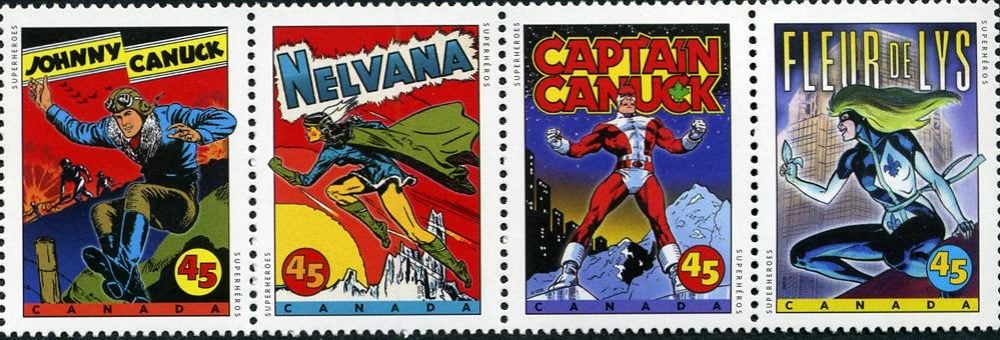
“Capitaine Kébec” like “Captain Canada” is a story which takes the motif of the costumed hero as the embodiment of established values and attitudes, turns that motif upside down and uses it to question and criticize those same established values and attitudes. However, the creators of “Captain Canada” and Capitaine Kébec” take very different approaches in expressing this criticism. In “Captain Canada” establishment values and attitudes are questioned through a hero that is an establishment buffoon and attacks the alternate values. In “Capitaine Kébec” the hero embodies the alternative values and attitudes and is attacked by an establishment villain. Nevertheless, both stories express the same conflict: youth with new ideas and attitudes being attacked by those with established ideas and attitudes. This was a very common viewpoint held by youth in the 1970’s and 1980’s

MEDIUM:

PERIODICAL GRAPHIC:

Content story & Cover front:

Les Aventures du Capitaine Kébec, 1. Car. Pierre Fournier. Les Éditions de l’Hydrocéphale Entêté Inc., 1, troisième trimester 1973: 1-23.

PERIODICAL GRAPHIC ANTHOLOGY:

Content avertisement & story & Cover back, illus., Pierre Fournier.:

L’Illustré, 8, September 1974:                                                                                                       “Capitaine Kébec no 2 bientȏt”. Car. Pierre Fournier: 27.                                                    “Capitaine Kébec/Hors série.” par Fernand Choquette d’apres Fourier, Godbout,             Hergé: 38.

Content serial:

Titanic …: “…” Car., Pierre Fournier: ….
5, Mars 1984: “Le Grand Retour du Capitaine Kébec”: 31-34.

6, Avril 1984: “Capitaine Kébec Contre Le Kidnappeur Automate”: 39-42.

7, Mai 1984: “Capitaine Kébec: Le Dernier Round?”: 39-42.

SOURCE:

Article book:

Guardians of the North: The National Superhero in Canadian Comic-Book Art. Writ., John Bell. Ottawa: National Archives of Canada, 1992: “Capitaine Kébec”, 42 – 48. A catalogue for the exhibit of the same name.

Article newspaper:

Toronto Star, 1 February 1992: “The Great Canadian Superhero.” Writ., Henry Mietkiewicz: J1.

GALLERY:

A picture containing text
Description automatically generatedL’Illustré, 8, September 1974. Back Cover, illus., Pierre Fournier.

CAPITAINE KEBEC 1Les Aventures du Capitaine Kébec,1, troisième trimester 1973: Front cover. Car. Pierre Fournier.

CAPITAINE KEBEC 2 Titanic, no. 7, Mai 1984:Front cover. Illus. Pierre Fournier.

CANADIENS [LES]

CANADIENS [LES]

A bilingual historical cartoon strip set in New France, created by Albert Chartier. It was syndicated by the Toronto Telegram News Service from 1963 to 1964.

LES CANADIENS, London Free Press ,23 Nov

London Free Press, 23 Nov. 1963:7.

CANADIAN WHITES

CANADIAN WHITES

This designation is given by collectors those comic books published in Canada for about five years from early 1941 into 1945-46.

On December 2, 1940 the Canadian Government passed the War Exchange Conservation Act whose purpose was to conserve Canadian currency for the purchase of military materiel from the U.S.A. In order to do this the government banned all non-essential imports including bananas and comic books. The unexpected result was the birth of a Canadian comic book industry.

The chief initiators of this new venture were portrait and landscape painters Adrian Dingle and the Kulbach brothers (Hillborough Studio), Ted McCall a writer and journalist (Anglo-American Publishing), Vern Miller a cartoonist (Maple Leaf Publishing) and Cy Bell a businessman (Bell Features Ltd.) but even in this last case it would be easy to argue that the real initiator was the cartoonist Edmund Legault who later disappeared into the military and has never really been given his due. The origins of Educational Products are uncertain but it seems that this company which had a broad line of products including colouring books based on classic novels like Robinson Crusoe and Treasure Island simply added the comic book Canadian Heroes to its product lines.

The achievement of these companies was truly astounding. At the beginning in 1941 there was no business structure, no pool of comic book talent and no expertise in printing and publishing comic books. Within a few short years there were three major comic book companies, a pool of reliable talent and printing and publishing that could be depended on. The assembly of a talent pool was all the more remarkable because it was being continually drained as individuals left the industry to join the armed forces. In 1945 Anglo-American took the final step and moved into colour with Bell Features close behind. In the five turbulent war years the Canadian comic book industry had moved from being non-existent to being capable of producing colour comics. Obviously these companies were looking to a future in comic book publishing.

When the import restrictions were lifted the deluge of U.S. titles shattered the tiny Canadian market into fragments. The U.S. companies of course could survive in such an environment. Their talent, production and overhead expenses were already covered by the U.S. market. Even their distribution costs were alleviated because the comic books could be shipped with other U.S. magazines. In short the U.S. comics entering the Canadian market were virtually expense free. In contrast this fragmented market had to produce enough revenue to cover the talent, production, overhead and distributions costs of the Canadian companies. It was simply no contest.

One might ask why the Canadian companies didn’t enter the U.S. market. The indications are they attempted to do just that. The scanty evidence that exists suggests that the U.S. companies successfully blocked their efforts..


CANADIAN SOCIETY FOR THE STUDY OF COMICS

CANADIAN SOCIETY FOR THE STUDY OF COMICS/SOCIÉTÉ CANADIENNE POUR L’ETUDE DE LA BANDE DESSINÉE (CSSC/SCEBD)

Organized by Sylvain Rheault of the University of Regina in October 2010:

“to promote the study of comics in all periods and languages and its relationships with other disciplines and cultural contexts when applicable.”                                              From the constitution of the CSSA/SCEBD.

It held its first conference in May 2011 as part of the “New Narrative” conference at the University of Toronto. Its annual conferences are held in conjunction with the Toronto Cartoon Arts Festival, but it also has other “discussions” and “conversations” etc. throughout the year.

SOURCE:

Internet:

Taken principally from the CSSA/SCEDB website.


CANADIAN ILLUSTRATED NEWS

CANADIAN ILLUSTRATED NEWS

By picturing our own people, the broad dominion they possess, its resources and progress, its monuments and industry, its great men and great events, such a paper would teach them to know and love it better, and by it they would feel still prouder of the proud Canadian name.”                                                                          Canadian Illustrated News,30 October 1869:16. Facsimile edition 1970.

First published by George Edward Desbarats, 30 October 1869, just two years after Confederation, this is Canada’s first national magazine. It is the first magazine in the world to successfully publish photographs by using half tone printing, an invention by William Leggo also of Québec. It was the earliest magazine to consistently publish editorial cartoons. Its French language sister magazine was L’Opinion publique, was launched a few months later on 1 January 1870, making Desbarats company the prototype for bilingual publishing in Canada.

It covered the major events in Canada, was critical of lackluster patriotism, was more oriented towards Europe than the U.S. and in these days of Britain’s less than enthusiastic support of Canada when annexation by the U.S. was a real threat, it thought of “Uncle Sam” or “Brother Jonathon” as a cunning creature of questionable trustworthiness. See JACK CANUCK.

The last issue appeared 29 December 1883, just a couple of years short of the Northwest Rebellion.

SOURCE:

Article book:

The Canadian Encyclopedia A-For. Hurtig Publishers Ltd., 1985: “Cartoons.” Writ., Peter Desbarats: 299-300.

The Hecklers. Writ. & Ed.., Peter Desbarates & Terry Mosher. McClelland and Stewart Ltd., 1979: 30.

Folio:

Canadian Illustrated News, A Commemorative Portfolio Selected and Introduced By Peter Desbarats. Ed., & Writ., Peter Desbarats. McClelland & Stewart Ltd., 1970.

GALLERY:

C:\Users\Robert\Documents\CARTOONING ILLUSTRATION ANIMATION\IMAGE CARTOON C\CANADIAN ILLUSTRATED NEWS, 23 July 1870, 16.jpgCanadian Illustrated News, 23 July 1870: 16, Facsimile edition.

CANADIAN FISHING COMPANY

CANADIAN FISHING COMPANY

This Vancouver fishing company used cartoon stories as an indirect promotion of their products which were canned salmon: Gold Seal, Red Seal and Pink Seal, and tuna: Gold Seal. Although no dates are given the booklets were probably produced in the 1950’s to 1960’s.

The array of characters include “Freedy”; “Sammy Gold Seal”, a salmon; “Pete Pelican”; “Wally Walrus” and the villain “Sneaky Seagull”. The covers and contents were printed on pulp paper. The art work and production values were quite good considering these booklets were free throw- aways. This company most definitely was a pioneer of product placement in stories.

PRODUCT:

BOOK GRAPHIC:

Pacific Rescue. The Canadian Fishing Co., no date.

The Sea Pirates. The Canadian Fishing Co., no date.

The Silver Treasure Hunt. The Canadian Fishing Co., no date.

GALLERY:

C:\Users\Robert\Documents\CARTOONING ILLUSTRATION ANIMATION\IMAGE COMIC BOOK COVERS\Canadian Fishing Co. Pacific Rescue.jpg

C:\Users\Robert\Documents\CARTOONING ILLUSTRATION ANIMATION\IMAGE COMIC BOOK COVERS\Canadian Fishing Co. The Sea Pirates.jpg

C:\Users\Robert\Documents\CARTOONING ILLUSTRATION ANIMATION\IMAGE COMIC BOOK COVERS\Canadian Fishing Co. The Silver Treasure Hunt.jpg