BIRDSEYE CENTER/JUNIPER JUNCTION
Kenneth Barker called it anglophone Canada’s first successful comic.
Pete Harris described it as: “… one of the enduring institutions of the Canadian popular arts – Birdseye Centre, a weekly black and white strip that was the comic realization of everyone’s dream of small-town life, but with a gentle touch of satire and slapstick humour.”
Ed Furness once remarked to Robert MacMillan that any youngster wanting to be a cartoonist attempted to copy Jimmie Frise’s style.
*****
“Birdseye Centre” later called “Juniper Junction” first appeared in the Toronto Star Weekly the 12 December 1920 and ran till Frise’s death 13 March 1948. The name continued into the 1960’s but it was a different strip.
Barker called it the first successful strip because Jimmie had made a previous attempt, a half page feature called “Life’s Little Comedies”. It was modelled on popular U.S. syndicated features but it dealt with city people and city situations which were not Jimmie’s experiences. He never liked it and it was not popular with readers. He then attempted “Birdseye Center”, also a weekly half-page cartoon but this time based on the village life of his youth. It was a hit. By 1923 “Birdseye Centre” and its characters were known all over the country and in 1926 readers of the Star Weekly voted it their favourite comic.
Jimmie created an entire community of characters and features. There was “Archie” and his domesticated bull moose, “Foghorn”; “Wes Clipper”, the friendly barber; “Eli and Ruby Doolittle”, the lazy husband and over-worked wife; the “Police Chief” and “Pig-skin Peters”. To these characters Frise added a background of freckle faced urchins, an assortment of wild and domestic animals including “Big Jack” the giant jackrabbit, “Hector” the pup, sad eyed beagle hounds and alert roosters, not to mention a wily black bass. There was the “Grand Hotel” and the “Noazark”, a top heavy lake steamer captained by the “Police Chief”. A journalist called it “… Canada’s foremost family of cartoon characters.”
Jimmie connected the strip to the outer world in which he lived. International fads and national emergencies inspired “Birdseye Center’s” ingenious citizens to action. In the late 1920’s the Canadian National Exhibition was promoting swims along Lake Ontario’s chilly waterfront. It was natural that, “Pigskin Peters” would begin training for the event in the “Birdseye Center Creek”. The creek’s waters were warm compared to Lake Ontario, but that didn’t deter “Pigskin”. He brought in truckloads of ice to make the creek match Lake Ontario’s temperature. Jimmie took the joke even further. He persuaded a retired athlete and baseball comedian Harold (Hap) Richard Watson to pose as Pigskin, complete with iron hat, sulphurous cigar and stripped T-shirt.
“I set up camp at the exhibition and people flocked to see the great “Pigskin”. Mackenzie King then Prime Minister came to shake Pigskin’s hand and wish him well. For weeks afterwards I did little else but officiate at country fairs, open dance pavilions and judge beauty contests.” said Harold Watson in “Birdseye Revisited.”
In December 1947 Jimmie left the Star Weekly and joined the Standard [Montreal] which was being transformed by its owner The Montreal Star, into Weekend Magazine. The Star Weekly retained the “Birdseye Center” name so the strip became “Juniper Junction” in the Standard which began syndicating it in the U.S.. Jimmie’s death 18 months after he joined the Standard ended this new promising initiative.
When Jimmie Frise died suddenly 13 June 1948 of a heart attack, Doug Wright was asked by Dick Hersy and Phil Surrey to take over Juniper Junction, but the strip, no longer reflected Jimmie’s attitudes and experiences. Junction’s readership declined. The strip lost several client papers and it was decided to cancel it. With only days left in the strip’s run, Wright received a call from the editor of the Family Herald also owned by the Montreal Star. He wanted it in that periodical. Doug agreed but did not sign the strip for the first five years as he thought the strip really belonged to Frise Finally at the insistence of the Family Herald, he signed it with DAW. Until at least 17 December 1953 it was a full page feature. Then sometime between that date and 29 April 1954 it was reduced to a half page probably because of Doug’s workload caused by his own weekly cartoon Nipper/Doug Wright’s Family and the editorial cartoons he was now asked to produce. However it continued to appear in the Herald until Doug left The Montreal Star for The Canadian published by Southam.
On November 1, 1960, a two week exhibition of the cartoons of Jimmie Frise was shown at the Royal Ontario Museum in Toronto.
In October 1984, as part of the Ontario Bicentennial, the Borelians Community Theatre, Scugog Memorial Library and Town Hall 1873, mounted a musical adaption of Birdseye Center, written by Les Parkes, lyrics by Zoe Allen, music by Geordie Beare & Paul Chilco.
* * * *
“Birdseye Center/Juniper Junction” is the beginning of a Canadian tradition that continues through Walter Ball’s “Rural Route”, Doug Wright’s “Nipper/Doug Wright’s Family” and his “Tickytacky Township” to Lynn Johnston’s, ‘For Better Or For Worse” and Sandra Bell-Lundy’s “Between Friends“. There is a thread of gentle humour perhaps touched with satire looking at a world that is basically benign but not saccharine.
Through this tradition one witnesses not only a continuity of purpose, but also the changing social fabric of Canada. In “Birdseye Centre”, there is the rural setting where the community is the unit. It is a physical lifestyle with hunting and fishing. The natural world is dominant and machinery plays a minor role. From this environment we move to the nuclear family and a modern farm setting where machinery is prominent and the natural world has moved to the background. Then we enter a lifestyle where the family is still nuclear but the setting is urban with its machinery and the natural world has vanished. Finally, we arrive at a setting were the unit is individual friendships, family is in the background and the outside world has virtually vanished.
However, “Birdseye Center/Juniper Junction” also differs significantly from its descendants. It is easily the most fictionalized feature of the tradition. All the creators use personal experience and observation for their stories, but, only Frise so completely submerged those experiences and observations that they completely disappeared into a fictional world called “Birdseye Center”. Subsequent cartoonists created characters that can be more or less easily identified with actual persons in the creator’s lives, and even the creators themselves, although Wright did begin “Nipper” when he was a bachelor, Frise created characters who had no visible models – except to Frise himself. In addition, no other cartoonist has created such a complex community of odd individuals as in “Birdseye Center”. We are attracted to subsequent cartoonist’s characters because we identify with them. We are attracted to Frise’s characters because they are intriguing.
Subsequent cartoonists set their characters in the world they live in or in the case of Walter Ball, remembered, Frise created a world for his characters. It was recognizably rural Ontario, but was also filled with such fantastical creatures as a domesticated moose, giant jack rabbit and clever bass. Frise so completely fictionalized this world that none of his colleagues could identify the community on which he based his creation. Frise was often asked which town was the inspiration for his village. To City Lights he once replied: “Well it is imaginary. It is bits of one and bits of another. In some ways, it is Toronto seen through the back.” Like later cartoonists Frise attached his world to the existing reality of his audience, but whereas they brought reality into their strips, Frise, as can be seen above, brought his world into the real world.
This fictionalization of small town Ontario is in stark contrast to Stephen Leacock’s Sunshine Sketches of A Little Town, which has been identified as Orillia. Yet, Frise and Leacock have a lot in common. They both romanticized small town life while at the same time treated it with humour and a bit of satire. Both as well created complex communities of characters. We must remember that both came from small towns and their audiences were also part of the exodus from rural to urban life that was occurring in that period. Both were singularly popular in their time, reaching the status of icons, and both were pioneers in using Canadian realities of the period to create popular fiction. Their creations were trail breakers for those who followed.
MEDIUM:
BOOK GRAPHIC COLLECTION:
Content strip cartoon & Cover dust jacket front :
Birdseye Centre. Car., James Frise. Commentary, Writ., Gregory Clark. Introduction, Writ., Gordon Sinclair. McClelland and Stewart Ltd., 1965.
PERIODICAL TEXT:
Content strip cartoon full page:
| Family Herald & Weekly Star: Canada’s National Farm Magazine, …: “Juniper Junction”. Car., Doug Wright: … |
| 25 January 1950: 36.
8 February 1950: 42.
18 May 1950: 44. |
18 January 1951: 38.
15 February 1951: 38.
22 February 1951: 44. |
22 March 1951: 42.
10 April 1952: 44. |
25 December 1952: 40.
17 December 1953: 32. |
Content strip cartoon half page:
| Family Herald & Weekly Star: Canada’s National Farm Magazine, …: “Juniper Junction”. Car., Doug Wright: …: |
| 29 April 1954: 36.
12 May 1954: 38. |
8 July 1954: 28.
13 January 1955: 34. |
21 April 1955: 44. |
15 December 1955: 40. |
| Family Herald: Canada’s National Farm Magazine, …: “Juniper Junction”. Car., Doug Wright: …: |
| 31 January 1957: 39.
2 May 1957: 30.
30 May 1957: 30.
27 June 1957: 24.
21 November 1957: 32 |
6 February 1958: 32.
8 May 1958: 36.
5 June 1958: 26.
17 July 1958: 26.
24 July 1958: 26. |
19 March 1959: 36.
2 June 1960: 22.
23 February 1961: 36.
20 April 1961: 34.
11may 1961: 30.
15 June 1961: 39. |
11 April 1963: 44.
4 July 1963: 39.
26 September 1963: 69.
10 October 1963: 78.
19 December 1963: 28.
17 December 1964: 14. |
SOURCE:
Article book:
J. E. Atkinson of the Star, Writ., Ross Harkness. University of Toronto Press, 1963: 176, 180, 184, 322-323.
The Collected Doug Wright. Drawn & Quarterly, April 2009: “Mr. Wright.” Writ., Brad MacKay: 36-37.
The World Encyclopedia of Comics, Ed., Maurice Horn. Chelsea House Publishers, 1976: “Frise James Llewellyn (1891- 1948), Writ., Peter Harris: 266.
Article periodical:
Inks: Cartoon & Comic Arts Studies, 4-2, May 1997: “An Introduction to the Canadian Newspaper Comic.” Writ., Kenneth Barker: 18-25.
Star Weekly Magazine, 29 Oct. 1960: “Birdseye Center revisited”.
Article newspaper:
Toronto Star, 16 Oct. 1984: “Birdseye Centre folk live on stage”: East 14.
Unidentified: “One more time for Birdseye Center.”
GALLERY:
 Birdseye Center: Front dust jacket. “Archie & Pigskin Peters.” Car., J. Frise.
 Pyrene Manufacturing Company reproduction from Toronto Star Weekly. Car., Jimmie Frise.
 The Standard, 3 August 1947. “Juniper Junction.” Car., James Frise. Reproduced in inks, 4-2, May 1947: 22.
 Family Herald & Weekly Star: Canada’s National Farm Magazine, 29 April 1954: 36. Car., Doug Wright.
 Family Herald: Canada’s National Farm Magazine, 30 May 1957: 30. Car., Doug Wright.
 Family Herald: Canada’s National Farm Magazine, 5 June 1958: 26. Car., Doug Wright.
 Family Herald: Canada’s National Farm Magazine, 20 April 1961: 34. Car., Doug Wright.
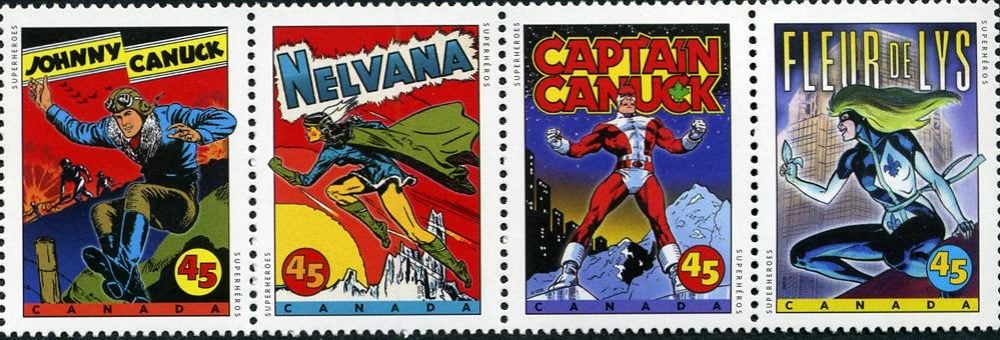
 Black Scorpion, 1, April 1991: “Knight Of Justice.” Illus., Steve Leblanc:15.
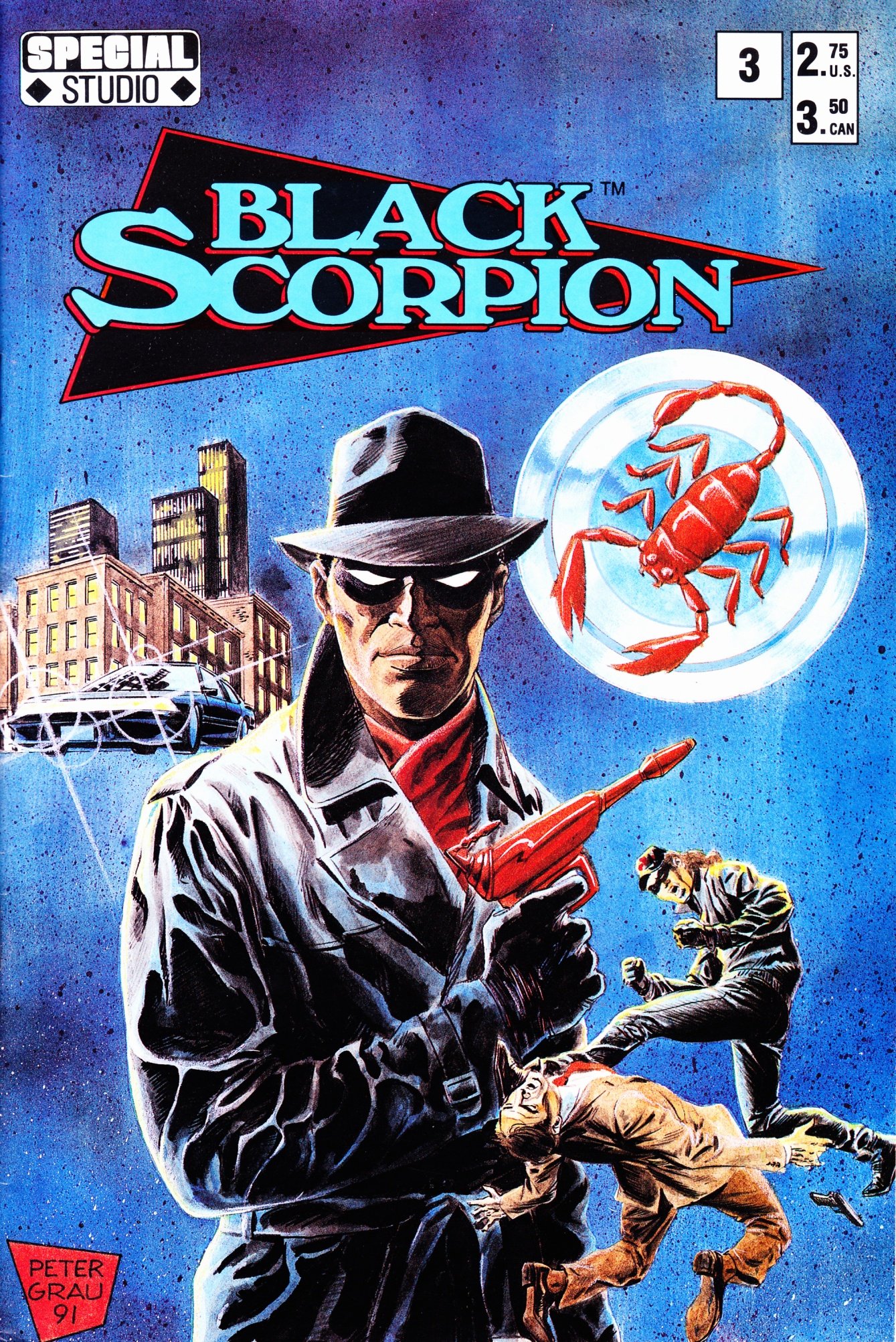 Black Scorpion, 3, October 1991: Front cover. Illus., Peter Grau:
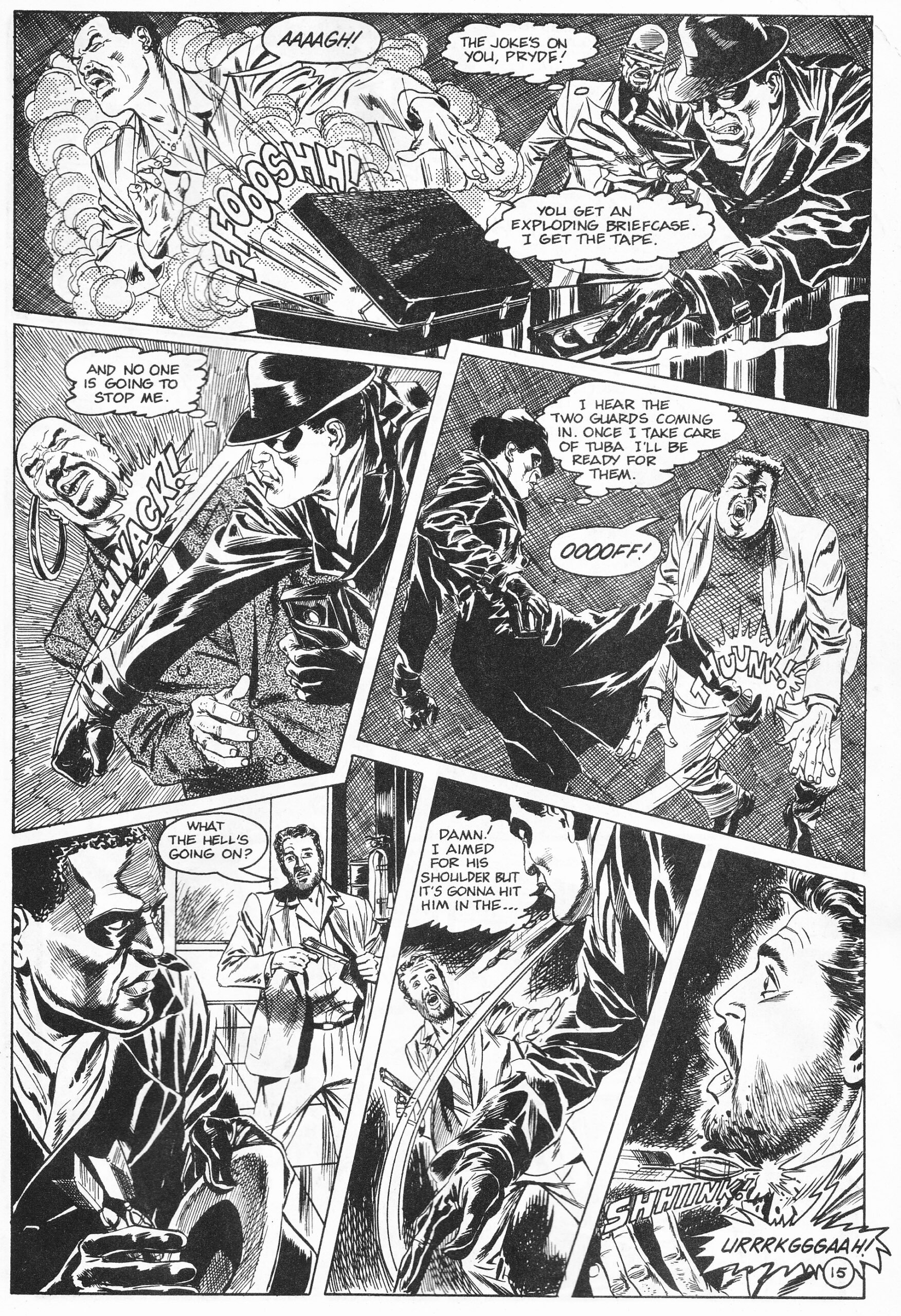 Black Scorpion, 3, October 1991: “Blackmailer’s Auction.” Illus., Peter Grau: 15.