KOZJAN Drazen

KOZJAN Drazen

Born in Karlovac Croatia, he moved with his family to Canada. He presently lives in Etobicoke Ontario.

In his childhood he listened to the folktales told by his mother and grandmother. His talent was recognized in grade 7 when his teacher asked him to draw Norse legends Thor and Loki. For this the teacher gave him two books, one on aliens and the other by Edgar Allen Poe. From there he moved on to doing posters and record albums for local bands which led to work on videos, in magazines and TV commercials. He moved into TV animation design and storyboard telling for programs like The Neverending Story, Rupert The Bear, Franklin The Turtle and George Shrinks.

In 2005 he illustrated his first children’s book Diary of a Fairy Godmother. He has since illustrated The Biggest Girl In The World, How To Tame A Bully, and Working Mummies.

His work has been exhibited at Gallerie Daniel Maghen in Paris France and Nucleus Gallery in Los Angeles U.S.A. among others.

He writes and illustrates a web print and multimedia project called The Happy Undertaker Mysteries.

He has participated in the 4 Panel Project, providing the experimental story “Apparitions: Three Leaves From A Witches Tree” in 4 Panel 2.

WORK:

CARTOONIST:

BOOK GRAPHIC ANTHOLOGY:

Content experiment:

4 Panel 2. 4 Panel Project, 2018: “Apparitions: Three Leaves From A Witches Tree.”

SOURCE:

Article book:

4 Panel 2. 4 Panel Project, 2018: “Drazen Kozjan.”

MERKLEY “Merk”

MERKLEY Christopher “Merk”

Christopher as illustrator and Kurt Martell writer, are two Thunder Bay Ontario based artists who partnered to produce the graphic novel Nowadays. They take an unusual approach to the Zombie apocalypse genre by making the zombies individuals with personalities and judgement. Judith Legatt explores this approach in her essay listed below.

Christopher, before Nowadays partnered with Andrew Sookram and Matthew Jowett both based in Winnipeg to produce Victor’s Legacy. Since Nowadays, he has both written and illustrated Season Of The Dead Hours. Kurt Martell has since pursued other projects.

SOURCE:

Article book:

Nowdays And The Free Will Zombie Apocalype.” Writ., Judith Leggatt. The Canadian Alternative: Cartoonists, Comics, and Graphic Novels. Ed., Dominick Grace & Eric Hoffman. University Press of Mississippi, 2018: 98-112.


HECKLERS [THE]

HECKLERS [THE]

Terry Mosher (Aislin) editorial cartoonist at Montreal Gazette and Ian McLaren a producer-director at the National Film Board initiated a project in 1973 to produce a film and later a book on the history of editorial cartooning in Canada. To aid in this project they obtained the help of Robert LaPalme and the iconic Duncan Macpherson.

Over the next two years Mosher and two researchers scanned 300,000 editorial cartoons, winnowed them down to 2,000, 500, 200 and finally the 181 works from 50 cartoonists shown in the documentary.

CBC aired the one hour The Hecklers, narrated by John Colios, on Sunday January 18, 1976 at 10:00 pm. It can still be viewed by going to the National Film Board’s website. In this history, were interviews with some of the current cartoonists of the day and with the politicians they lampooned. As Duncan Macpherson talked about his career and work, he drew the cartoon shown on the cover of the TV Times shown below.

A book of the same name by Mosher and prominent journalist Peter Desbarates was published by McClelland & Stewart in 1979.

MEDIUM:

BOOK TEXT & GRAPHIC:

The Hecklers. Writ. & Ed.., Peter Desbarates & Terry Mosher. McClelland and Stewart Ltd., 1979.

FILM:

The Hecklers. Director & Producer Ian McLaren. Music Eldon Rathburn. National Film Board, NFB 527808, 1975. 58 minutes.

SOURCE:

Article periodical & Cover front:

The Spectator [Hamilton] TV Times, Jan. 10 To Jan. 17, 1976.
          “The Hecklers ‘An inside-the-park triple’”. Writ., Wessely Hicks.                                      “The Heckled: John Diefenbaker the most caricatured”. Writ., Wessely Hicks.                “Aislin’s Diefenbaker.” Car., Terry Mosher. Aka “Aislin”.                                                    “Macpherson’d” Writ., unidentified.                                                                                   Cover, Illus., Duncan Macpherson

GALLERY:

C:\Users\Robert\Documents\CARTOONING ILLUSTRATION ANIMATION\IMAGE BY CARTOONIST\M\Macpherson, Duncan, TV Times, Jan 10 - Jan 17, 1976.jpg The Spectator TV Times, Jan. 10 To Jan. 17, 1976. Front cover. Cartoonist, Duncan Macpherson.
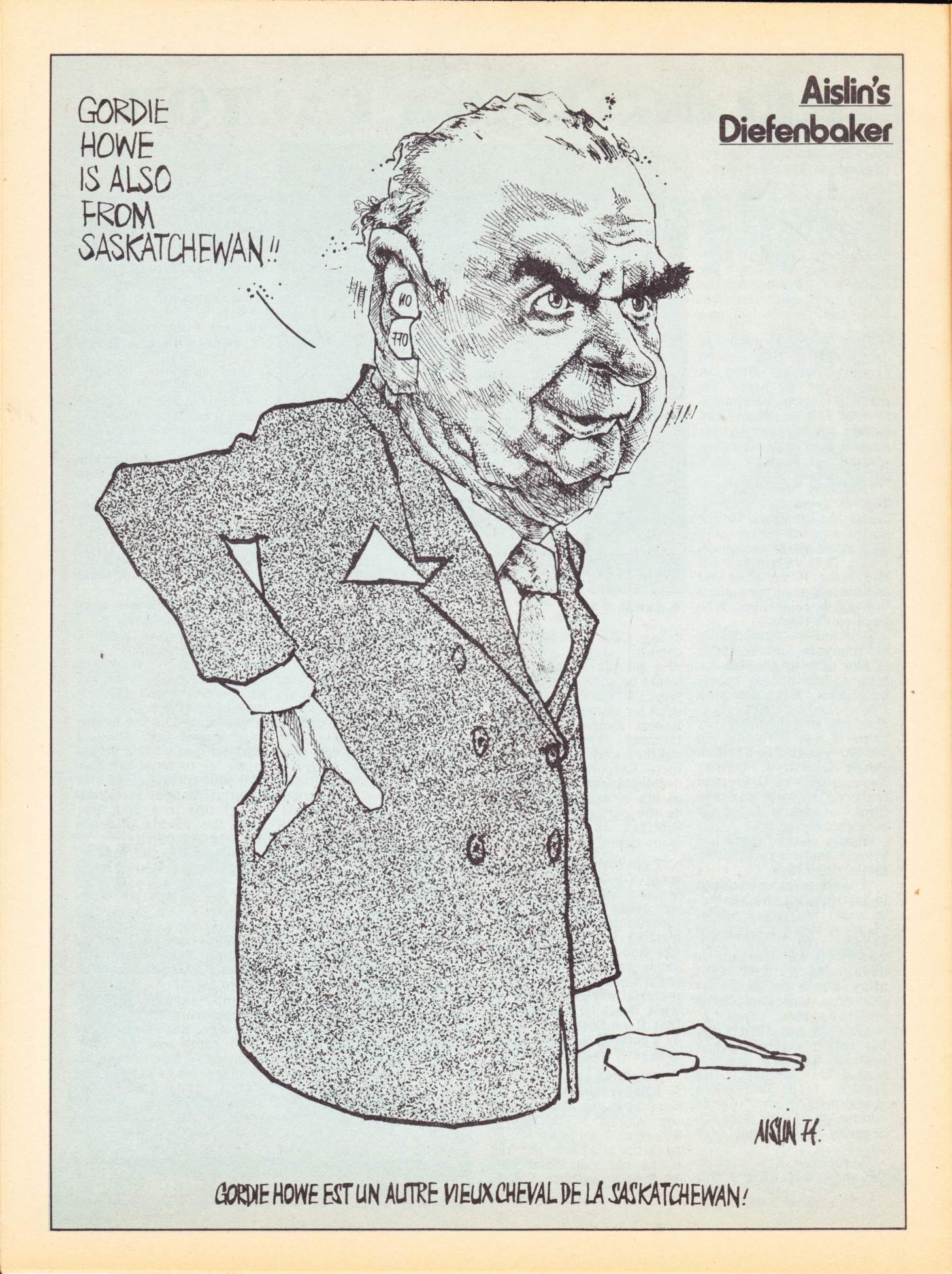
C:\Users\Robert\Documents\CARTOONING ILLUSTRATION ANIMATION\IMAGE BY CARTOONIST\M\MOSHER Terry, Spectator TV Times, Jan 10 - Jan 17, 1976.jpgSpectator TV Times, Jan. 10 – Jan. 17 1976: Cartoonist, Terry Mosher aka “Aislin”.

NOMBRILS [LES]

NOMBRILS [LES]                                                                                                            aka BELLYBUTTONS

“La vie est cruelle. Et puis après?”                                                                              Original French motto.

“Life is Cruel. Deal with it.”                                                                                                  English adaption.

This serial which focuses on three teenaged girls, Jenny, Vicky and Karine, was co-created by the team of Maryse Dubuc (writer) and Marc Delafontaine (illustrator). It first appeared in 2004 Safarir 188 a Québec humour magazine and in 2005 was picked up by the Franco-Belgian weekly magazine Spirou. It has been collected into eight books in French and three books in English published by British firm Cinebook. It has also been translated into Czech, Danish, Dutch, Greek, Italian and Norwegian. It disappeared in late 2009 but returned in 2011 in Spirou 3802. However, Maryse and Marc do not see this as a life-long project.

“Jenny” and “Vicky” are glamorous, self-centered and nasty. “Karine” is plain, kind and smart but exploitable. Their friendships are in tension with their competition for boys friends. The title of the serial comes from the body piercing jewelry that Jenny and Vicky wear in their navels. These two also refer to themselves as the “world’s bellybutton”. Below the surface satire and comedy, however, the serial as well deals with social issues like suicide, depression drugs, alcoholism and homosexuality.

SOURCE:

Article book:

The Canadian Alternative: Cartoonists, Comics, and Graphic Novels. Ed., Dominick Grace & Eric Hoffman. University Press of Mississippi, 2018: “Vicky.” Writ., Annick Pallegrin: 83-97.

Article newspaper:

La Presse, 12 Nov. 2013: Delaf et Dubuc: les nombrils du monde.”.

Internet:

“The Bellybuttons.” https://en.wikipedia.org/wiki/The_Bellybuttons . Accessed 19 May 2020.

DELAFONTAINE Marc

DELAFONTAINE Marc

Pseudonym “Delaf”

Born 9 October 1973 in Sherbrooke, Québec.

From about the age of twelve when reading magazines like Le Journal de Spirou (Franco-Belgian) and Fantasie he wanted to be a cartoonist. He met Maryse Dubuc at the Rolling Stone bar in Sherbrooke when they were both taking a Richard Langois class on cartooning.

After university he has worked in animation on the Caillou series, and illustrated text books. Then at a request from Safarir he and Maryse partnered to create “Les Nombrils” (“Bellybuttons”).

SOURCE:

Article book:

The Canadian Alternative. University Press of Mississippi, 2018: “Vicky”: Writ., Annick Pallegrin. 83-97.

Article newspaper:

La Presse, 12 Nov. 2013: Delaf et Dubuc: les nombrils du monde.”.

DUBUC Maryse

DUBUC Maryse

Born 21 October 1977 in Compton Québec.

She studied psychology at the University of Sherbrooke and communications at Université du Québec à Montréal. She then worked as a colourist for Vents d’Ouest and Éditions les 400 coups. At the same time she wrote youth novels published by Bayard Canada and Éditions Pierre Tisseyre.

She met Marc Delafontaine who later became her husband, at the Rolling Stone bar in Sherbrooke when they were both taking Richard Langlois course in cartooning. After following separate career paths for a time, they partnered to create “Les Nombrils” (“Bellybuttons”).

SOURCE:

Article book:

The Canadian Alternative. University Press of Mississippi, 2018: “Vicky.” Writ., Annick  Pallegrin: 83-97.

Article newspaper:

La Presse, 12 Nov. 2013:Delaf et Dubuc: les nombrils du monde”.

MacKINNON Paul

MacKINNON Paul “Moose”

A Cape Breton cartoonist who created stories about Cape Breton Island in a publication called Old Trout Funnies.

SOURCE:

Article book:

The Canadian Alternative: Cartoonists, Comics, and Graphic Novels. Ed., Dominick Grace & Eric Hoffman. University Press of Mississippi, 2018: “Paul ‘Moose’ MacKinnon And An Alternative Cape Breton.” Writ., Ian Brodie. 53-69.


AB NORMAL

AB NORMAL

“Ab Normal” seems to be not only the name of a character but the pseudonym of a 1940’s cartoonist who remains unknown to this day. His work appeared in the Bell Features line in the short period at the end of the war just before the company collapsed. Inhabiting the world of “Ab Normal” and his son “Ab Normal Junior” were “Wacky Willie”, “Casey The Cop”, “Patrick The Plumber” and “Ab Normal’s” cat “Tabby”. The setting was a rundown neighbourhood, and the cartoonist at times mixed reality with fiction, as in the case that “Ab Normal”, the character, drew cartoons for Bell Features and Publishing Ltd. One can find one of his stories in Triumph Comics 29.

Ivan Kocmarek described the feature as follows:

“From today’s perspective, his panels and pages look like anachronistic silvers in wartime comic books and seem to belong better in the pages of the underground comix, alongside the work of Gilbert Shelton and Robert Crumb. His characters and illustrations have that rebellious ethereal quality that often permeated the early iterations of underground commix.”

SOURCE:

Article book:

“Alternatives Within An Alternative Form.” Writ., Ivan Kocmarek. The Canadian Alternative: Cartoonists, Comics, and Graphic Novels. Ed., Dominick Grace & Eric Hoffman University Press of Mississippi. 2018: 3-15.