BADMAN

BADMAN

“Bad man” in SIN, appears to have been Jay Stephen’s first effort to create a fictional character which represents himself. Even the costumed “Batman’s” alter ego is called Jay Stephens. Jay will modify this practice in SIN Comics. It reaches its final shape in “Atomic City Tales” in the periodical of the same name.

In SIN, 1, June 1992, the “Land of Nod” story and “Badman” stories are integrated. First we have the “Land of Nod” story which stops in the middle of a fight between “Nod” and the “Dream King”. Abruptly we switch to an apparently unrelated “Badman” story in which Jay Stephens assumes his “Badman” persona which is clearly based on “Batman” and falls asleep. His dream ends with him falling from a great height, landing on and squashing the “Dream King”. “Nod” thanks him.

After this initial story, “Badman” becomes a stand alone, apparently a stand in for Jay, character. In “Year One” in issue 2, he broods in the “Hall of Brooding” an unheated small room Jay tells us, over why he dons his costume. He concludes it’s from his childhood, which reminds him of his first efforts at cartooning and his creation “Coxwell the Badly Drawn Ghost” which becomes a stand alone character in future stories.

“Year One” opens issue three, with “Badman” confessing about his “Badman” persona to “Superbwoman” to whom he is newly married. “Superbwoman” reacts to his confessions and justifications with skepticism, and hides her thought that he might be insane. The “Land of Nod” re-enters, as “Badman” aka Jay Stephens relates to “Superbwoman” the origin of “Nod” in a two page episode.

In issue four, Jay in his “Badman” persona decides to go autobiographical and settles on a two page description of his relationship with Taboo a Siamese cat given to “Superbwoman’ and himself as a wedding present.

The last “Badman” story occurs in issue 5 and describes Jay/Badman’s interaction with his characters. With this story he drops the “Badman” identity and introduces himself as a character in his stories. One character in this last story accuses him of preparing to kill off the characters in SI. Most of them he does when he begins the new series SIN Comics.

MEDIUM

PERIODICAL GRAPHIC COLLECTION:

Content serial black & white:

SIN,… “Bad Man.” Car., Jason Stephens. … Tragedy Strikes Press. Black & white.
1, June 1992: 7-11, 31. 2, Aug. 1992: “Year One”: 8-11.

3, Oct. 1992: “ Year One”: 1-5, .

4, Dec. 1992: 24-25.

5, Feb. 1993: 26-29.

GALLERY:

C:\Users\Robert\Documents\CARTOONING ILLUSTRATION ANIMATION\IMAGE CARTOON\IMAGE CARTOON B\BADMAN, SIN, 1, June 1992, 5.jpg The opening page for “Badman”. SIN, 1, June 1992: 7.

C:\Users\Robert\Documents\CARTOONING ILLUSTRATION ANIMATION\IMAGE CARTOON\IMAGE CARTOON B\BADMAN, SIN, 3, Oct. 1992, 5.jpg SIN, 3, October 1992: 5.

C:\Users\Robert\Documents\CARTOONING ILLUSTRATION ANIMATION\IMAGE CARTOON\IMAGE CARTOON B\BADMAN, SIN, 5, Feb 1993, 26.jpg SIN, 5, February 1993: 26.

C:\Users\Robert\Documents\CARTOONING ILLUSTRATION ANIMATION\IMAGE CARTOON\IMAGE CARTOON B\BADMAN, SIN, 5, Feb 1993, 27.jpg SIN, 5, February 1993: 27.

C:\Users\Robert\Documents\CARTOONING ILLUSTRATION ANIMATION\IMAGE CARTOON\IMAGE CARTOON B\BADMAN, SIN, 5, Feb 1993, 28.jpg SIN, 5, February 1993: 28.


LAMB BOBAK Molly

LAMB BOBAK Molly  

She was a major Canadian artist and only official female official artist in the Second World War.

In December 1942 she graduated from art school and joined the Canadian Women’s Army Corps (CWAC). She began keeping what she called a “war diary” She laid it out on Broadsheet newspaper and titled it W110278, her service number. It contained nearly 200 cartoons and watercolours describing CWAC life. In one cartoon depicting her first meal as an officer and modelled on the Last Supper by Leonardo da Vinci, Nathan M. Greenfield describes how in her self portrait she looks very much like Tintin even to his “famous cowlick”.

After the war Molly went on to an illustrious career in oil and watercolour, becoming Canada’s most successful female artist of her era.

SOURCE

Article Periodical:

Canada’s History, 100-6, Dec. 2020/Jan. 2021: “Beyond The Canvas.” Writ., Nathan M. Green: 28-35.

GALLERY:

C:\Users\Robert\Documents\CARTOONING ILLUSTRATION ANIMATION\IMAGE BY CARTOONIST\L\LAMB BOBAK Mary, Canada's History, Dec,Jan 2021, 31.jpg Canada’s History, 100-6, Dec. 2020/Jan. 2021: 31.


WIEBE Megan

WIEBE Megan

WORK:

ILLUSTRATOR:

PERIODICAL TEXT & GRAPHIC ANTHOLOGY

Content story:

Kayak, 73, September 2020: “Care For All.” Writ., Elizabeth Brooke: 20-23.

Cover front:

Kayak, Canada’s History Magazine for Kids, …. Canada’s National History Society.
74, December 2020: Seeking Safety.”

GALLERY:

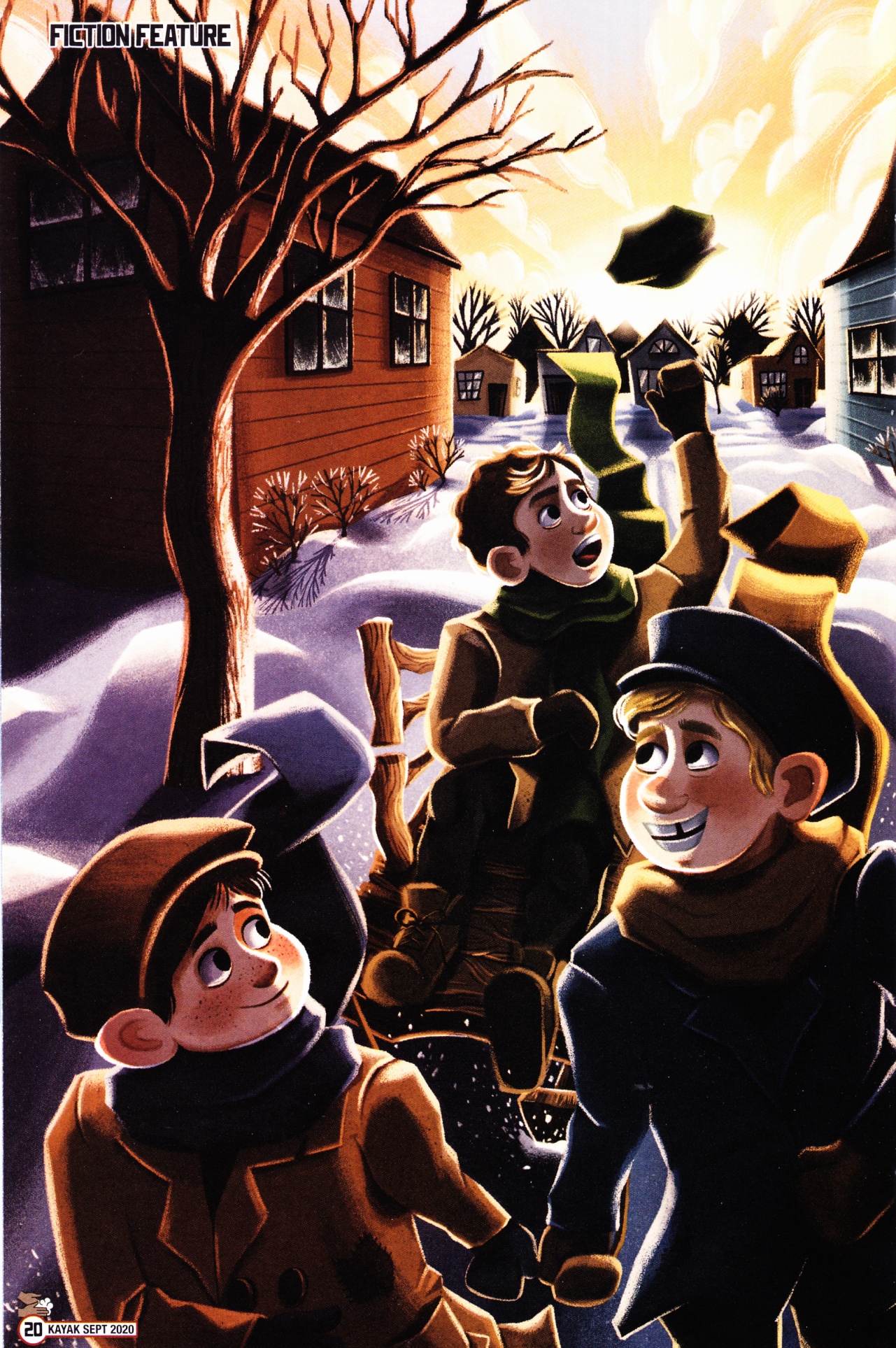
C:\Users\Robert\Documents\CARTOONING ILLUSTRATION ANIMATION\IMAGE BY CARTOONIST\W\WIEBE Megan, Kayak, 73, Sep 2020, 21 .jpg Kayak, 73, September 2020: 20.

SINISTER HORDE

SINISTER HORDE

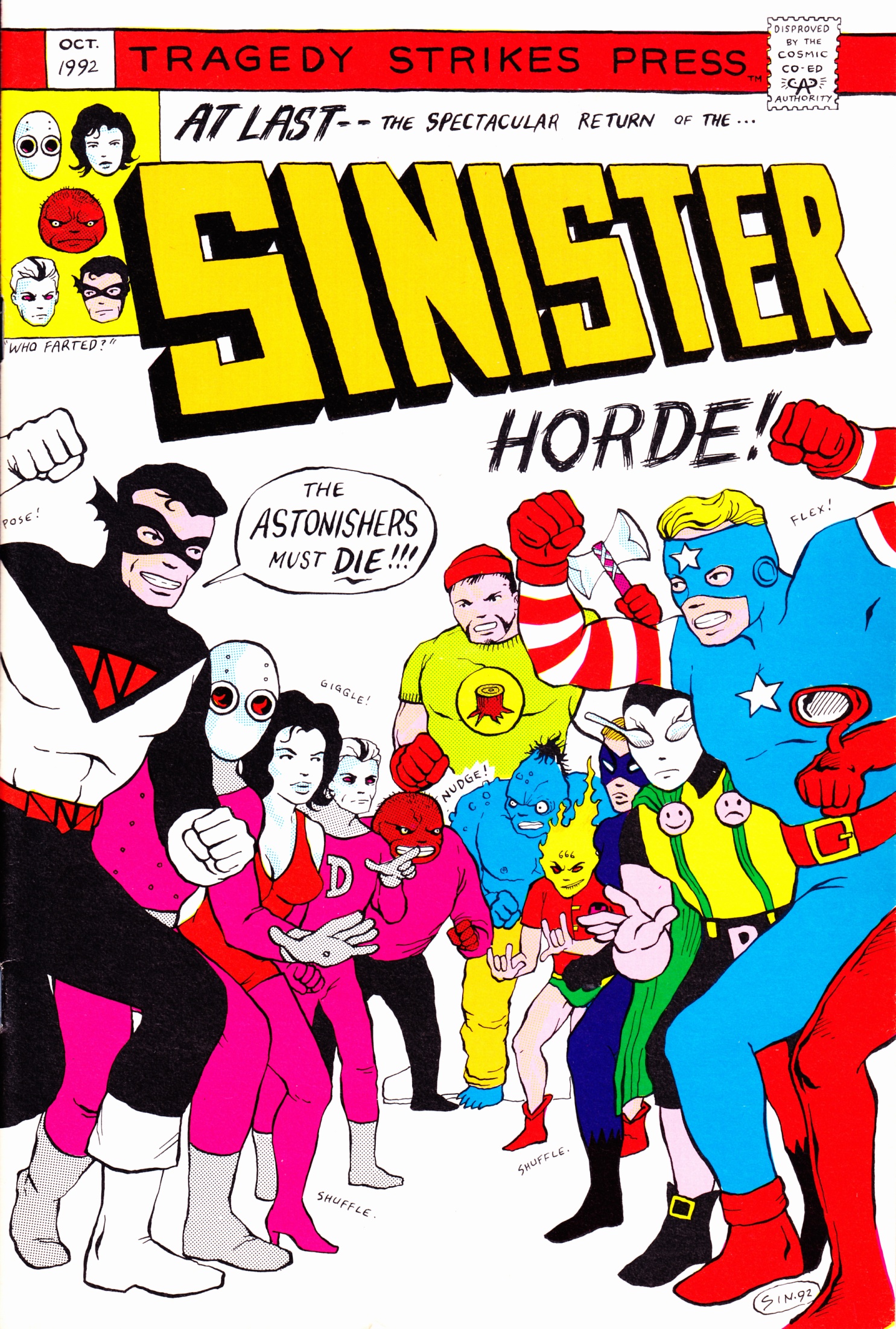
“Sinister Horde” created by Jason Stephens first appeared in SIN, 1, June 1992. It derives its humour through role reversal. “Sinister Horde” are the bad guys and they consistently defeat the good guys.

In the first issue, the members are introduced. “Mr. Dead” is the leader of the group. “The Clot” has abnormally tough skin. “Malady” has kisses that kill. “Captain Nasty” is devious and “Necroman” is toxic bile contained in a suit. In the “Necroman” story that follows these introductions, he kills a hero “Blazing Sun” who was in turn overcoming two villains.

In issue two we are introduced to a group of misbegotten heroes called “The Astonishers”. They are led by “The Fighting Republican” and include “Phantasmo”, “Mustang Sally”, “The Ugly Freak”, “Teen Satan” “She-Bug and “Paul The Lumber Lord”. Their purpose is “to bring the “Sinister Horde” to Justice”. In the ensuing battle Phantasmo” and “The Ugly Freak” go home. “Captain Nasty” likes “Teen Satan” and makes him his junior partner. “Malady” gives “She Bug” some advice and her cosmetic surgeon’s business card. “Necroman” dissolves “Paul”, and Mr. Dead tells “The Fighting Republican” and “Mustang Sally” to “vamoose” which they do.

Issue 3, tells us that “The Sinister horde” are really cartoon heroes in a periodical called “Sacred Organ” read by the characters in the “Land of Nod” – or are they? It also gives us the “Horde’s” origins.  After a couple of jabs at superhero stories with claims of coming from the planet “Hordon” or being bit by a radioactive cockroach, “Malady” settles down to the “true” account. They were a group of circus performers who dreamed of making a fortunate building a space ship and going into space. When someone stole their spaceship, they formed a suicide pact and overdosed on pills. Instead of killing them, the pills turned them into mutants.

All that is except “Captain Nasty”. His is another story. He was mutated by the U.S. Government in 1942, and became “Captain Nice” leader of the “Idealists”. He was so popular that the government and the other “Idealists” became jealous and locked him in a refrigerator. Decades later, the circus mutants freed him and he became “Captain Nasty” committing crimes and other nastiness.

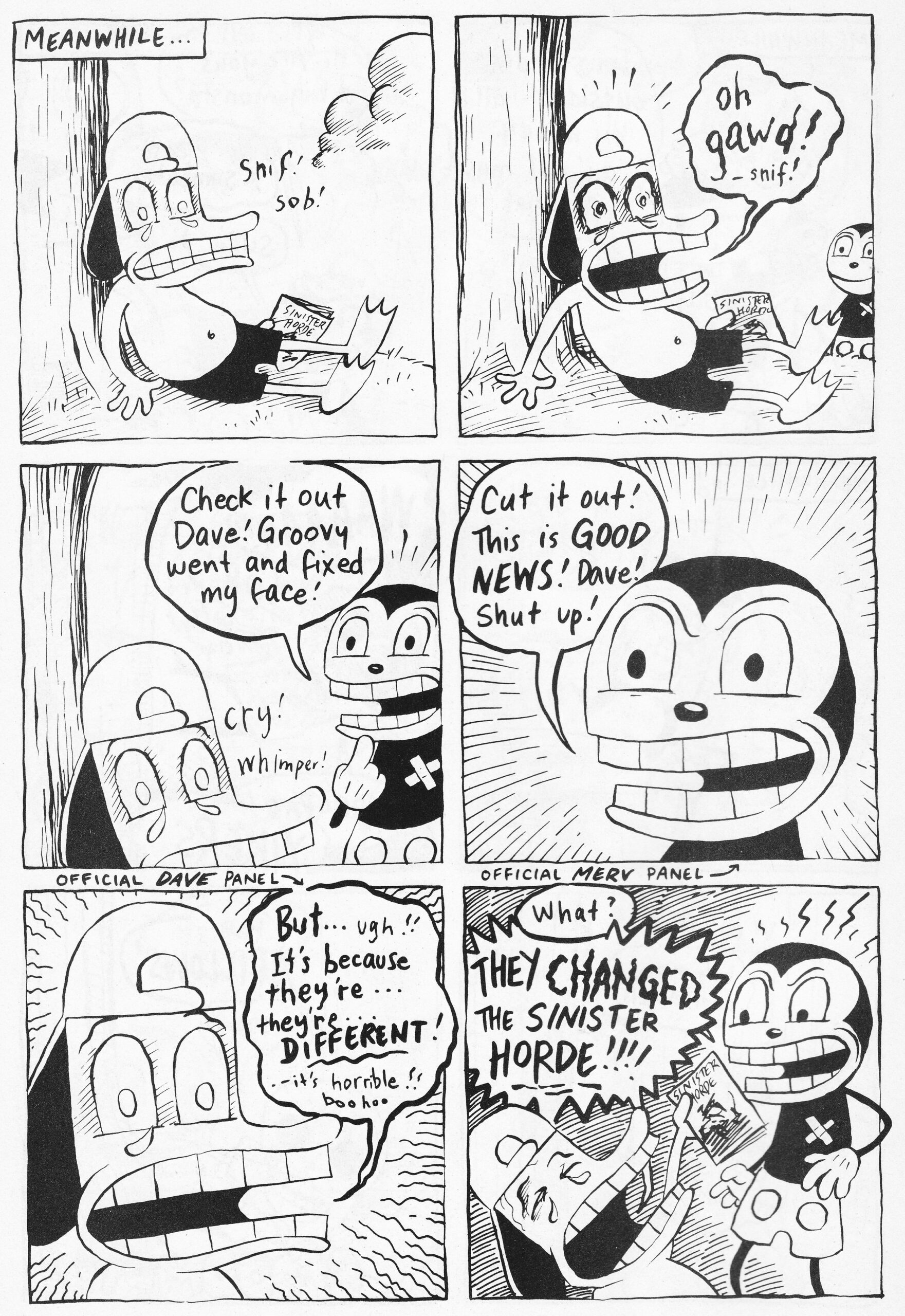
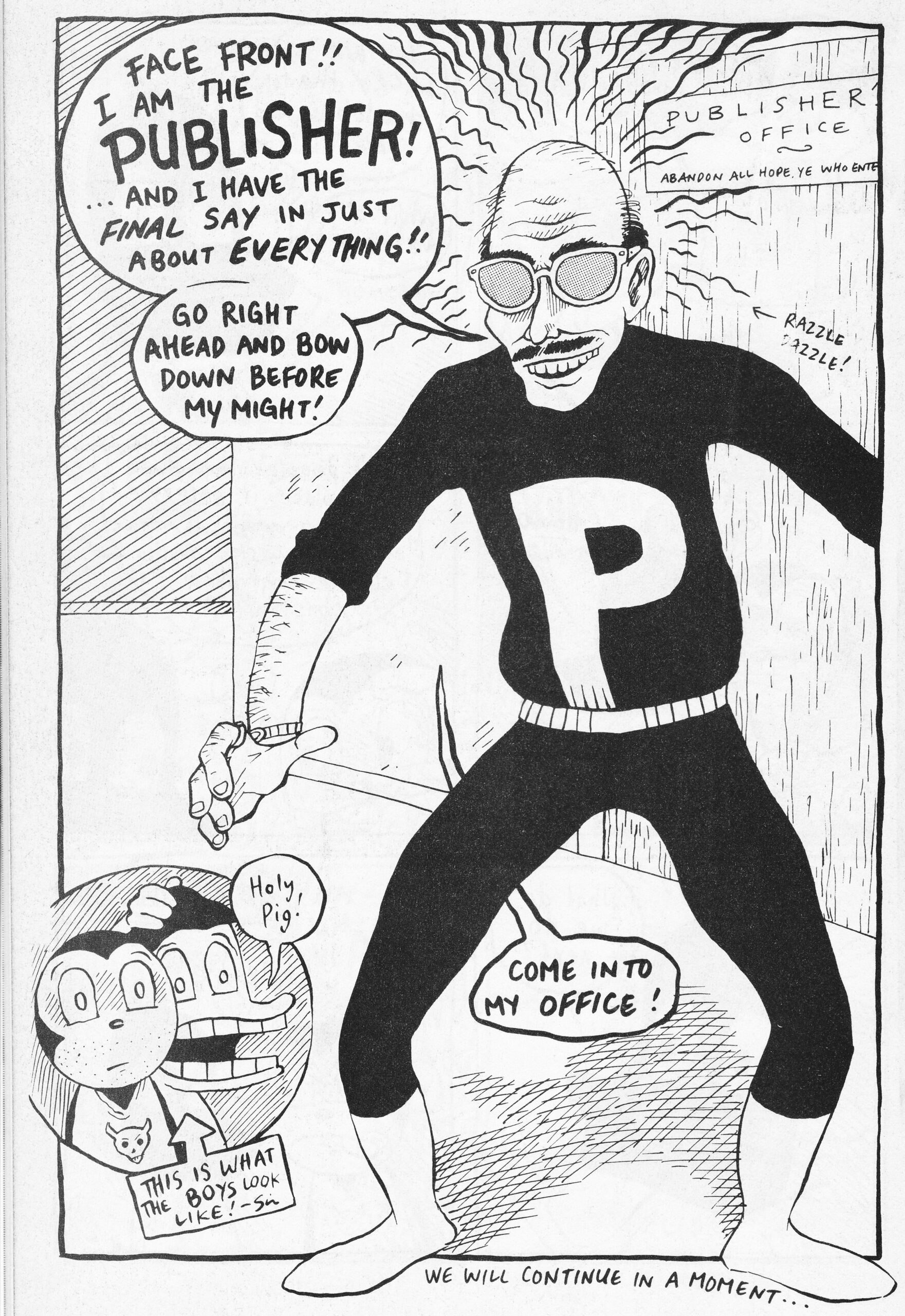
In issue 4, enter “The Land of Nod” “Dave reading “Sinister Horde Special Preview”. He is shocked to see the “Sinister horde” has been altered. There is a “Sinister Horde” four page description of the alterations. Back in “The Land of Nod”. Merv and Dave go to “Fascinating Komics Incorporated” to confront the “Publisher” who they destroy by seizing the contract. Dave rips up the contract and frees the “Sinister Horde” who show no gratitude except that “Captain Nasty” tosses “Dave” a signal ring for which “Dave” is incredibly grateful.

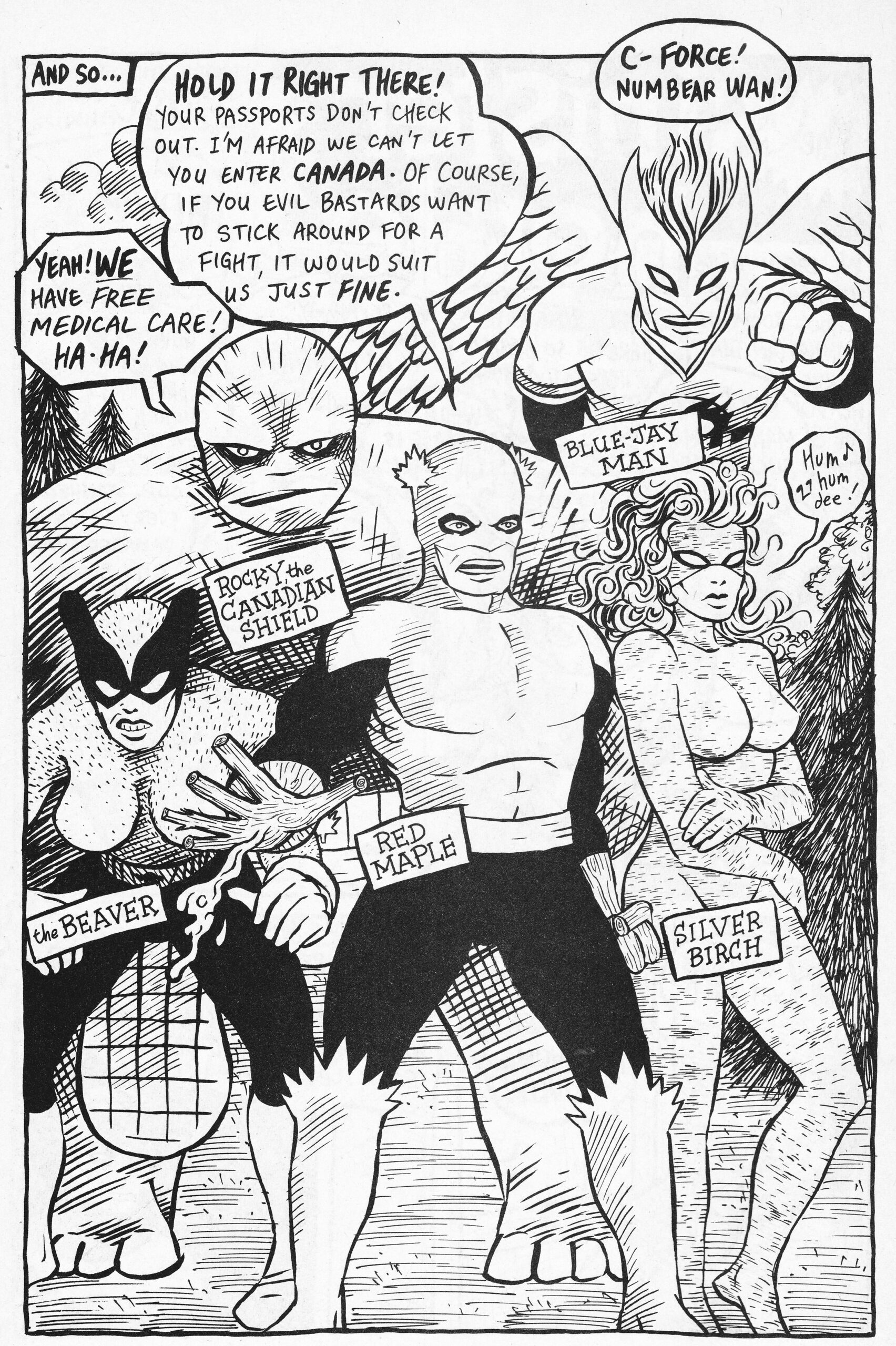
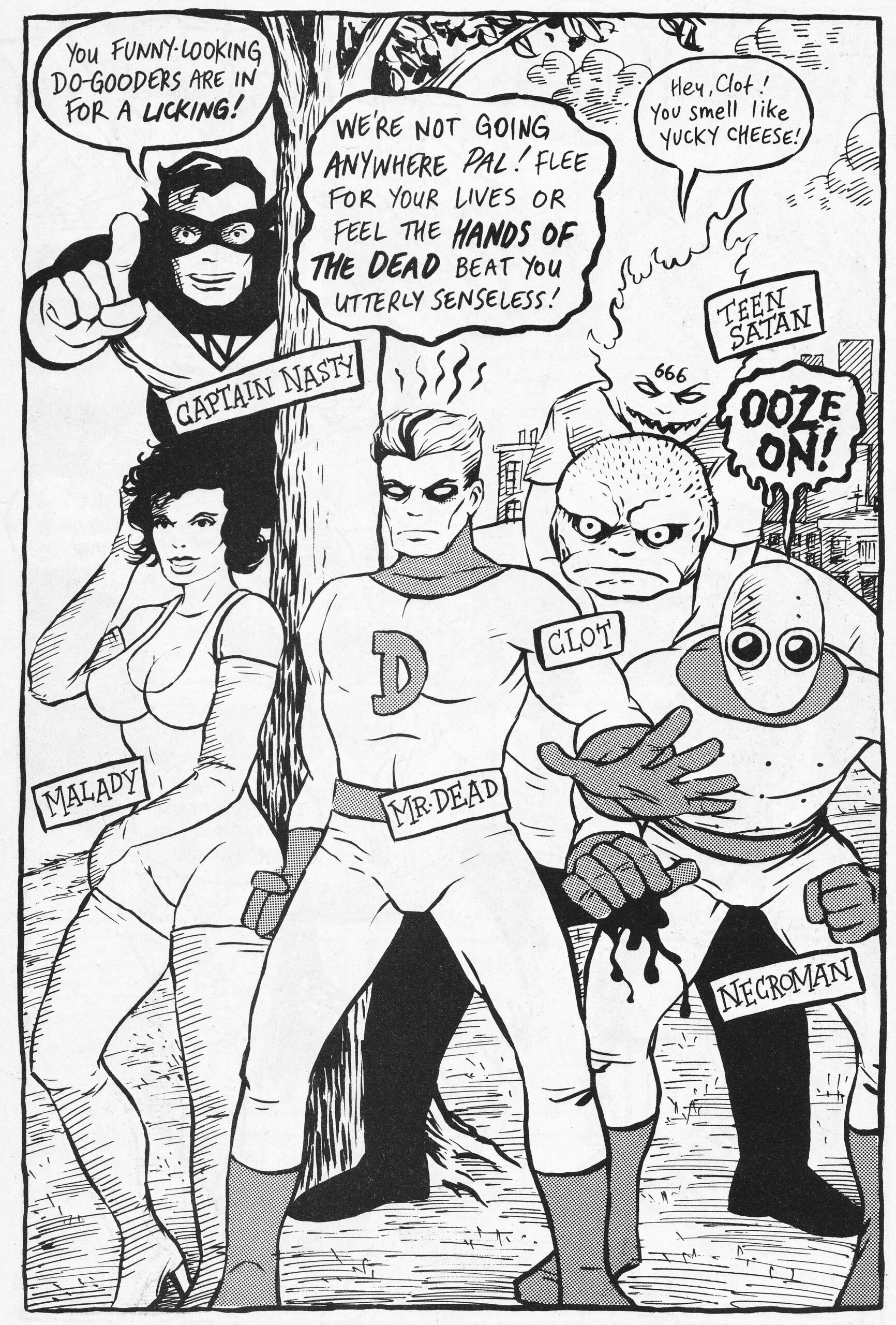
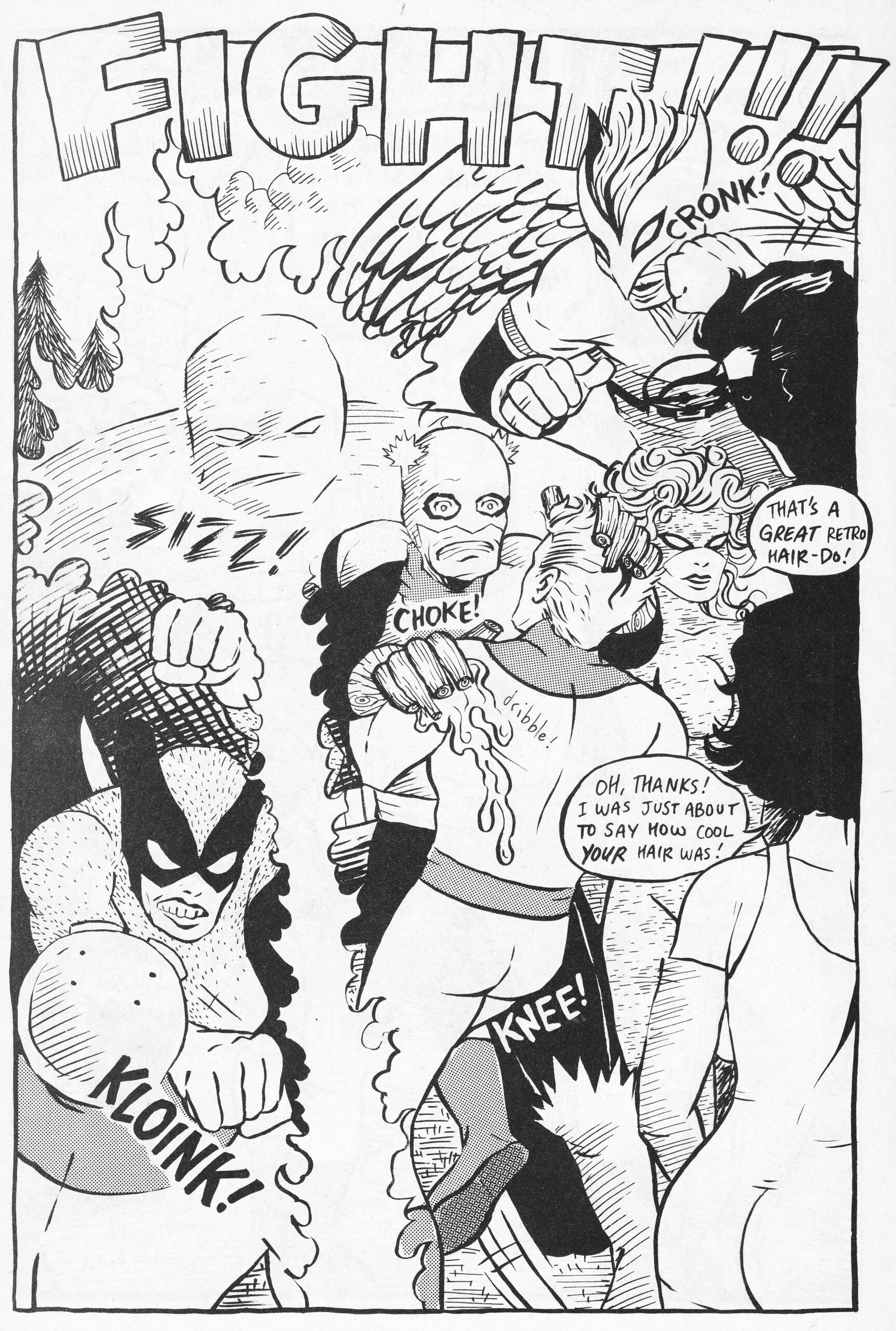
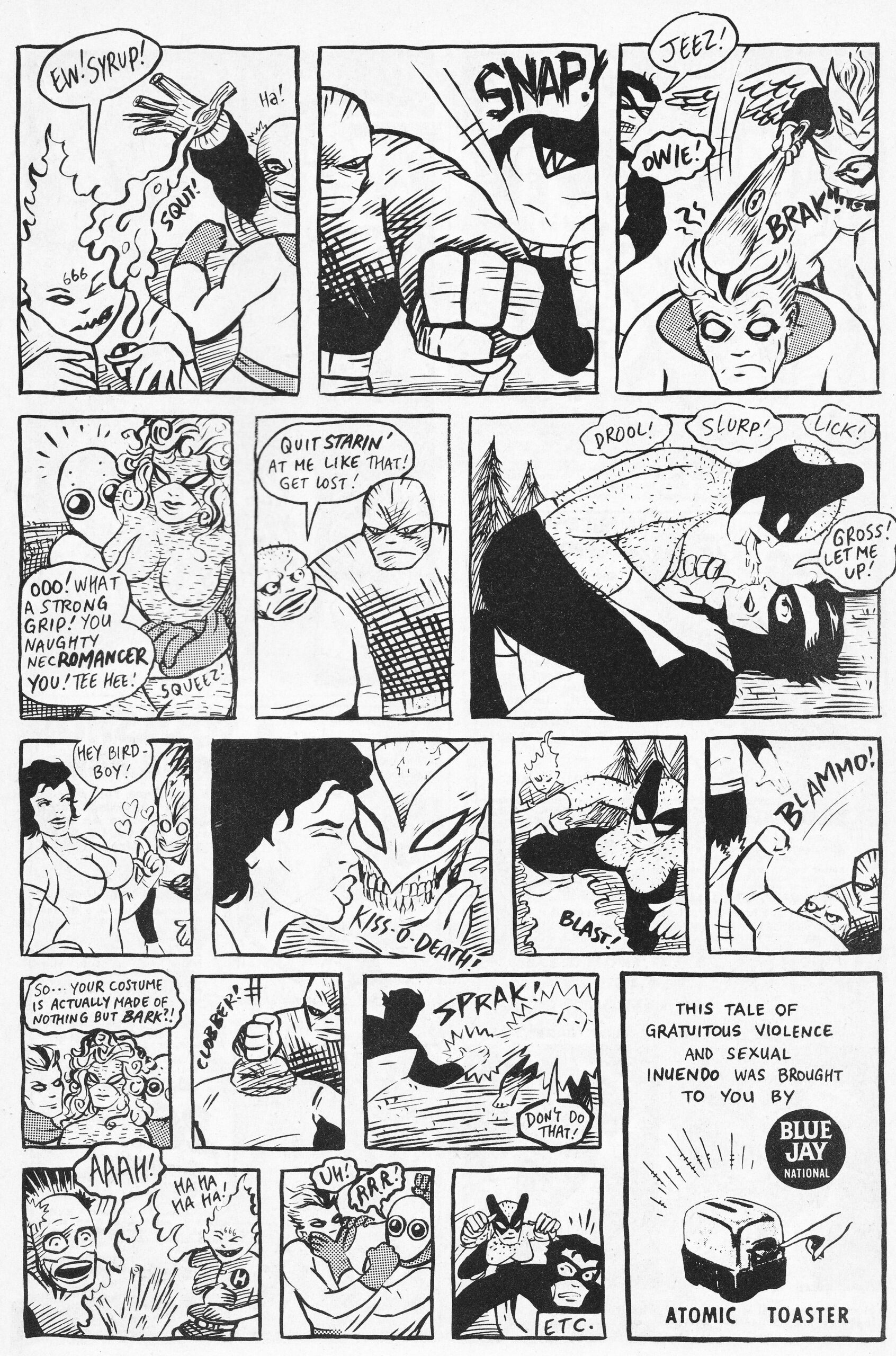
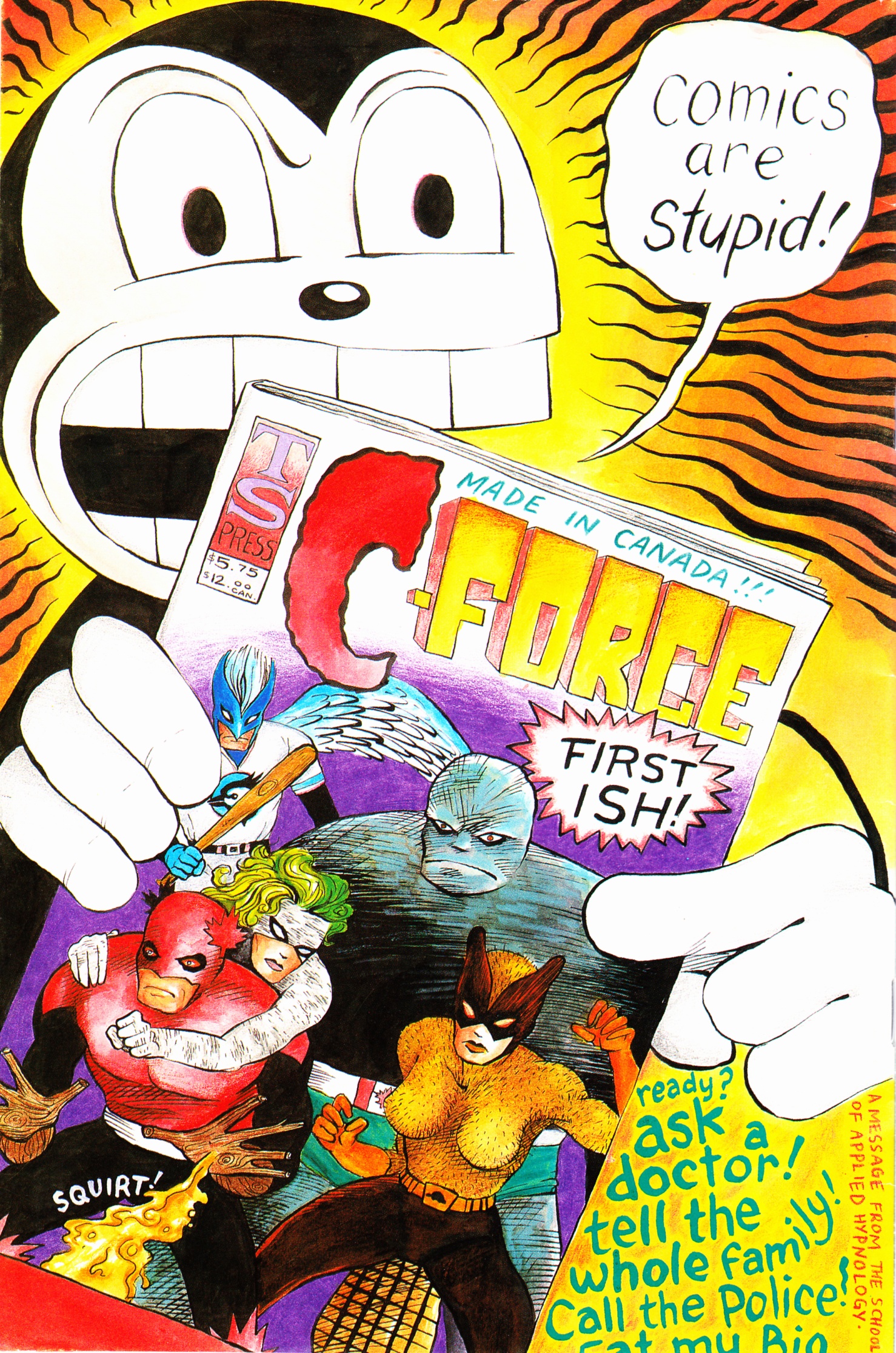
In the final story the “Sinister Horde” decide to leave the U.S. because the crime rate is too high, and there is too much competition and move to a place with a low crime rate and no “Astonishers” to inconvenience them. They go to Canada but come up against C-Force composed of Red Maple, “The Beaver”, “Rocky The Canadian Shield” “Blue Jay Man” and “Silver Birch”. What follows is a two page fight which stops in the middle.

Here both SIN, and the “Sinister Horde” serial end. When SIN Comics begins “Sinister Horde” has been replaced by “Atomic City Tales with Big Bang”

MEDIUM:

PERIODICAL GRAPHIC COLLECTION:

Cover:

Back: SIN, 2, Aug. 1992.Illus., Jay Stephens. Tragedy Strikes Press.

Front: SIN, 3, Oct. 1992. Jay Stephens. Tragedy Strikes Press.

Content serial:

SIN,… Cartoonist, Jason Stephens. Tragedy Strikes Press. Black & white.
1, June 1992: “take the cake”:19-24.

2, Aug. 1992: “The Astonishers”: 1-10.

3, Oct. 1992: “it’s a head-splitting origin”: 15-24.

4, Dec. 1992: “Sinister horde”: 9-12, 29- 30.

5, Feb. 1993: “Bust a move”: 13-17.

GALLERY:

C:\Users\Robert\Documents\CARTOONING ILLUSTRATION ANIMATION\IMAGE CARTOON\IMAGE CARTOON S\SINISTER HORDE, SIN, 2, Aug 1992, fc.jpg“The Sinister horde” (left) vs “The Astonishers” (right). SIN, 2, August 1992: Back cover.

C:\Users\Robert\Documents\CARTOONING ILLUSTRATION ANIMATION\IMAGE CARTOON\IMAGE CARTOON S\SINISTER HORDE, SIN 4, Dec 1992, 8.jpg“Dave” discovers “The Sinister horde” has been altered.” SIN 4, Dec. 1992: 8

C:\Users\Robert\Documents\CARTOONING ILLUSTRATION ANIMATION\IMAGE CARTOON\IMAGE CARTOON S\SINISTER HORDE, SIN, 4, Dec 1992, 18.jpg“Dave” and “Merv” go to confront the publisher of Sinister horde.” SIN 4, Dec. 1992: 18.

C:\Users\Robert\Documents\CARTOONING ILLUSTRATION ANIMATION\IMAGE CARTOON\IMAGE CARTOON S\SINISTER HORDE, SIN, 5, Feb 1993, 14.jpg“C-Force” confronts “Sinister horde” SIN 5, Feb. 1993: 14.

C:\Users\Robert\Documents\CARTOONING ILLUSTRATION ANIMATION\IMAGE CARTOON\IMAGE CARTOON S\SINISTER HORDE, SIN, 5, Feb 1993, 15.jpg“Sinister horde” confronts “C-Force” SIN 5, Feb. 1993: 15.

C:\Users\Robert\Documents\CARTOONING ILLUSTRATION ANIMATION\IMAGE CARTOON\IMAGE CARTOON S\SINISTER HORDE, SIN, 5, Feb 1993, 16.jpgThe confrontation continues. SIN 5, Feb. 1993: 16.

C:\Users\Robert\Documents\CARTOONING ILLUSTRATION ANIMATION\IMAGE CARTOON\IMAGE CARTOON S\SINISTER HORDE, SIN, 5, Feb 1993, 17.jpgThe confrontation ends. SIN 5, Feb. 1993: 17.

C:\Users\Robert\Documents\CARTOONING ILLUSTRATION ANIMATION\IMAGE CARTOON\IMAGE CARTOON S\SINISTER HORDE, SIN, 5, Feb 1993, bc.jpgSIN 5, Feb. 1993: Back cover.


TJIA Sherwin Sullivan

TJIA Sherwin Sullivan

Born in Toronto and based in Montréal Sherwin has produced about 11 books, and is a magazine and website designer. He has been invited to attend various national and international art and literature festivals, featured internationally at England’s Fierce Festival, Poland’s Artloop Festival, and the Fusebox Festival in Texas U.S.A. In Canada he has been featured at Calgary’s Wordfest and Montréal’s Blue Metropolis Literary Festival.

The World Is A Heartbreaker (2005) a collection of 1300 pseudohaikus poems was a finalist for the Quebec Writers Federation A.M. Klein Poetry Award. In 2007, he illustrated Black Stars In A White Sky written by Jonarno Lawson. In 2010 his The Hipless Boy, a collection of short interconnected graphic stories was a finalist for the Doug Wright Best Emerging Talent Award and was nominated for four Small Press Expo Ignatz Awards. The following year, at Montréal’s Expozine Alternative Press fair, reputed to be the largest in Canada, You Are A Cat won the Best English Book Award. His latest book Plummet was chosen by CBC Books as one of fifteen graphic books to read.

WORK:

CARTOONIST:

BOOK GRAPHIC:

Content novel & Cover book front and back:

Plummet. Conundrum Press, 2019.

SOURCE:

Article book:

Plummet. Conundrum Press, 2019: “About the Author”.

GALLERY:

C:\Users\Robert\Documents\CARTOONING ILLUSTRATION ANIMATION\IMAGE BY CARTOONIST\T\TJIA Sherwin William, Plummet, 2019, fc.jpg Plummet. Conundrum Press, 2019:


OCELOT Catherine

OCELOT Catherine

C:\Users\Robert\Documents\CARTOONING ILLUSTRATION ANIMATION\IMAGE OF PERSON\O\OCELOT Catherine, Conundrum, 1, 2020, 20.jpg                            Photo by Justine Latour. Conundrum: An Annual Magazine of Comic Arts, 1, 2020: 20.

This Montréal based artist came from Québec City

She began her career at CBC/ Radio Canada as a designer and art director. She has collaborated on a number of television, publishing and performance art projects.

About Art Life, she has said:

‘The book is for the most part a sort of artistic coming-of-age story, in which I search out others and listen to their experiences. I try to learn by observing, evoking the idea of studying a species: the artist. These bird costumes can be seen as a way of representing the themes of the persona and protection from the outside world – both ideas present throughout the book. How to be permeable, to take in influences while remaining whole and protected are very much of interest to me; it’s a difficult balance to achieve as an artist. Finally, as I also speak about my fear of falling in the book, the feathers are there to soften my eventual fall, which happens when I’m standing on a branch and try to hoist myself up on a tree that isn’t mine.”                                              Conundrum: An Annual Magazine of Comic Arts, 1, 2020: 21.

WORK:

CARTOONIST:

BOOK GRAPHIC:

Content novel & Cover front & back:

Art Life. Trans., Aleshia Jensen. BDANG/Conundrum Press, 2019.

SOURCE:

Article book:

Art Life. BDANG/Conundrum Press, 2019. Back cover flap.

Article periodical:

Conundrum: An Annual Magazine of Comic Arts, 1, 2020: “ Catherine Ocelot”:20-29. Interview & folio.

GALLERY:

C:\Users\Robert\Documents\CARTOONING ILLUSTRATION ANIMATION\IMAGE BY CARTOONIST\O\OCELOT Catherine, Art Life, 2020, 27.jpg Art Life. 2019: 17.

C:\Users\Robert\Documents\CARTOONING ILLUSTRATION ANIMATION\IMAGE BY CARTOONIST\O\OCELOT Catherine, Art Life, 2020, 28.jpgArt Life. 2019: 18.

C:\Users\Robert\Documents\CARTOONING ILLUSTRATION ANIMATION\IMAGE BY CARTOONIST\O\OCELOT Catherine, Art Life, 2020, 29.jpg Art Life. 2019: 19.


BIGHAM Sean

BIGHAM Sean

This London Ontario based artist attended the Alberta College of Art & Design and works as a concept artist in the video games industry. Tuniit: Mysterious People of the North was the first book he illustrated.

WORK:

ILLUSTRATOR:

BOOK TEXT & GRAPHIC:

Content anthropology & Cover book front & back:

Tuniit: Mysterious People of the North. Writ., Rachel & Sean Qitsualik-Tinsley. Inhabit Media Inc., 2014.

SOURCE:

Article book:

Tuniit: Mysterious People of the North., 2014: “Contributors”: 31.

GALLERY:

C:\Users\Robert\Documents\CARTOONING ILLUSTRATION ANIMATION\IMAGE BY CARTOONIST\B\BIGHAM Sean, Tuniit, 2014, fc.jpg Tuniit: Mysterious People of the North., 2014: Front cover.


FURNESS Ed

FURNESS Ed

C:\Users\Robert\Documents\CARTOONING ILLUSTRATION ANIMATION\IMAGE OF PERSON\F\FURNESS Ed, circa1943-44.jpg                        Ed Furness, circa 1943/44.

“Outside of animation, which I still think is the purest form of creativity that an artist can possibly be involved in, this other [cartooning] was a good second best as far as I was concerned.”

Ed Furness was born 11 May 1910 in Yorkshire England. He migrated with his family to Welland Ontario in 1920 where his mother had family.

They later moved to Dunnville Ontario of which he had very happy memories. He remembered drawing cartoons and getting in trouble with the teachers because of them. At one point, he recalled, “I conned my dad into paying for a correspondence course in cartooning. A complete waste of his money and my time.”

Later, he began writing for the Dunnville Chronicle and was a stringer, a local correspondent paid on the basis of lineage, for one of the Hamilton papers. The editor of the Chronicle, Ed Fry, hoped to make a sports writer of him and so took him to Toronto in 1929, where he met Jimmie Frise and Bill Hewit son of Foster Hewitt the great Hockey announcer. He was offered a job as a sports writer but turned it down, much to the chagrin of Fry. But, as he said he no intention of being a sports writer.

He went to the Ontario College of Art (O.C.A.) and trained under J.E. Macdonald, Frank Carmichael, Franz Johnston and William Beatty, and graduated in 1933. The first three were members of the famous Group of Seven painters.

“If I learned anything from those wonderful men, particularly from J.E. Macdonald, it was to work with integrity and intensity, … I guess it’s the word ‘intensity’ that makes me go, … I’m going to enjoy doing what I’m doing, full tilt.”

His first job after graduation was in animation. In May 1933, Bryant Fryer, one the teachers at O.C.A., who, according to Ed, was more entrepreneur than instructor, started a film company Bryant Fryer Productions at 96 Bloor Street Street West in Toronto. The company was backed by the Gooderham family and Ontario government. The films were Baby Bunting, Sailor’s Night On The Town, and Jack and the Beanstalk, a seven minute film.

Ed and a Ralph Blaber were hired on at $5 per week which as Ed pointed out was a good wage during the Depression.. The two of them did backgrounds and layouts, then story boards. Although Ed remembered they got the idea of using silhouettes in black from China, Karen Mazurkewich discovered it came from the art of the Chinese shadow play.. They had a hand turned camera which gave jittery light and jittery motion. The exposure problem was solved when Livingston in the Parliament Buildings motorized the camera and mounted it facing down.

Bryan took the films to England to promote more business. He was not successful and the company ended from lack of funds. One or more of the films is archived at the National Film Board Archives.

Ed returned to Dunnville where he tried to start a commercial art business but since there was already a company in town this effort did not succeed. He in turn went into life insurance sales which went quite well. At the same time, since he could play the fiddle, he made extra money going to various local dances as part of a pickup band.

He went to the U.S. and did window displays for department stores in Cincinnati. Not liking the work he returned to Canada, married Nellie Gifford, then they returned to the U.S. where they travelled about the country, with Ed doing freelance work. About 1939, he did create a comic strip which he tried unsuccessfully to sell in New York. They might have stayed there but World War Two broke out and Ed returned to join the armed forces. For health reasons, he wasn’t accepted, at the same time he found it difficult to get a good job, but as he said you knock on enough doors and you’ll find one..

About this time Ed became involved with Ted McCall and Anglo-American. Ed’s friend Syd Stein was doing the illustration duties on Ted’s “Robin Hood & Company when Ted now involved with Anglo-American came up with an idea for a World War Two espionage hero, who became known as Freelance. He approached Stein to illustrate it but Stein wasn’t interested. He wanted to return to commercial art. He told Ted that he had a friend Ed Furness, who might be willing. Furness recalled his first encounter with Ted. “He gave me a script and I looked at it and thought, Holy Moses, this guy should write for Cecil B. DeMille. He’s always talking about hundreds of extras.” In spite of these reservations, Ed drew some pages which satisfied McCall who took him to meet Jack Calder, the Managing Editor of Anglo-American. Since Ted wanted him Calder was ready to hire him but Ed was not about to give up his existing job for this untried company. He countered with a free-lance proposal. “You give me the scripts. I’ll show you the finished work. If you’re not happy, we’ll scrub the whole deal. If you are happy, I’ll keep turning it out.” So, Ed drew comics at night for $5 a page for about six months during which he realized he would have to make a choice between his two jobs. By this time he was earning more money cartooning and so he chose Anglo-American. But there may have been more to it than that. “I was enthralled by the whole prospect. Outside of animation which I still think is the purest form of creativity that an artist can possibly be involved in, this was a good second best as far as I was concerned.” McCall continued to script hundreds of extras and Furness learned the value of a big head in the center of the panel. Peter Harris said “Furness’ initial artwork on “Freelance” can only be described as crude but issue by issue he evolved a dramatic style….”

As he gained experience Ed Furness created “Don Shield & His Reverso Ray”, “Red Rover” and “Dr. Destine”. For more information on these characters go to the appropriate entry.

Anglo-American with its coloured comics and its streamlined stable of original characters was well positioned to take on the American comics as they flowed back into postwar Canada and so it came as a shock when it closed its doors. Ed Furness was stunned when he learned that Freelance December – January 1947 would be the last issue. He had settled in his mind that comic books would be his career, but this wasn’t enough to entice him to move back to the U.S.

About the time Anglo-American was shutting down, Jimmie Frise died in June 1948. Ed was offered the job of continuing his strip, but he wasn’t interested. In his mind it should not have been continued. It was Frise’s strip unique to him. As Ed said if he took it over it would have changed and in effect become his strip not “Juniper Junction”. Looking at post Frise “Juniper Junctions” this is exactly what happened. It lost the personality Frise brought to it and quickly declined in popularity.

Ed went back into commercial art and worked for about eighteen years for Southam Printing. As time passed the company became more corporate and less personal so that when Alex Gilchrist of Gilchrist Printing which specialized in fine colour reproductions, wanted to retire and sell the business Ed was ready to join two employees there and to buy the company in 1966. He eventually became president of the firm.

In 1976 he retired to devote his time to landscape painting and getting together with some other fellows to play in a band at local functions. His work hangs in collections in Canada, England, Germany, South Africa and the United States, and appeared in local and one man shows like T. Montgomery Inn in 1986 and the Richview Library in 1988.

He died peacefully at the Tyndall Nursing Home 20 April 2005 in his 95th year.

WORK:

ANIMATOR ASSISTANT:

FILM:

Bye Baby Bunting, 1933: Anim./Director, Bryant Fryer. Assist: Ed Furness & Ralph Blaber. Mus., Fraser Allen. Prod. Co., Bryant Fryer. 163.7 m. National Film Archives.

Jack The Giant Killer, 1933: Anim./Director, Bryant Fryer. Assist: Ed Furness & Ralph Blaber. Mus., Fraser Allen. Prod. Co., Bryant Fryer. 1 reel. National Film Archives.

CARTOONIST:

PERIODICAL GRAPHIC ANTHOLOGY:                                                                          All published by Anglo-American Publishing Ltd.

Content :

Information:

Grand Slam Comics, 1-5, April 1942: “Well What Do You Know about …”: 35 & 36.          Black & white.

Serial:

Grand Slam Comics, …: “Don Shield and His Reverso-Ray.” Black & white.
1-4, March  1942: 38-49.

1-5, April 1942: 23-34.

1-6, May 1942: 39-

1-8, July 1942: 52-63. By issue 2-2, January 1943, Capt. Marvel Jr. Had replaced “Don Shield”.

CO-CARTOONIST:

PERIODICAL GRAPHIC ANTHOLOGY:

Content serial:

Grand Slam Comics… “The Crusaders…” Co-car., Les Gilpin Black & white .
“…” 2-3, February 1943: 32-41.

“…” 2-4, March 1943: 31-40.

“…” 2-5, April 1943: 31-40.

“…” 2-7, June 1943: 32-41.

“… and the Dream Of Baron Todt!” 2-8, July 1943: 31-40.

No story. 3-1, December 1943.

No story. 3-2, January 1944.

GALLERY:

SOURCE:

Article book:

Cartoon Capers: The History of Canadian Animators, Writ., Karen Mazurkewich. McArthur & Company, 1999: 17-18.

Embattled Shadows: A History of Canadian Cinema 1895-1939. Writ., Peter Morris. McGill-Queen’s University Press, 1978: 261, 266, 291, n84.

The World Encyclopedia of Comics, Ed., Maurice Horn. Chelsea House Publishers, 1976: “FREELANCE (Canada).” Writ., Peter Harris.. 265.

Article newspaper:

Etobicoke Guardian, 25 Nov.1981: “Artist Puts Intensity into Full –Time Career.” Writ., Sheila Johnston.

Interview:

This is based on 1980’s interviews with Ed Furness.

GALLERY:

Photos from Ed Furness.

C:\Users\Robert\Documents\CARTOONING ILLUSTRATION ANIMATION\IMAGE OF PERSON\F\FURNESS Ed, in his studio, 1943-44.jpg                        Ed Furness in his studio, circa 1943/44.

C:\Users\Robert\Documents\CARTOONING ILLUSTRATION ANIMATION\IMAGE OF PERSON\F\FURNESS Ed, retired and painting Nov 1981.jpg                          Ed Furness retired, in front of one of his paintings, November 1981.

C:\Users\Robert\Documents\CARTOONING ILLUSTRATION ANIMATION\IMAGE OF PERSON\F\FURNESS Ed, painting the characters he drew in 1940's 1989.jpg                                Ed Furness, 1989, painting a portrait of the characters he drew in the 1940’s.
TICK TOCK TOM

TICK TOCK TOM

(Also called TIC TOC TOM)

Location: 1442 Lawrence Ave. West #215, Toronto.

Founder: Chetan Patel

The Tick Tock Tom group:

Karl J. Borst, Chris Chiasson, Brent Feschuk, Ken Gallant, Peter Macchione, Paul Marhue, Chetan Patel, Yan Rozentsveig Jeff Turner.

TICK TOCK TOM is both the name of the character and the name of the group behind it.