MacDONALD Blaine

MacDONALD Blaine

C:\Users\Robert\Documents\CARTOONING ILLUSTRATION ANIMATION\IMAGE OF PERSON\M\MacDONALD, Blaine, Cartoons By Blaine 1970.jpg                                  Cartoons By Blaine 1970, 1970: “Kansas City Bunnies Chose Blaine’s Cartoon As Their Favourite…”

“One cartoon without caption can sum up several thousand words uttered in Parliament.”                                                                                                                  The Hecklers: 230.

Born 1937 in Glace Bay Nova Scotia.

He drew his first editorial cartoons for The Cape Breton Post. Realizing that he was not going to make a living working out of Cape Breton, he headed west in 1961. His first stop was Toronto where he drew cartoons for the Globe and Mail while staff cartoonist Jim Reiford was on holiday. He then headed for the U.S. but on his way he stopped in Hamilton at the Spectator was hired as an editorial cartoonist. This was still in 1961. He remained there till he retired. He was also syndicated throughout Canada, and freelanced for New York Times, Time and Playboy.

In 1963 he won the Grand Prize at the first International Salon of Caricature and Cartoon in Montréal. In 1970 he was presented with the Reuben, an American award named after the cartoonist Rube Goldberg, for being “the outstanding cartoonist of the year.” He was the recipient of National Newspaper Awards in 1974 and 1982. Hugh Buchanan Associate Editor of The Spectator said of Blaine’s cartoons, “All survey’s of our readers show that his cartoons are the most popular feature in The Spectator…” He was also regarded by his contemporaries as a mater of the brush stroke. He travelled extensively producing illustrations and sketchbooks for the Spectator and other publications. He was also involved in photography, portraiture and painting.

WORK:

CARTOONIST:

BOOK GRAPHIC ANTHOLOGY:

Content editorial cartoon:

Best Canadian Political Cartoons, 1983. Ed., N.M. Stahl. For., David Rosen. McClelland & Stewart Ltd. Sept. 1983.

Best Canadian Political Cartoons, 1984. Ed., N.M. Stahl. For.,Robert LaPalme. McClelland & Stewart Ltd. Sept. 1984.

Portfoolio, The Year 85 In Canadian Caricature. Ed., Guy Badeaux & Alan King. Writ., Charles Gordon. Ludcom Inc. 1985.

Portfoolio, The Year 86 In Canadian Caricature. Ed., Guy Badeaux. Writ., Charles Gordon. Ludcom Inc. 1986.

Portfoolio, The Year 87 In Canadian Caricature. Ed., Guy Badeaux . Ludcom Inc. 1987.

1988 Portfoolio, The Year In Canadian Caricature. Ed., Guy Badeaux . Writ., Charles Gordon. Eden Press. 1988.

Portfoolio: 1989 in Canadian Caricature. Ed., Guy Badeaux . Writ., Charles Gordon. Macmillan of  Canada, 1989.

Portfoolio …: The Year in Canadian Caricature. Ed., Guy Badeaux . Writ., Charles Gordon. Macmillan of Canada, ….
6: 1990. 7: 1991. 8: 1992. 9: 1993.
Portfoolio…: The Year’s Best Canadian Editorial Cartoons. Ed., Guy Badeaux . Writ., Ken MacQueen Macmillan of Canada, ….
10: 1994. 11: 1995. 12: 1996.

BOOK GRAPHIC COLLECTION:

Content editorial cartoon Cover book:

The Hamilton Spectator Presents Editorial Cartoons by Blaine. Hamilton Spectator, 1967.

Cartoons by Blaine. Hamilton Spectator, 1970.

Cartoons 1971. Hamilton Spectator, 1971.

SOURCE:

Article book:

Blaine Cartoons 1971, Hamilton Spectator, 1971: “Forward.” Writ., Hugh Buchanan.

The Hamilton Spectator Presents Editorial Cartoons by Blaine. Hamilton Spectator, 1967: “Forward.” Writ., William F. Gold.

The Hecklers. Writ. & Ed.., Peter Desbarates & Terry Mosher. McClelland and Stewart Ltd., 979: 186-187, 230.

Portfoolio, The Year 85 In Canadian Caricature. Ludcom Inc. 1985: “Blaine”: 198.

Portfoolio 12: The Year’s Best Canadian Editorial Cartoons. Macmillan of Canada, 1995: “Blaine”.

GALLERY:

C:\Users\Robert\Documents\CARTOONING ILLUSTRATION ANIMATION\IMAGE BY CARTOONIST\M\MacDONALD BLAINE, Hamilton Spectator, 15 Oct. 1983, F4.jpgSpectator [Hamilton], 15 Oct. 1983: F4.
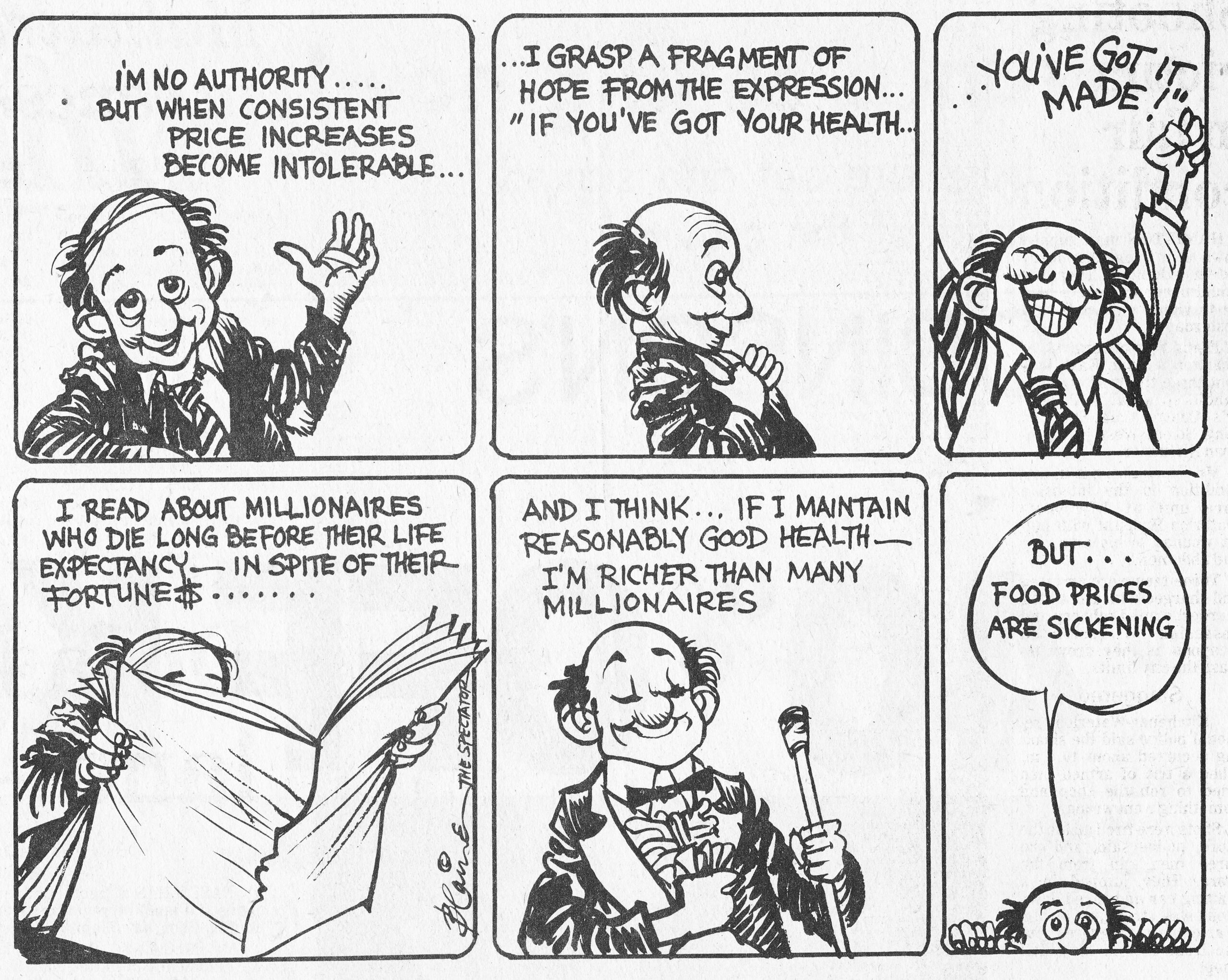
C:\Users\Robert\Documents\CARTOONING ILLUSTRATION ANIMATION\IMAGE BY CARTOONIST\M\MacDONALD BLAINE, Hamilton Spectator, 30 May 1981, 6.jpgSpectator [Hamilton], 30 May 1981: 6.

C:\Users\Robert\Documents\CARTOONING ILLUSTRATION ANIMATION\IMAGE BY CARTOONIST\M\MacDONALD BLAINE, Hamilton Spectator, 29 Dec 1989, A6.jpgSpectator [Hamilton] 29 Dec. 1989: A6.

C:\Users\Robert\Documents\CARTOONING ILLUSTRATION ANIMATION\IMAGE BY CARTOONIST\M\MacDONALD Blaine, Portfoolio 9, 6.jpg“ A Duncan Macpherson Tribute.” Portfoolio 9: 6.

MacDONALD Katherine

MacDONALD Katherine

WORK:

ILLUSTRATOR:

BOOK TEXT & GRAPHIC ANTHOLOGY:                                                                          All published by Potlach Publications Ltd., Ed., R. F. Neilson. Art Dir., M. Tach.

Content story text:

Canadian Children’s Annual, 1977. 1976.                                                                                    “The Birthday Cake.” Writ., Lise Loewy:19-20.                                                                    “The Ghost of Eileen O’Bannion.” Writ., J. Robert Janes: 33-35.

Canadian Children’s Annual, 1979.1978.                                                                                      “The Butchering.” Writ., Edna P. Bates: 28-32.                                                                    “The Christmas Storm.” Writ., Joy Borle: 159-161.


MAANDAG Nick

MAANDAG Nick

WORK:

CARTOONIST:

PERIODICAL TEXT & GRAPHIC ANTHOLOGY:

Content story graphic:

Canadian Notes & Queries, 92, Spring 2015: “The North Wing: Selections from the Lost Library of CanLit Graphic Novels Episode Thirteen, Stephen Leacock’s, Sunshine Sketches Of A Little Town, as Adapted by Nick Maandag”: 26-27.

Taddle Creek, XIX1, 36, Winter 2015-2016: “Whispered Apologies”.

Taddle Creek, XXIV-2A, 47A, Summer 2021: “Richard Wadsworth In ‘Wedge Issue’”: 10-13.

MA(R)DE IN KEBEC 

MA(R)DE IN KEBEC                                                                                                          Location: Sherbrooke, Québec.                                                                                          Owner/Publisher: Fernand Choquette and André Boisvert.

A company created by Fernand Choquette and André Boisvert to publish the periodical Ma(r)de in Kebec. Its name was later changed to Made in Kebec. In existence from 1970 to 1972, it published five issues.

SOURCE:

Article book:

Canuck Comics. Ed., John Bell. Matrix Books/Matrix Graphic Series. 1986: “Québec: A Short History.” Writ., Luc Pomerleau: 107-108, 149.


RURAL ROUTE

RURAL ROUTE

C:\Users\Robert\Documents\CARTOONING ILLUSTRATION ANIMATION\IMAGE OF PERSON\B\BALL Walter, Given by Walter Ball (2).jpg                              Walter Ball beside the iconic mail box that appeared in his “Rural Route” cartoon strips. Received from Walter Ball. Photographer unknown. Appeared in the Spectator 30 Dec. 1981.

Walter Ball was already a newspaper illustrator with a quarter century of experience doing illustrations for written features from sports to crime, when he created the half tab cartoon strip “Rural Route” which first appeared 3 November 1956. It began as an experiment but immediately got an enthusiastic response which kept it as the most popular feature in The Star Weekly over most of its duration and never saw it fall below third place. One survey showed 85 percent of subscribers read it, an unusually high percentage for any magazine feature. The cartoon remained a feature of the Star Weekly until the magazine itself ceased publication in 1968.

Walter belonged to a tradition of cartoonists ranging from Jimmie Frise, thru Walter, Doug Wright, Lynn Johnston to Sandra Bell-Lundy who based their strips on their personal experiences. The cartoon nature of the illustrations belied the reality of the content. In contrast the reality of the drawing style in most American cartoons belied the fantasy of the content. The autobiographical elements in “Doug Wright’s Family”, and “Ticky Tacky Township” “For Better and For Worse”, and “Between Friends” are all clearly visible. In describing his sources Ball related that the house in the cartoon was modeled after the house he grew up in. The stove in the “Rural Route” kitchen was copied after the one in which his mother used to bake the family bread. The mailbox that was the logo for the strip was based on the mailbox Walter’s father bought for $3 in 1911, the year Walter was born. Walter continued to use the mailbox at his home in Thornhill till the end of his life. The characters were combinations of people he knew. For example Dr. Ripley, a friend, who enjoyed ice fishing, appeared in the strip in a reworked fashion.

From the beginning the strip was based on Walter’s remembrances and observations of rural life, but it began as a series of individualized gag cartoons. After about a month Walter realized there was a need for a continuity derived through character or a particular location, to tie the series together. He settled on “Elmer” and “Myrtle”. Walter described Elmer as a man with the best intentions but even when he managed to do the right thing it was usually at the wrong time. He thought there was a lot of “Elmer” in him. But unlike Walter I never saw “Elmer” as a bit of a stumble bum but rather as an every person trying to cope with the world around them rather than mastering or dominating that world. This is another clear characteristic that sets this tradition apart.

To illustrate this point let us digress a moment to the father of the Canadian adventure cartoon strip Ted McCall and his feature “Men of the Mounted” and the syndicated strip “Zane Grey’s King of the Mounted”. Even in the titles we see the difference. In McCall’s strip we see a community of more or less ordinary men confronting the criminal elements in their society. In Zane Grey’s strip we are presented with the apex individual overcoming the forces of evil. Exploration of McCall’s work especially in the Big Little Book also called “Men Of The Mounted” shows the same sense of coping, community and helping one another that we find in the tradition to which Walter belongs.

There are differences however. These strips differ in that each reflects a different aspect of the huge changes that have occurred in Canada over period of time from Jimmie Frise to Sandra Bell-Lundy, shifts that saw Canada change from rural to urban, from the communal life of “Birdseye Centre” to the nuclear family of “Doug Wright’s Family” and “For Better Or For Worse” to the individual interacting with friends in “Between Friends”. In this continuum Walter’s “Rural Route” occupies a transitional position. Yes Walter’s strip is about a rural community, but it is not the same community as “Birdseye Centre”. In “Rural Route” the mechanized farm and the focus on a nuclear family has replaced the pre-mechanized farm community with its eccentric characters. In a Canada becoming increasingly urbanized this is the last strip that will deal with rural topics.

It also reflects a change in narrative style. As discussed in the appropriate sections, Jimmie Frise was able to submerge his own experiences and observations so deeply into a fictional milieu that no one has ever been able to discover the sources of his inspiration. Even Stephen Leacock could not achieve this in his Sunshine Sketches Of A Little Town. At the other end of the spectrum the biographical sources for the strips of Doug Wright, Lynn Johnston and Sandra Bell-Lundy are reasonably easy to discern. Again Walter lies somewhat in the middle. Earlier we have noted that Walter thought there were large similarities between himself and “Elmer”, but one would never mistake “Elmer” and “Myrtle” for Walter and Olive. Both of the latter were thorough urbanities, living in a subdivision in Thornhill and actively engaged in urban activities such as going to the theatre and concerts etc. In short “Rural Route” represents a transitional phase in the trend from heavily fictionalized accounts based on experience to more or less biographical accounts of those experiences.

“Rural Route” Ball then is part of a shared comic strip tradition with its own distinctive features, that extends over almost a century but at the same time displays features that due to the changing nature of Canadian society and the preferences of its author set it apart from other features of that tradition.

MEDIUM:

PERIODICAL TEXT:

Content strip cartoon:

Star Weekly Magazine …. Car., Walter Ball. Black & white.
5 July 1958: 38. 2 July 1960: 46.
Star Weekly Magazine …. Car., Walter Ball. Colour
7 Sept. 1963: 18.
S.W.Comics …. Car., Walter Ball. Colour
20 May 1967 7 Oct. 1967. 14 Oct. 1967

SOURCE:

Article periodical:

Star Weekly Magazine, I June 1957: “His Heart Is In His Rural Route.” Writ., Joh Brehl: 16.

Article newspaper:

Richmond Hill Liberal, 10 Sept. 1980: “Cartoon creator finds humour in everyday life.” Writ., Sharon Hay: 1.

Spectator [Hamilton], 30 Dec. 1981: “Elmer and Myrtle live on as comic strip Canadiana.” Writ., Paul Wilson: 10.

Interviews:

With Walter Ball 1982.

GALLERY:

C:\Users\Robert\Documents\CARTOONING ILLUSTRATION ANIMATION\IMAGE CARTOON\IMAGE CARTOON R\RURAL ROUTE, Star Weekly Magazine,2 July 1960, 46.jpgCar., Walter Ball. Star Weekly Magazine, 2 July 1960: 46.

C:\Users\Robert\Documents\CARTOONING ILLUSTRATION ANIMATION\IMAGE CARTOON\IMAGE CARTOON R\RURAL ROUTE, Star Weekly Magazine, 20 June 1964, 36.jpgCar., Walter Ball. Star Weekly Magazine, (?): 36.

C:\Users\Robert\Documents\CARTOONING ILLUSTRATION ANIMATION\IMAGE CARTOON\IMAGE CARTOON R\RURAL ROUTE, Star Weekly Magazine, 7 Sept 1963, 18.jpgCar., Walter Ball. Star Weekly Magazine, 7 Sept. 1963: 18.

C:\Users\Robert\Documents\CARTOONING ILLUSTRATION ANIMATION\IMAGE CARTOON\IMAGE CARTOON R\RURAL ROUTE, S.W. Comics, 20 May 1967.jpgCar., Walter Ball. S.W. Comics, 20 May 1967.

C:\Users\Robert\Documents\CARTOONING ILLUSTRATION ANIMATION\IMAGE CARTOON\IMAGE CARTOON R\RURAL ROUTE, S.W. Comics, 7 Oct 1967.jpgCar., Walter Ball. S.W. Comics, 7 Oct. 1967.

C:\Users\Robert\Documents\CARTOONING ILLUSTRATION ANIMATION\IMAGE CARTOON\IMAGE CARTOON R\RURAL ROUTE, S.W. Comics, 14 Oct 1967.jpgCar., Walter Ball. S.W. Comics, 14 Oct. 1967.

Note: The 1967 cartoons are printed on pulp paper. The previous cartoons are printed on glossy magazine paper.

RYAN Peter

RYAN Peter

His illustrations have appeared in Walrus, Wired, New York Times, and Scientific American.

WORK:

ILLUSTRATOR.

PERIODICAL TEXT & GRAPHIC:

Content story:

Taddle Creek, XVII-3, 33, Summer 2014: “The Giant’s Knock.” Writ., Philippa Dowding.: 2-4.

SOURCE:

Article periodical:

Taddle Creek, XVII-3, 33, Summer 2014: “ The Contributors.” Inside back cover.


RYAN Alonzo

RYAN Alonzo

He was born in Montréal about 1868.. He was one of the first Montréal cartoonists to be used by newspapers on a regular basis. He variously worked on Le Canada, Le Journal, The Witness, La Patrie, the Herald, Le Canard, and le Combat. He created a caricature of the average Québecois which he called “Baptiste Canadian – soi-meme et chezlui”. He may have been the one to introduce this symbol which was used by the following 2 generations of Québec cartoonists. He was non-partisan attacking both Liberals and Conservatives. According to Staley, “It was a common saying in Montreal editorial circles: ‘Ryan may be with the Government at nine o’clock but he is with the Opposition at eleven.’.” and “The general opinion of Ryan’s work expressed in Montreal is ‘Toujours spirituelle-jamais inordinate”.

SOURCE:

Book text:

The Hecklers. Writ. & Ed.., P. Desbarates & Terry Mosher. McClelland &Stewart Ltd., 1979: 249 -250.

Periodical text:

“The Cartoonmen of Canada.” Writ., John Edgecumbe Staley. Maclean’s Magazine, Mar. 1914: 44.


RUST Matt

RUST Matt

WORK:

CARTOONIST:

PERIODICAL GRAPHIC ANTHOLOGY:

Content story:

Orb Magazine,…: “…” ….
1-1, 1974: “The Whirls Of Numb-A, pts. 1-3.” 43-54.

1-2, July 1974: “Men Call Me The Seeker.” Let., Chris Middleton. 27-30.

1-3, Dec. 1974: “The Astounding Origin Of Karkass.” 47-50.

1-4, Nov./Dec. 1975: “Presenting For The First Time: Encore Une Fois.” 13-16.                                              “Spaze Scouts.” Col. Matt Rust. “46 – 55.

ILLUSTRATOR:

PERIODICAL GRAPHIC ANTHOLOGY:

Content story:

Orb Magazine, 1- 6, March/April 1976: “Woof Woof.” Writ., George Henderson. Let., Michael Cherkas: 6-22.

CO-WRITER:

PERIODICAL GRAPHIC ANTHOLOGY:

Content story:

Orb Magazine, 1- 6, March/April 1976: “Gyk The Barbarian.” Co-writ., John Sech. Pen., Paul McCusker. In., Jim Craig. Let., Michael Cherkas: 26-33.

RUSSELL William

RUSSELL William

A person kneeling on the floor
Description automatically generated              billrussellfineart.com/bio/

William’s career has embraced fine art, illustration, visual journalism, teaching and web design.

He was born and raised in Canada. He earned his degree from Parsons School of Design in the U.S. As can be seen below much of his illustration work has appeared in Canadian magazines and newspapers. His work has also appeared at the Reactor Gallery in Toronto, and at Stanford University, SFMoMA Artists Gallery, Marin MOCA, California College of the Arts and Sofie Contemporary all in the U.S. .

For eight years he was an adjunct professor of Illustration at California College of the Arts. In 2010, he was resident artist at Kala Art Institute Berkeley and in 2018 at Recology in San Francisco.

WORK:

ILLUSTRATOR:

PERIODICAL TEXT:

Content essay:

Harrowsmith, December 1989: “Toby’s Tomato”. Writ., Philip Stratford: 22.

Maclean’s …
… 4 September 1978; “They’re alright Jack; …?”. Writ., William Lowther: 49.

… 25 September 1978: “Watergate’s lessons do not travel …”. Writ., T. Wicker: 22-23.

… 10 June 2002: “Home from away”. Writ., John Demont: 64.

Saturday Night October 1996: “Sam I am”. Writ., Michael Fellman: 43.

NEWSPAPER:

Content book review:

Globe & Mail, 14 May 1977: ‘The Donnelly Album”. Writ., Unknown.

Content story text:

Globe & Mail, 23 Dec. 1995: “A Christmas Lorac.” Writ., Margaret Atwood: C1.

SOURCE:

Internet:

billrussellfineart.com/bio/ Accessed 17 February 2024.

GALLERY:

A group of people in a row
Description automatically generatedGlobe & Mail, 14 May 1977.

A newspaper with a person standing in a field with a tomato
Description automatically generatedHarrowsmith, December 1989: 22.

A newspaper article with a person looking in a mirror
Description automatically generatedSaturday Night October 1996: 43.

A newspaper article with a drawing of a bagpiper
Description automatically generatedMaclean’s, 10 June 2002: 64.