BERNCHE Stanley

BERNCHE Stanley

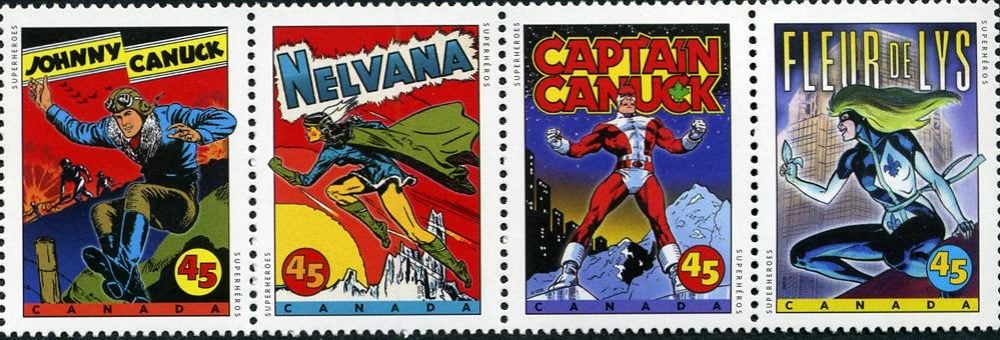
Stanley Berneche was born in Windsor, Ontario, in 1947. Following his studies at Mount Allison University, he became the leading artist associated with the counterculture humour magazine Fuddle Duddle, which was published in Ottawa by Jeffrey R. Darcey (JRD Publishing) from 1971 to 1972. The magazine’s name derived from remarks made by Prime Minister Trudeau in the House of Commons. Berneche’s main collaborator at the magazine was the writer Peter Evans, a friend from his university days. Their satirical character Captain Canada, the first national superhero to appear following the Canadian Golden Age of Comics, made his debut in Fuddle Duddle 3. The second Captain Canada adventure appeared in issue 4 (a third and final adventure remains unpublished).  At the same time he was contributing outrageous comics to Fuddle Duddle, Berneche was also drawing the strip “True Tales of the RCMP” for the Canadian Boy Scout magazine Trailblazers. Following the demise of Fuddle Duddle, he continued to pursue his career as a graphic artist and illustrator. He is currently working on a variety of multimedia, web-related products and services, including website design, the design of next-generation, public-access, graphical user-interfaces, and the development of web-delivered, limited-series illustrations. He also claims to be “shooting billiards to a level never seen before.” One of the most talented Canadian comics artists of the 1970s, Berneche made the following statement regarding his current activities — “I am still the guy who comes up with the ideas… for marketing all sorts of companies on any and all media available. I am still the guy who makes observations on life through illustrations and photo manips available on my multiple social web accounts… for anyone to enjoy or comment on” and as to his future plans — “Who really ever knows?… maybe another Jeff Darcy is out there waiting to do something new”.

WORK:

CARTOONIST:

PERIODICAL GRAPHIC ANTHOLOGY:

Content story:

Orb Magazine, 1-1, 1974: “The Ride”: 1-8.

ILLUSTRATOR:

PERIODICAL GRAPHIC ANTHOLOGY:

Content story & Cover front & back:

Fuddle Duddle,1-4, 1971/1972: “Captain Canada Matches Mettle With The Monstrous Menace of The Media-Master” Concept, Robert Norton. Writ., Peter Evans..

SOURCE:

Article book:

The Hecklers. Writ. & Ed.., Peter Desbarates & Terry Mosher. Toronto: McClelland and Stewart Ltd., 1979: 228.

Correspondence:

Email from James Waley.

BENSON Susan

BENSON Susan

WORK:

ILLUSTRATOR:

POSTER:

Drama:

Jitters. Playwright, David French. Jan. 9 – Feb. 8, 1986. Centre Stage Company.

BENOIT François

BENOIT François

WORK:

WRITER:

BOOK GRAPHIC:

Content story:

Les aventures de Ray Gliss: Fraude Électrique. Illus., Remy Simard. Éditions Ovale, 4e trimestre 1984.

Les aventures de Ray Gliss: Le Cloître de New York. Illus., Remy Simard. Éditions Ovale, 3e trimestre 1986.

BENNETT Jamie

BENNETT Jamie

A person sitting at a table sewing Description automatically generatedTaken from Transatlantic Agency Website.

“My style has a lot to do with my personality. I’d like to be able to work more loosely but I keep on defining and defining.”                                                              The Toronto Star, 20 Nov. 1988: G1.

She was part of a group of young Toronto graphic artists in the late 1980’s, which included Blair Drawson, Jeff Jackson, Anita Kunz, Maurice Vellecoup and Rene Zamic whose work had spread throughout both the North American and European markets. “I was in New York at a symposium a couple of weeks ago and everyone was talking about what a hotbed of talent Toronto has become.” Said Kunz, “Art directors now seem to be on the lookout for people from Toronto.”

She specialized in book jackets such as the cover for Margaret Atwood’s Cat’s Eye and magazine illustrations for Gentlemen’s Quarterly, Post Magazine, Sports Illustrated, Saturday Night, Toronto Life, and Washington Life among others. About half of her work was for the U.S. market.

WORK:

ILLUSTRATOR:

BOOK TEXT:

Cover dust jacket:

Cat’s Eye. Writ., Margaret Atwood. McClelland & Stewart Ltd., 1988.

Life of Pi. Writ., Yann Martel. Alfred A. Knopf Canada, 2001.

PERIODICAL TEXT ANTHOLOGY:

Content essay:

Saturday Night, 112-6, July/August 1997:                                                                                   “flavour of the month” Writ., Jennifer Dell: 12.                                                                     “in the lion’s den”. Writ., Stephen Finucan: 67,  69.

Saturday Night, 114-4, May 1999: “Where it Comes From Where it Goes”. Writ., Bill Gaston: 82-83.

Saturday Night, 114-10, Dec. 1999/ Jan. 2000:                                                                           “What Have We Done?”. Writ., Christopher Moore: 37.                                                     “Too many Solitudes”. Writ., David Frum: 39.                                                                     “Failing Health”. Writ., Michael Bliss: 42.                                                                             “Exile Fiction”. Writ., Pico Iyer: 46.

Content essay:

Radio Guide, 5-4, April 1985: “A Voice Abroad”. Writ., Mark Abley: 39.

Radio Guide, 5-9, September 1985: “Beirut Dispatch”. Writ., Patrick Brown: 3.

Content story:

Toronto Life, 31-11, August 1997: “Heart Lake”. Writ., Erika de Vasconcelos: 79.

Content essay & Cover front:

Radio Guide, 5-12, December 1985: “A Christmas Coral”. Writ., Lister Sinclair: 3.

SOURCE:

Article newspaper:

The Toronto Star, 20 Nov. 1988: “Vital Designs.” Writ., Christopher Hume: G1.

Website:

www.transatlanticagency.com/2020/06/04/a-big-welcome-to-illustrator-jamie-bennett/

GALLERY:

A newspaper page with a drawing of a landscape Description automatically generatedRadio Guide, 5-4, April 1985: 39.

A cover of a magazine Description automatically generatedRadio Guide, 5-12, December 1985: Front cover.

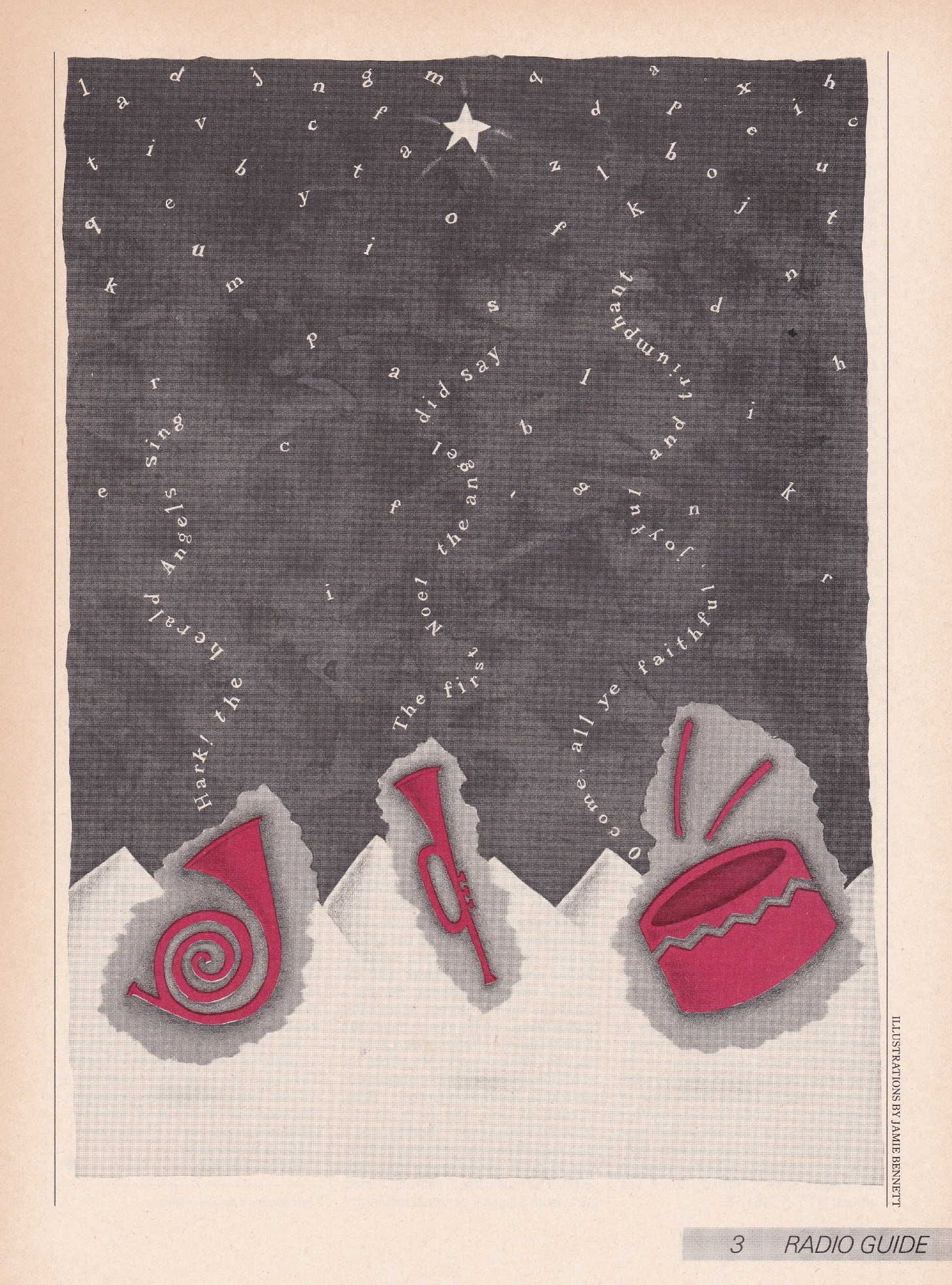
A close-up of a postcard Description automatically generatedRadio Guide, 5-12, December 1985: 3.

A book cover of a person in a black robe Description automatically generatedCat’s Eye. Writ., 1988. Dust jacket front.

A close-up of a person's face Description automatically generatedToronto Life, 31-11, August 1997: 79.

A newspaper article with a cartoon character Description automatically generatedSaturday Night, 112-6, July/August 1997: 12.

A newspaper with a cartoon of a person holding a flag Description automatically generatedSaturday Night, 114-10, December 1999/ January 2000: 37.

A book cover with a tiger face Description automatically generatedLife of Pi. 2001: Dust jacket front.

BENNETT Harold

BENNETT Harold

WORK:

CARTOONIST:

PERIODICAL GRAPHIC ANTHOLOGY:

Content story:

Active Comics, 27, No .date: “Rocky Summers”: 10-15.

BENGOUGH J. W.

BENGOUGH John Wilson


BENGOUGH J                                The Hecklers: 40

Considered by Peter Desbarats to be Canada’s first great political cartoonist, Bengough was also an author, journalist, editor, publisher, entertainer and politician. His career paralleled that of John A Macdonald, and as Diefenbaker was the necessary catalyst for Duncan Macpherson so Macdonald was the inspiration for Bengough’s greatest work. “The cartoons that Bengough produced on the subject of Macdonald and his political activities are regarded today as a document of that turbulent era. What he lacked in technical skill he made up for with clout.” [228-229]

He was born in Toronto April 7 1851 but grew up in Whitby. He began as a compositor at the Whitby Gazette but was soon writing articles for the paper. One effort was a serial called “The Murder’s Scalp, or the Shrieking Ghost of the Bloody Den”. Even at this time he was practicing his skills as a caricaturist. Regularly he purchased Harper’s Weekly to study the cartoons of the great American cartoonist Thomas Nast. Bengough later remarked “Nast had the field of political cartooning to himself for years and must have inspired thousands of boys as he did me.”

Bengough moved to Toronto where he became a junior reporter at George Brown’s Globe in 1871 or 1872. He took evening classes organized by the Ontario Society of Artists but he left before the end of the first term, “the copying of placid countenances of Greek Deities in plaster casts proved too much for me.”

Bengough found the countenance of Senator James Beattie proprietor of the conservative The Leader “an irresistible subject … and on a memorable day, I produced a pencilled portrait.” The day was memorable for Bengough because it introduced him to lithography. Sam Beattie the Senator’s nephew and business manager for The Leader took the drawing to a lithographer who had it reproduced. “The ease and accuracy with which the reproduction was done struck me with amazement but further it gave me an idea.” The idea was Grip.

At age 22, Bengough published the first issue of the satirical weekly Grip on May 24, 1873. Fortunately the Pacific Scandal involving John A. Macdonald erupted at the same time and the magazine’s future was secured. The name Grip was borrowed from the raven who regularly accompanied the central feeble-minded character of Charles Dickens’s novel Barnaby Rudge. The bird itself often appeared in Bengough’s cartoons. The magazine was probably modelled on Punch Magazine in Britain. Bengough greatly admired its cartoonist John Tenniel.

During Grip’s 21 year existence (it ceased publication in 1894) Bengough was its editor and virtually its only illustrator. To create the illusion there was more than one cartoonist he sometimes altered his style and used the name L. Côté. Was he attempting to make his readers think these were done by the notorious cartoonist Jean-Baptiste Côté ? This deception was so successful that a visitor once commented “L. Côté, that fellow can draw; no offence, you know but you really ought to model yourself on his style.”

About a year after Grip appeared Bengough made his debut as a public speaker in Toronto’s Music Hall at the corner of Church and Adelaide Streets. His main purpose was cartooning for the audience. The speech provided a framework for his drawings. He produced 15 to 20 sketches on the easel on stage, using black crayons on white newsprint, the caricatures were auctioned off at the end of the speech. Leo Bachle of “Johnny Canuck” fame would adapt this process into a successful performance of his own on cruise ships in the Caribbean. With the success of the first Chalk Talk Bengough embarked on a nine week tour of Canada from Rat Portage Ontario to Victoria B.C. with 34 stops in between. He continued his public speaking for more than thirty years in all parts of Canada as well as Australia, Great Britain, New Zealand and the United States.

As time progressed he often used the sketches as a vehicle to help express political or moral values. His values were those absorbed from contemporary moral reformers. [DB] He was a proponent of women’s suffrage, prohibition, tax reform, proportional representation and free trade.

He also held opinions that reflected the views dominant in the English Canada of the time. He supported Anglo-Saxon nationalism, English as the only official language of Canada. Although he deplored the social and economic conditions of the aboriginals he had only scorn for Louis Riel and strongly supported the death penalty for him.

He was active in politics. He was a prominent member of the Public Ownership League and the Canadian Peace and Arbitration Society. He was President of the Single Tax Society and served as a Toronto alderman. Peter Desbarats has commented, “In some respects, he was the Victoria predecessor of the politically aware journalists and cartoonists who appeared in Canada in the 1960’s.” [47]

Like Macpherson with Diefenbaker, Bengough found in Macdonald a subject that inspired his greatest cartoons. “Bengough … developed Macdonald’s frizzy hair, long nose and large mouth into national symbols. No other political figure came to life so vividly beneath Bengough’s pen; … . The Prime Minister still seems to live, breathe and hiccough in Bengough’s cartoons.” [49] “Bengough’s cartoons of Macdonald contain not only an element of good humour but something approaching grudging admiration, despite the overt political intent.” [50] “Other politicians in Bengough’s drawings usually play stock characters and assume symbolic postures. He was never able to breathe life into Alexander Mackenzie … who succeeded Macdonald …. Bengough supported Mackenzie politically but it was Macdonald who supported Bengough as a cartoonist.”

In 1892, Bengough gave up the editorship of Grip when new management appointed T. Phillips Thompson to the post. A year later Bengough returned to the post to try to save the magazine but it ceased publication in 1894.

Following the demise of Grip Bengough’s cartoons were published in the Toronto Globe, the Toronto Daily Star, The Montreal Star and Saturday Night Magazine. His work appeared in specialty publications like the Public in Chicago and the Square Deal in Toronto. He continued with his chalk talks but his most productive years were behind him.

He died in Toronto 2 October 2 1923.

WORK:

CARTOONIST:

BOOK GRAPHIC COLLECTION:

Content editorial cartoon

A Caricature history of Canadian politics. Ed., Douglas Featherington. Peter Martin Assoc. Ltd. 1974. Reprinted in an abridged version from A Caricature history of Canadian politics. 2 volumes, Toronto: 1886.

A Caricature history of Canadian politics, v. 1. The Grip Printing & Publishing Co. 1886.

A Caricature history of Canadian politics, v. 2. The Grip Printing & Publishing Co. 1886.

Cartoons Of The Campaign 1900, Contributed To The Daily Globe By J.W. Bengough. Poole Publishing Co., 1900.

The Grip Cartoons vols. I & II, May 1873 to May 1874, Rogers & Larminie, 1875.

Grip, v. 29: Magazines July 2, 1887 to December 17, 1887 bound together. The Grip Printing & Publishing Co.

ILLUSTRATOR:

BOOK TEXT AND GRAPHIC:

Content humour:

The decline and fall of Keewatin: or, the free-trade redskins; a satire,1876.

Flapdoodle: A Political Encyclopaedia and Manuel for Public Men. Ed., “An Ex-Minister”. Publisher unidentified. 1881.

Bengough’s popular readings: original and select, Toronto: 1882.

The prohibition Aesop: a book of fables, Royal Templar Book & Publishing Co. No date. (sometime between 1889 and 1897).

Motley: verses grave and gay, 1895.

The Up-to-date primer,1896. Reprinted with introduction by Douglas Feathering. 1975.

The gin mill primer, 1898.

A book of verse, 1902. The whole hog book: being George’s thoro’ going work “Protection or free-trade?” rendered into words of one syllable and illustrated with pictures; or, a dry subject made juicy, 1908.

Chalk talks, Toronto: 1922.

Content portrait:

Grip’s Almanac For 1891: “1890, or John A. Napoleon in the Zenith of His Glory.”.

WRITER & ILLUSTRATOR:

PERIODICAL TEXT:

Content reminiscences:

Canadian Magazine, LX-4, Feb. 1923: “Reminiscences Of A Chalk-Talker”: 295- 305.

PERIODICAL TEXT & GRAPHIC:

Content poem & sketch:

The Sunset of Bon Echo, 1-6, April/May 1920: “A Welcome to Horace Traubel”: 2-3.

EDITOR:

PERIODICAL GRAPHIC:

*Grip’s Comic Almanac For 1891.

PERFORMER:

Program:

All-Spice: Crayon and Comedy. Sketching and Entertainments at Chautauqua, July 17 and 19, 1888.

SOURCE:

Article book:

The Canadian Encyclopedia v. 1, Hurtig Publishers, 1985: “Bengough John Wilson.” Writ., Doug Fetherling: 162.

The Hecklers. Writ. & Ed.., Peter Desbarats & Terry Mosher. McClelland and Stewart Ltd., 1979: 31, 44-52, 228-229, 234.

Article periodical:

Canadian Magazine, LX-4, Feb. 1923: “Reminiscences Of A Chalk-Talker”: 295- 305.

Maclean’s Magazine, Mar. 1914: “The Cartoonmen of Canada.” Writ., John Edgecumbe Staley: 43-46.

Internet:

“Bengough John Wilson.” Writ., Ramsay Cook. Dictionary of Canadian Biography Online, University of Toronto/Université Laval, 2000: DB.

GALLERY:

J.W. Bengough

Library and Archives Canada/C-78604).

BELL-LUNDY Sandra

BELL-LUNDY Sandra


C:\Users\Robert\Documents\CANADIAN CARTOONING ILLUSTRATION and ANIMATION\IMAGE OF CARTOONIST OR ILLUSTRATOR\CARTOONIST &, or ILLUSTRATOR B\BELL, LUNDY, Sandra, Toronto Star, 2 Apr. 1995, C1.jpg

Photo, Tony Brock, Toronto Star, 2 Apr. 1995: C1.

“If I hadn’t enjoyed cartooning so much, there’s no way I’d have taken that much rejection [of her strip by newspapers] and kept going.”                                   Sandra Bell-Lundy, Toronto Star, 2 Apr. 1995: C1.

Born in St. Catharines Ontario.

This self-taught cartoonist, began by sketching cartoons of her friends in humorous situations. Out of this came “Between Friends”. Taking only one commercial art course, she learned to draw cartoons by analyzing them in the newspapers. She began sending samples of “Between Friends” to newspapers in 1986 with few results. She sent one sample to the editor of the St. Catharines Standard. He rejected it but told her to stay in touch after four years, he accepted a revised version.

In 1994, her cartoon strip, “Between Friends” was syndicated by King Features Syndicate. In 1995 it appeared in seventy-five newspapers including the Toronto Star, Spectator [Hamilton], Waterloo Regional Record.

A collection of the strips appeared as Death of a Saleswoman in 2015.

WORK:

CARTOONIST:

BOOK GRAPHIC COLLECTION

Content strip cartoon & Cover book front:

Death of a Saleswoman. Third Life Press, 2015.

 SOURCE:

 Article newspaper:

Toronto Star, 2 Apr. 1995: “Strip’s inspiration just between friends.” Writ., Nancy White. C1, C9.

GALLERY:

C:\Users\Robert\Documents\CANADIAN CARTOONING ILLUSTRATION and ANIMATION\IMAGE CARTOON B\BETWEEN FRIENDS S. Bell-Lundy Death of a Saleswoman.jpg“BETWEEN FRIENDS” by Sandra Bell-Lundy, Death of a Saleswoman: Back cover.

BELL Marc

BELL Marc

Born London, Ontario.

He received the 2010 Doug Wright Pigskin Peters Award for Hot Potatoe.

He is editor (2014) of Nog A Dod (Prehistoric Canadian Psychdoolia).

WORK:

CARTOONIST & ILLUSTRATOR:

BOOK GRAPHIC:

Content novel & Cover book front & back:

Stroppy. Drawn and Quarterly, June 2015.

BOOK GRAPHIC COLLECTION:

Content story & Cover book front & back:

Pure Pajamas. Drawn and Quarterly, August 2011.

BOOK TEXT & GRAPHIC ANTHOLOGY:

Content story:

Drawn and Quarterly: Twenty-Five Years …. Drawn & Quarterly, May 2015:                              “Gnewest Mahtchoe”: 478. First appeared in Hot Potatoe, 2009.                                      “Illusztraijuns: an excerpt”: 479-481. (First appeared in Illusztraijuns, 2009)                      “Shrimpy Is In Trouble”: 476-477.

PERIODICAL TEXT & GRAPHIC ANTHOLOGY:

Content story graphic:

Canadian Notes & Queries, 93, Summer 2015: “The North Wing: Selections from the Lost Library of CanLit Graphic Novels Episode Fourteen, Jim Munroe’s, Angry Young Spaceman, as adapted by Marc Bell.” 70-71.

Descant, 164, Spring 2014: “Broughton Bean Bandits”: 184-187.

SOURCE:

Article book:

Drawn and Quarterly: Twenty-Five Years …. Drawn & Quarterly, May 2015: “So Far Out, You Can’t See How He Got There: an appreciation.” Writ., Lee Henderson: 473-474.

Article periodical:

Descant, 164, Spring 2014: 250.

GALLERY:

C:\Users\Robert\Documents\CARTOONING ILLUSTRATION ANIMATION\IMAGE BY CARTOONIST\B\BELL Marc, Stroppy, 2015, fc.jpgStroppy. 2015: Front cover.

BELL John

BELL John

C:\Users\Robert\Documents\CARTOONING ILLUSTRATION ANIMATION\IMAGE OF PERSON\B\BELL John, Invaders from the North, 2006, dj.jpg                                        Invaders from the North, 2006: Dust jacket.

Born in Montréal and raised in Halifax.

He co-compiled CDN SF&F: A Bibliography of Canadian Science Fiction and Fantasy, and co-edited Visions From The Edge: An Anthology of Atlantic Canadian Science Fiction and Fantasy. In 1984, he edited The far Islands And Other Tales Of Fantasy. He was an associate editor of the Ottawa based poetry magazine ARC, and editor of the book Canuck Comics.

When an archivist in the manuscript division of the National Library of Canada he curated of the show Guardians of the North: The National Superhero In Canadian Comic Art in 1992.

WORK:

EDITOR:

BOOK TEXT:

Canuck Comics, Montréal: Matrix Graphic Series, 1986.

PERIODICAL TEXT ANTHOLOGY:

Borealis, 1-1 Summer 1978. Northern Star Press

Borealis, 1-2, Spring 1979. Northern Star Press

WRITER:

BOOK TEXT:

Content history:

Invaders Of The North. Dundurn Press, 2006.

PERIODICAL TEXT & GRAPHIC ANTHOLOGY:

 Content article:

 Borealis, 1-2, Spring 1979: “James DeMille: Canadian Pilgrim Through Space and Time.” Illus., Larry Dickison: 7-9.

Content story graphic:

Orion, 1-2, 1982: “Captain Canduck: The Towering Imbrogio.” Illus., Owen Oulton: 49-53.

 SOURCE:

 Article book:

Canuck Comics. Ed., John Bell. Matrix Graphic Series,1986: “John Bell”: 152.

 Article newspaper:

Toronto Star, 1 Feb.192: “The Great Canadian Superhero.” Writ., Henry Mietkiewicz: J1+.


BELL Ian

BELL Ian

WORK:

ILLUSTRATOR:

DISC AUDIO 33 RPM:

Artwork:

Atlantic Fiddling. Various Artists. Toronto: CBC Merchandising, 1979. LM 470.

Stories For Christmas: Read by Alan Maitland on CBC Radio’s “As It Happens. Alan MaitlandToronto: Canadian Broadcasting Corp./ Société Radio-Canada, 1980. PR-15.

The Best of Touch The Earth. Folk Performers on Radio Series. Toronto: Canadian Broadcasting Corp./Société Radio-Canada. 1981. LM473.