YELLOW SUBMARINE
See DUNNING George
WILLIAMS Richard
 Bright Particular Stars. Mosaic Press, 2016:151
Born 1933 in Toronto.
He came from a visual arts oriented family. His mother Kay was an illustrator and his uncle Ken Bell was a prominent photographer author of books like Not In Vain and The Way We Were. Martin Hunter author of Bright Particular Stars maintained that from an early age Richard was already drawing cartoons of Donald Duck, Bugs Bunny etc that were as good as those in the comic books. Richard and Martin met when they were five years old, became childhood friends and although their career paths diverged, remained in contact for the rest of their lives. In addition to cartooning they immersed themselves into all forms of popular entertainment of the day movies of every kind, and radio programs They began writing small plays, the first was one called Cat and Dog. These they performed at the groups they belonged to including Wolf Cubs at church.
Now in Northern Technical School later called Northern Secondary School Richard became interested in Dixieland Jazz, learned to play the coronet and soon was playing with other young musicians. He and Martin soon combined music and comedy skits to produce the Ivan Yurpee Show. Organizing bands to play jazz was to become a lifelong side activity of Richard.
At age fifteen, in the summer he went to California and looked up one of his parent’s acquaintances who was a draughtsman at the Disney Studios. Through this connection, the company allowed him to hang around the studio and learn what he could. When he returned home in the fall, he enrolled in the Ontario College of Art (OCA) in the commercial art courses. Then in the summer before his last year at OCA, he went to Mexico and was transformed when he saw pre-columbian art and the work of the great Mexican muralists. He returned to OCA and transferred from commercial to fine art, in which course he did some remarkable lithographs. He also studied the great figures of literature, classical music especially Beethoven and of fine art particularly Goya & Rembrandt. He continued playing the coronet and joined a small combo of college art students that included Michael Snow on piano and Graham Coughtry on trombone, both of whom would become prominent in the field of fine art. He finished OCA but did not graduate because he has switched courses.
While he was pursuing his studies at OCA, television production began opening up in Toronto and animated commercials were in demand. Drawing on his experiences at Disney, he began working at Graphic Associates, a studio founded by George Dunning and Jim McKay formerly of the National Film Board and located in Kleinburg. This pursuit proved quite lucrative for him.
When he finished OCA, and in 1953 went to Ibiza Spain it was to pursue the life of a fine artist, but even then he was still attached to animation, drawing story boards for what would become The Little Island. At the same time he made a series of paintings of circus performers which many years later would find life as a film. In 1955 he moved from Ibiza to London England apparently having lost an interest in pursuing a life in fine art.
By chance he met George Dunning who had just set up a studio in London for United Productions of America (UPA). Dunning hired him and he returned to creating animated television commercials for which he won innumerable prizes. He continued to work nights on Little Island with the support of Bob Godrey British animator who provided him with factilities and camera in return for work. In 1958, he completed Little Island which is a satirical story about three individuals on an island each obsessed with a single ideal, Good, Truth and Beauty but unable to see the other ideals. For the film he won the British Academy of Film & Television Arts (BAFTA) animated film award.
According to Martin, while working in Dunn’s studio he developed an animated short called The Apple based on the story of William Tell. It won second prize at the Annecy International Animation Film Festival in France. He followed this with Love Me, Love Me, Love Me (1962), about a man craving for attention. The success of this film allowed him to start his own company Richard Williams Animated Films. at Soho Square in London. He did this without telling George Dunning. The resulting split was acrimonious and the two never spoke to each other again. In his own studio, he continued to do television commercials and win numerous awards. Another film A Lecture On Man: Diary Of A Mad Man was issued in 1965.
Now he added animating movie title sequences for What’s New Pussy Cat? (1965) and A Funny Thing Happened On The Way To The Forum (1966) and Return of the Pink Panther (1975) to his repertoire. About these sequences He later said: “The fact is we were willing to do anything they asked for. We were totally eclectic, and the ironic thing is this is now seen as my style.”
Another success was his animated sequences for Director Tony Richardson’s live action film The Charge Of The Light Brigade (1968). For this he adopted the style of George Cruikshank (1792 to 1878) a British social caricaturist and book illustrator, in order to give the film a Victorian look.
He exploited this approached again in a half hour animated version of Charles Dickens’s A Christmas Carol (1971). For this film he based the animation on the original novel’s engravings. This feature won him his first Academy Award in 1972. It was also a point at which he turned from caricature to a more realistic style. According to Karen Mazurkewich this change was precipitated by Chuck Jones executive producer on Christmas Carol. He introduced Richard to veteran animators like Ken Harris and Abe Levitow.
In the mid 1960’s he embarked on a project that would dominate his thoughts for the next three decades. It was to be an animated feature film based on the tales of character Mulla Nasruddin, based on an actual Mulla Nasruddin who was a 13th century Seljuq satirist. It was titled Nasruddin. The film evolved from a series of storybooks that Richard illustrated in 1964. John Culhane a former Newsweek columnist worked with Richard on the original script.
One might say he was obsessed with the project. As Martin Hunter described it:
“Dick would work around the clock making commercials for six months, and then turn the studio over to producing perhaps five or ten minutes of The Thief, until he had exhausted his resources and had to turn around and make more money.”
About 1973, after a dispute with his partners, he discarded most of the original drawings, eliminated the Mulla Nasruddin character and changed the feature into a romance/adventure about Princess Yum Yum, Tack the cobbler, the evil Grand Vizier ZigZag and a a mute thief obsessed with stealing three golden balls which protected the city from invasion. The title of the new work was The Thief And The Cobbler.An example of his meticulous attention with this project is revealed by the fact he spent years perfecting a scene where the villain ZigZag shuffles a deck of cards.
He had been operating two offices one in London and one in Los Angeles. In his efforts to fund The Thief and the Cobbler, he spent more and more time in Los Angeles.
In the 1977 he agreed to work on the full length feature Raggedy Ann & Andy. He moved to the U.S. and put The Thief on hold. The partnership with the producers did not last as his stress for quality clashed with their cost and scheduling objectives. He left before the project which achieved neither critical nor financial success was completed. He returned to London and resumed work on commercials and The Thief, and closed his studio in Los Angeles.
In 1986, he became involved in Who Framed Roger Rabbit project. He signed a two picture deal which first included Roger Rabbit and then The Thief. For Roger Rabbit He won an Academy Award for animation and one for life time achievement. It is also considered a turning point for animation which at the time was fading into obscurity.
He never completed The Thief and the Cobbler, after conflicts with the producers he was removed from the film in 1992. Miramax a Disney held company then acquired rights to it and reworked it completely, and finally released it in 1995 as Arabian Knight. It was completed and released far short of his vision for it. Karen Mazurkewich called this final version “… a brutal rape of William’s vision.” “Envisioned as a film told through moveme3nt and with an economy of language, The Thief and the Cobbler was suddenly a cacophony of noise – narrative jokes and babble.”
After the collapse of the The Thief and the Cobbler project, Richard closed his studio in London and moved to Salt Spring Island off the British Columbia coast. Here he began a new hand animated film based on Aristophanes’ comedy Lysistrata. His wife Mo, a British film maker, could not realize her ambitions in this remote location and so in 1997 they moved to a village on the west coast of Wales, where he continued with his work on Lysistrata. While there he wrote a book The Animator’s Survival Kit. Published by Faber & Faber in 2002, it was a how to book that became a key reference book for animators.
He and his wife next moved to Bristol where from 2008 he worked as artist in residence at Aardman Animations. In 2010, he completed a nine minute film called Circus Drawings based on the sketches he made of clowns and performers at the local circus while he was living in Ibiza in the 1950’s.
On 10 December 2013, a “director’s cut” of The Thief And The Cobbler, a work print of Richard’s original version including roughs was screened in Los Angeles, but a finished version of the film was never made. However, according to Martin this version has been shown on the internet in a cut that more or less follows Richard’s original vision. The sound track is now the sound track that he recorded. It roughly shows the narrative arc that he envisioned, and it shows the numerous elements of his style.
Finally in 2015, the first six minutes of Lysistrata, the animation he began on Salt Spring Island was shown under the title Prologue. Lysistrata like The Thief And The Cobbler it was never completed.
Richard died in Bristol of cancer 16 August 2019.
SOURCE:
Article book:
Bright Particular Stars. Mosaic Press, 2016: “High Flyer: Richard Williams.” Writ., Martin Hunter. 151-168.
Cartoon Capers. McArthur & Co., 1999: “Richard Williams – The Prophet.” Writ., Karen Mazurkewich: 223-242.
Take One’s Essential Guide To Canadian Film. Ed., Wyndham Wise. University of Toronto Press, 2001: “Williams Richard”: 223.
The World of Animation. Writ., Stephen Cavalier. University of California Press, 2011: 17.
Internet:
https://en.wikipedia.org/wiki/Richard_Williams_(animator). Accessed 20 June 2020.
DUNNING George
Born, 1920 in Toronto.
As a young man he worked under Norman McLaren at the National Film Board where he made a number of shorts including Grim Pastures (1944), Three Blind Mice (1945), Cadet Rouselle with Colin Low (1946), and Family Tree with Evelyn Lambart (1950).. In 1949.
He and fellow N.F.B. alumni Jim McKay began one of Toronto’s first animation studios called Graphic Associates. This studio employed future big names like multimedia artists Michael Snow, Joyce Wieland and iconic animator Richard Williams. It was also a hangout for future journalist and television celebrity Pierre Berton and prominent television broadcaster Lister Sinclair.
He then worked briefly for United Productions of America (UPA), in New York before moving to London England in the mid 1950’s where he set up a studio for UPA to do animated commercials. He also produced a variety of feature work including The Wardrobe (1959), The Flying Man and The Apple both in 1962 . The Flying Man won first prize (then called the Grand Prix) at the 1962 Annecy International Animation Film Festival in France. In 1966, he did a BBC-TV animation series based on the Beatles, which led to the iconic film The Yellow Submarine (1968). Other films were Canada Is My Piano (1967) Moon Rock ((1970) and Along These Lines (1974)
He died 1979.
SOURCE:
Article book:
Bright Particular Stars Mosaic Press, 2016: “High Flyer: Richard Williams.” Writ., Martin Hunter: 156.
Take One’s Essential Guide To Canadian Film. Ed., Wyndham Wise. University of Toronto Press, 2001: “Dunning George.”
The World of Animation. Writ., Stephen Cavalier. University of California Press, 2011: 17.
ANWAR Sanya
Originally from Winnipeg, now (2019) a Toronto based freelance writer and illustrator. Known for cartoon story “1001”.
WORK:
ILLUSTRATOR:
PERIODICAL GRAPHIC:
Cover front:
Agents Of P.A.C.T. 1, January 2017. Chapterhouse Comics.
THOMAS Andrew
WORK:
LETTERER:
PERIODICAL GRAPHIC: Published by Charterhouse Comics.
Content novel:
| Agents Of P.A.C.T. …: Col., Caroline Nolasco. Ed., Allison O”Toole. Chapterhouse Comics |
| 1, Jan. 2017: “Ch., 1”. Writ., Kalman Andrasofszky & Blake Northcott. Illus., Federica Manfred..
2, May 2017: “Ch., 2”. Writ., K. Andrasofszky & B. Northcott. Illus., F. Manfred. 1-3, May 2017: “Ch., 3: Breach”. Writ., Maggie Alexander & K. Andrasofszky. Illus., F. Manfred. Assist., David Namisato. 1-4, Apr. 2017: Ch., 4: Alone”. Writ., M. Alexander & K. Andrasofszky. Lay., F. Manfred. Fin. Art., D. Namisato & Christopher Johnson. |
| Fallen Suns …: “…” Writ., Van Jensen. Co-illus., Neil Collyer & Leila Del Duca. Col., C. Nolasco. | |
| 1-1, Sept. 2017: “Ch., 1: Seed”.
1-2, Oct. 2017: “Ch., 2: Surrender”. |
1-3, Nov. 2017: “Ch., 3: Escape Velocity” |
NORTHCOTT Blake
Born: Bramalea Ontario.
This novelist has written a number of sci-fi novels including the ”Vs Reality” series, the “Area Mode Saga” series and the “North Valley Chronicles” series, . She has also written writes graphic stories for DC Comics, Chapterhouse Comics, Heavy Metal Magazine, and others.
WORK:
CO-WRITER:
PERIODICAL GRAPHIC:
Content novel:
| Agents Of P.A.C.T. …: “Agents of P.A.C.T…” Co-writ., Kalman Andrasofszky Illus., Federica Manfred Let., Andrew Thomas. Col., Caroline Nolasco. Ed., Allison O”Toole. Chapterhouse Comics | |
| 1, Jan. 2017: “Ch., 1”. | 2, May 2017: “Ch., 2”. |
AGENTS OF P.A.C.T.
This serial lasted only four issues and so into what kind series it would have matured is not known. However, P.A.C.T. itself and some of the characters have much longer histories which we will explore later.
The serial has two narratives running parallel. The first acts as a three-page prologue in each of the four issues. Its object is to provide background information about Manon Descamps aka La Fleur De Lys and P.A.C.T. The time is 1976 Manon Deschamps is introduced as Canada’s most decorated athlete, an international singing sensation and a guardian. We jump to RCMPSS headquarters in Ottawa where agent Joseph Evans who has been investigating a “Stardance event” is being told he will not receive funding, due to lack of evidence, for an expedition to Melville Island to carry on his investigations. Enter Manon Deschamps. She’s impressed by his work on the “Stardance” file and will arrange to get funding for the expedition. But, before they do, they must go to Makkovik Newfoundland to investigate some disappearances. The citizens of Makkovik are decidedly uncooperative, they deny there have been any disappearances, but just as the situation is getting tense between the bar clientele and the two, an alien appears. The Makkovik inhabitants have been protecting it from snoopers. The disappearances were other aliens simply deciding to go home. Marion is aware of the dangers that aliens face from humans who want to destroy those who are different. She wants to form an organization that will create understanding between humans and aliens. Therefore, Manon, Joseph and the alien form a pact to build an organization with such goals. Probably if the series had continued this prologue would have completed the background that would have brought us up to the current story.
The main story which follows presumably occurs in the present. A short introduction on the inside front cover tells us “Captain Canuck” aka “Tom Evans” has walked away from “Equilibrium” and his unreliable brother “Michael Evans” now runs it. Manon Descamps is Director of P.A.C.T. the Paranormal Investigation Arm of C.S.I.S located in Montreal. This organization’s mandate is to protect the earth. In response to the rising number of breaches, it was organized to understand and contain the super beings and extraterrestrials making the breaches. To accomplish this objective, “Manon” is recruiting a team of costumed agents.
The story opens with “Manon” and a recruit “Marla Ritchie” flying into “Alpha” on Melville Island the former headquarters of the deceased “Mr. Gold” who we are told experimented on “Marla” and others who are now dead. A team is attempting to clean up the liquid gold spread over the environment. “Marla uses her powers to initially begin cleaning up the gold then a voice and a pain in her head causes her to lose control and the gold splashes back onto the landscape. The scene switches to a giant crater or “Breach” at Cold Lake Alberta. Dr. Cape informs “Manon” these “Breaches” have been occurring all over the world. Switch to a ship on the Sea of Japan. A costumed alien (?) super being (?) appears. Switch to P.A.C.T. headquarters in Montreal. We learn that in addition to coping with “Breaches” there is tension between P.A.C.T. Equilibrium and H.A.L.O, Phillip Wise aka “Northguard” also of P.A.C.T. confiscated Equilibrium’s “proprietary tech”. “Manon” will not work with H.A.L.O. a U.S. organization. Jump to Equilibrium headquarters Resolute Bay Nunavut. Manon meets with Michael Evans. “Red Coat” part of the Equilibrium appears. We learn that “Equilibrium” has entered a partnership with “H.A.L.O.”. “Marla” accidently reveals her powers coming up against Amber-Lynne leader of “Michael’s” militia. The meeting breaks up. Switch to Mount Babel Quebec and “Le Jardin” a P.A.C.T. facility that studies and contains the extraterrestrial phenomenon and paranormal super being breaches that its investigations” reveal. We find this facility is operated by the same “sentient light being” called Vin that we encountered in the prologue. We learn more about H.A.L.O. It is the U.S. counterpart of P.A.C.T. but has a different ideology in that it eliminates anything that is unusual or different. The tension is personal with “Manon” who lost associates close to her because of this organization. Vin describes Marla as being bonded to an extra-dimensional symbiotic liquid metal which gives her, her extraordinary abilities. Another jump to a scene between “Manon” and “Redcoat”. We learn that Manon has a file that Redcoat doesn’t want revealed to Michael and that Manon is using it to manipulate Redcoat. Final jump, there is a “Breach” in the Venetian Islands Florida caused by the same costumed alien (?) who appeared in the Sea of Japan.
The P.A.C.T. team and “Red Coat” arrive at the devastated aftermath. They are reminded they are in “hostile territory” and must collect data and depart before the American authorities arrive. Marla then the team are distracted from their work in order to rescue victims much to the chagrin of Red Coat who is also part of the team. A team from Equilibrium led by the militia leader previously mentioned now arrives. Another fight between him and Marla follows. The conflict results in damage to a building so severe it begins to collapse. Marla uses her symbiotic liquid metal powers to support it. Amber-Lynne attempts to destroy Marla while she is occupied supporting the building, but Redcoat intervenes. Marla does not have enough metal (gold) to hold the building and it collapses on her and Dr. Ron Cape who had also been defending her. At Ron’s suggestion Marla manages to pull gold out of the crater and extricate them from the rubble. The Equilibrium team has left the scene and P.A.C.T. do the same. Next, in order to strengthen the team Manon sends Redcoat to recruit Yvette Arsenault aka Kebec who previously worked with Equilibrium. She immediately joins. Cut to P.A.C.T. headquarters. Dr. Ron Cage has discovered that each breach occurs at a site where Captain Canuck formerly used his powers. It appears the creature of the breach is searching for Captain Canuck. The next site is predicted to be Equilibrium headquarters.
Next scene is Redcoat and Kebec are trying to infiltrate Equilibrium – to reach Parminder Patel – to warn them of the incoming breach. Switch to a scene where Manon previously assigned Kebec a secret mission, unknown to the warning team, to infiltrate the Equilibrium mainframe and upload a virus. In short Manon is asking Kebec to sabotage her former comrades. Back to main action, Redcoat and Marla who is now called Crucible are discovered and captured by Michael who of course won’t listen to their warning of an incoming breach. A fight erupts between the Redcoat and Marla team who is more than willing to fight and Michael’s militia. Switch to the appearance of the previously mentioned alien who materializes before Parminder Patel and attempts to speak to her. Kebec appears on the scene and tells Patel to run while she attacks the alien. In the process Kebec is injured. The alien breaks into the main room and Marla and Amber-Lynne ally to fight the alien. The alien prevails. Gold appears and the alien moves to it Marla grabs him and they both disappear. Redcoat goes to the aid of Kebec and discovers the virus stick that she is carrying.
This episode commences with Manon and a team now at Equilibrium observing the destruction. Redcoat tells Manon that both missions, the rescue mission and the “… clandestine backdoor rubbish you nearly got Kebec killed for.” are failures. She goes on to inform Manon that Kebec is stable and that Marla has disappeared through a portal. Switch to Marla in another dimension. She is experiencing the voice in her head again. This dimension is a tunnel to Aleph on Melville Island where Eldon is cleaning up the gold mess. Marla and the alien crash there. Marla finds herself in a dream (?) surrounded by individuals in gold condemning her as weak and ineffective, demanding she use them, set them free. Then she is conscious at Alpha. The alien runs towards the clean up crew. Eldon dispatches they and confronts the alien. Marla from behind entangles the alien in gold threads which also entangle Eldon. The conflict between Marla and the alien continues. The question is, is the alien good or bad? The voices inside Marla think so and want her to destroy this “impurity” but there is another voice Manon is talking with Marla. Marla resolves her inner conflict and does not destroy the alien because “That’s not what P.A.C.T. does.” The alien escapes into another dimension. But Eldon has been infected by the gold. Marla goes back into the realm of the gold people, confronts and destroys the leader and assumes leadership of the rest. The first order of business is to release Eldon from his gold infection. In a final wrap up, Redcoat rejects Manon and after chastising him returns to a relationship with Michael. It appears that Kebec has also returned to Equilibrium. Only Marla is left on the team. Manon intends to rebuild, but the serial ends here.
***
One major characteristic of this serial is that it is saturated in conflict. There is the implied conflict of an invasion by aliens and super beings, conflict between P.A.C.T., Equilibrium and H.A.L.O., conflict between the members of P.A.C.T., and the inner conflict of Marla. With so many conflicts and the continual jumping from location to location the story line is fragmented and difficult to follow. One is reminded of the first law of commercial television “Thou shalt give them enough jolts per minute or thou shalt lose them” as stated in T.V. critic Morris Wolfe’s book Jolts. The corporate organization of the creators also leads to discontinuity in the visual aspects and less obviously in the written section. It cannot get away from the superhero model which has all powerful males saving weak and ineffective females. Here the model is reversed but is now uninteresting to the other half of the potential readership. Using a model of male/female partnerships would have freed the serial from this cliché.
It had promising initiatives which would have been interesting to watch develop. One was the liberal use of francophone words and phrases which was not only appropriate for the Canadienne characters but may have also been employed to reflect the bilingual nature of Canada. Another interesting feature was the ideological conflict between P.A.C.T. which “respects all life” and “stands for containment” and H.A.L.O. which prefers to eliminate the “different”. Were the creators defining their vision of Canada’s apparently increasing inclusive and accepting attitudes compared to the Americans’ increasing insularity and fear of the other?
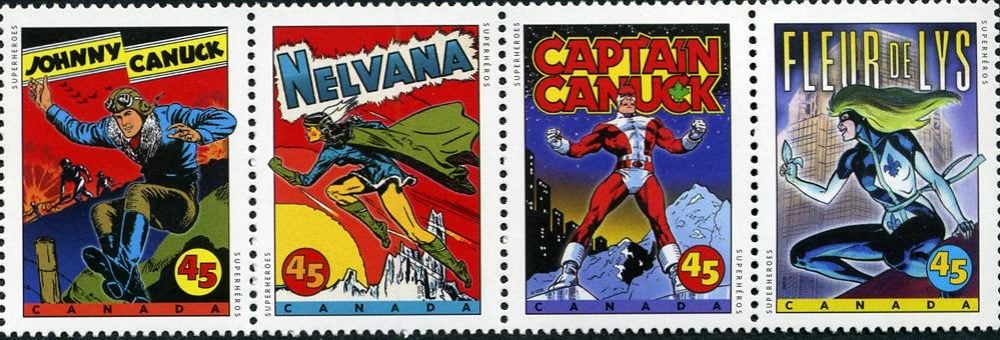
Another interesting aspect of this serial was its recycling of characters and institutions from other sources. Manon Descamps aka Fleur De Lys, “Phillip Wise” aka “Northguard” and P.A.C.T. all originated in the “Northguard” serial created by Mark Shainblum and Gabriel Morrissette, although P.A.C.T. originally Progressive Allied Canadian Technologies created by a group of Canadian scientists has been changed to “Paranormal Activity Containment Team” created by “Fleur De Lys”.
“Redcoat” and “Kebec” both created by Richard Comely appeared in issue 2 of Captain Canuck when the serial first appeared. Both characters were at that time, were otherwise nameless males. They have been transformed into females Olivia Wallace-Yeats and Yvette Arsenault respectively. “Michael Evans” and “Equilibrium” also come from the “Captain Canuck” series. This presents another difficulty for readers. They have had to read the Captain Canuck periodicals in order to understand much of the background information occurring in Agents of P.A.C.T.
MEDIUM:
PERIODICAL GRAPHIC: Published by Chapterhouse Comics. Coloured cover & content.
Cover front:
| Agents Of P.A.C.T. …. Illustrator:… Single & multiple covers per issue. | |
| 1, Jan. 2017: A, Sanya Anwar.
2, May 2017: A, Bella Rachlin. 1-3, March 2017: A, Bella Rachlin. |
1-4, Apr. 2017: A, Bella Rachlin. B, Alex Perkins (variant cover). |
Content serial:
| Agents Of P.A.C.T …: “Agents of P.A.C.T. …”. Writ., Kalman Andrasofszky & Blake Northcott. Illus., Federica Manfred. Let., Andrew Thomas. Col., Caroline Nolasco. | |
| 1, Jan. 2017: “ …Ch., 1”. | 2, May 2017: “…Ch., 2”. |
| Agents Of P.A.C.T …: “Agents of P.A.C.T. …”. |
| 1-3, May 2017: “…Ch., 3, Breach”. Writ., Maggie Alexander & Kalman Andrasofszky. Illus., Federica Manfred. Assist., David Namisato.
1-4, Apr. 2017: “…Ch., 4, Alone” Writ., Maggie Alexander & Kalman Andrasofszky. Lay., Federica Manfred. Fin. Art., David Namisato & Christopher Johnson. |
SOURCE:
Book:
Jolts: The TV Wasteland and the Canadian Oasis. Writ., Morris Wolf. James Lorimer & Company Publishers, 1985: 14.
GALLERY:
 Agents of P.A.C.T., 1, Jan. 2017: Front cover. Top to bottom, Manon Deschamps, Redcoat, Crucible, Kebec. Illus., Bella Rachlin.
 Agents of P.A.C.T., 1-3, March 2017: Front cover. Top to bottom, Michael Evans, unknown, Redcoat, Manon Descamps. Illus., Bella Rachlin.