FRISE James Llewellyn
 City Lights Magazine 1-3, January 1935: 14.
“Modest, open handed, and seemingly carefree, he drove himself relentlessly, but never did Jas Frise – as he signed his first sketch- draw, trace or paint an unkind line or speak a mean word about anyone.” Unknown, “Birdseye Center Revisited.
“… Jim Frise was recording on his drawing board the agreeable homey events of small town Canada in a way that had not been done before and certainly has never been done since.” Gordon Sinclair. The Times [Port Perry] 18 October 1984.
“A self-taught Canadian cartoonist-illustrator … Jimmie Frise created one of the enduring institutions of the Canadian popular arts …” Peter Harris, The World Encyclopedia of Comic: 266
Frise is the greatest of our story telling cartoonists, as opposed to panel or editorial cartoonists who constitute another form, that anglophone Canada has produced. His only equal is francophone cartoonist Albert Chartier. His “Birdseye Center” has a diversity and complexity that given the confines of the cartoon strip is remarkable. It was an icon feature in the Star Weekly. As revealed in his illustrations for Gregory Clarke’s columns, his abilities to create an accurate likeness of a person while at the same time revealing character through a deft line showed him to be a superb caricaturist. The team of Clark and Frise created a second icon in the pages of the Star Weekly. According to Ross Harkness, Frise became the most famous artist and cartoonist The Star ever had and possibly the most widely known in Canada. As Ed Furness, co-creator of “Freelance” once remarked, any young aspiring cartoonist of the time in Canada attempted to copy Frise’s style.
Born in 1891 on a farm at a crossroads known as Finger Board on Scugog Island in Scugog Lake near Port Perry, Ontario, James Frise was the only son, of John and Hanna Frise. According to Greg Clark his long time friend and partner, Frise’s superb drawing talent appeared at a very early age. His school books were littered with sketches and even a dusty window pane was a page on which to sketch a local character. Teachers and others told him he should study art, but he never did. In his own words Frise described his only venture into formal art training after his arrival in Toronto.
“At the same time, I enrolled in the Ontario College of Art but I only went one night, because it was winter, and there were free skating rinks in Toronto, and I met a fellow who was one of the pioneer skiers in Toronto. He wanted me to come skiing. So all the education I had as an artist was one night at the Ontario College of Art and we didn’t get past enrolling and being sold some paper and pencils.”
At 19 years, in 1910 he headed to Toronto to pursue a career in illustration. He got a job with Rolph, Clark Stone an engraving company, ruling squares on Canadian Pacific immigrant-settlement maps of Saskatchewan. Frise’s ironic sense of humour reveals itself in his comments about the job:
”I started work making small squares on big stones. They were homestead maps. Lithographed. I drew the small squares that showed the homesteads. The ones that were shaded were taken up. The unshaped ones were open for settlement. They were in Alberta and Saskatchewan. Being born and raised on the farm, Rolph Clark knew I could put feeling into these squares.”
Six months later, the map project was completed, and Frise was let go, he continued.
“… I had no idea Rolph Clark were dissatisfied with my squares. I was putting all the feeling I could in them. I was outfitting each square in my mind’s eye, with tumble down farm houses and shabby sheds and skinny cattle hid behind stables as wintry gales swept across the map of Alberta. I could see farmers on the little squares buried in their lonely homes, or thrusting their way through the deep snow to thaw out a pump. I guess art is a retreat from farming, maybe. At any rate, unknown to me Rolph Clark were about to give me the bun ”
In this description of farm life, we see another characteristic that appeared in “Birdseye Center” Frise never sentimentalized rural life.
Before Rolph Clark Stone let him go Frise tickled by a letter from a farm-hand challenging the editor of The Star to a milking contest, Frise a drew a cartoon showing the editor trying to milk a very upset cow from the wrong side. He mailed the cartoon to the Toronto Star and although it appeared in the paper he received no reply. Frise hadn’t included his address and so the paper didn’t know where to mail his cheque. However, the next day he came to the office with the clipping in his hand and was immediately hired.
About 1911, Frise, now a young man of twenty, was retouching photos for the Daily Star when he began illustrating the whimsical columns written by Greg Clark a reporter also at the Star.. Thus began a partnership that would last thirty-eight years and end only with Frise’s death. According to Barker, he was also drawing cartoons for small town papers. Apparently one of these appeared on 13 April 1913 in the Owen Sound Sun.
In 1916, Frise moved to Montreal to work for another engraving company but after a few months left the job to enlist as a gunner in the Canadian Field Artillery. He lost part of his left hand at the battle of Vimy Ridge when an enemy shell hit close by killing two pack horses he was using to deliver ammunition to his battery. It appears that Frise did a series of war front cartoons for newspapers on the home front. “Sketches From the Canadian Front” appeared in the Brantford Courier in 1918 before the end of the war. It is possible that it was some of these cartoons that were used for Battery Action.
Frise along with Clarke who had also enlisted returned to the Toronto Star and both were the first staff men to be transferred from the Daily to the Star Weekly.
At first Frise drew a half-page panel called “Life’s Little Comedies” modelled on a popular syndicated U.S. feature but it dealt with city people and city situations which were not his experiences. Frise never liked it and it was not popular with the readers. In 1920 he began “Birdseye Center”: a weekly half-page cartoon based on village life. By 1923 “Birdseye Center” and its characters were known all over the country and in 1926 readers of the Star Weekly voted it their favourite cartoon.
At the same time Clarke and Frise began a feature in which Clarke wrote a half page of text and Frise drew a half page illustration. Clarke’s whimsical humour about characters he met developed into weird or humorous adventures that were pure fiction. Under Editor H. C. Hindmarsh’s encouragement the Clarke-Frise effort flowered and eventually became the most popular feature in the Star Weekly. These columns and illustrations have been reproduced in a series of books, but the illustrations in the books never approach the gorgeous rendition of the originals.
The pervasiveness in Canadian society of his characters cannot be over estimated. CCM and Dunlop Tires used them extensively for their advertisements, chocolate bar companies used them on the gratuities, indeed the list of companies using them is almost endless. They appeared on dust jackets for school text books, jigsaw puzzles etc. The work that Frise turned belies his reputation as a laid back relaxed person.
In December 1947 Frise and Clarke left the Star Weekly and joined the Standard [Montreal] which was being transformed into Weekend Magazine. They agreed to move to the Standard for only slightly more than they were getting from the Star Weekly. However, they would share in income from syndication, something the Star never allowed its staff.
To understand this change one must go back to 1945. Clarke’s son was killed in action in 1944 and Clarke’s wife suffered a nervous breakdown. He and his wife went to visit their son’s grave in Europe. For the return trip home Clarke asked that passage be arranged with the RCAF which controlled all flights. Authorization was not received for ten days which puzzled Clarke since he knew that it was usual that authorization was granted immediately upon The Star’s request. In addition when Clarke got home he asked that the “Greg and Jim” feature be dropped for two weeks since he did not want readers to think he was still writing humorous nonsense just after his son was killed. (In fact The Star had been running reprints for several weeks.) Hindmarsh refused to drop them. This created bitter feelings in Clarke. A year later Clarke discovered that the delay in authorization had occurred because The Star had merely requested his passage home without indicating any compassionate grounds. Hindmarsh had brusquely refused to discuss accelerating the request and it had been Norman Robertson, Undersecretary of State for External Affairs that made the arrangements. This was enough Clarke told Hindmarsh he was quitting. Hindmarsh simply told Clarke he would buy the “Greg and Jim” feature and pay Clarke an amount that was his salary. Clarke officially resigned September 8. 1945. Clarke went to Frise and told him that he, Clarke, would be looking for another market but that this should not affect Frise whose “Birdseye Centre” was still the Star Weekly’s most popular comic. However, Frise was already upset at the pressures being put on old employees to force them out, he believed, without pension. He may have been thinking of editorial cartoonist Les Callan creator of “Johnny and Monty” who was treated very poorly by the Star when he returned to the paper after serving in the war. Duncan Macpherson was another cartoonist upon whom the treatment of Callan left a profound impression. In December 1947 Clarke found the new market and they left The Star.
On learning that the Star Weekly had lost its two oldest and most popular features, owner J.E. Atkinson declared that the Star must never again be in such a dependent position where employees were so popular that they were almost indispensable.
The Star Weekly retained the “Birdseye Centre” title and so “Birdseye Centre” became “Juniper Junction” in the Standard which began syndicating in the U.S. The 57 year old Frise died June 13 1948, 18 months after he joined the Standard ending this new promising development in his career.
On November 1, 1960, a two week showing of the cartoons of Frise was shown at the Royal Ontario Museum in Toronto.
WORK:
CARTOONIST:
BOOK GRAPHIC COLLECTION:
Content strip cartoon & Cover dust jacket front:
Birdseye Centre. Commentary, Writ., Gregory Clark. Introduction, Writ., Gordon Sinclair. McClelland and Stewart Ltd., 1965.
Content strip cartoon & Cover book front
The First Great War As Seen By Jimmy Frise. Introduction Greg Clark. The Forty Third Battery Association, March 1973. A collection of cartoons from Battery Action.
NEWSPAPER:
The Brantford Courier, 16 May 1918: “Sketches From The Canadian Front.”
ILLUSTRATOR:
BOOK TEXT:
Content history regimental illustrated by cartoons:
Battery Action. Writ., Hugh R. Kay, George Magree & F.A. MacLennan. Warwick Bros. & Rutter Ltd., No date. 4(3rd Battery CFA during World War 1.)
Stretcher-Bearers … at the Double: History of the Fifth Canadian Field Ambulance which Served Overseas during the Great War 1914-1918.. Writ., Fredrick.W. Noyes. Publisher unidentified. No date.
Content story collection:
Wolves Don’t Bite: Joyous Tales of Algoma. Writ., J.W. Curran. The Sault Daily Star, 1940.
Content frontispiece & Cover book front:
Sir Toby’s Lampoons and Laments. Writ., John M. Copeland. The Sovereign Press Ltd. 1932.
Content information & Cover book front:
Skillet Skills For Camp and Cottage. Writ., Jack Hambleton. Borden Milk Co., 1947.
BOOK TEXT & GRAPHIC COLLECTION:
Content essays illustrated & Cover dust jacket front:
Greg Clark and Jimmy Frise Go Fishing. Writ., Gregory Clark. Collins, 1980.
Outdoors. Writ., Gregory Clark. Collins, 1979.
Silver Linings. Writ., Gregory Clark. Collins, 1978.
So What? Writ., Gregory Clark. Reginald Saunders Publisher, Nov. 1937. .
Which We Did. Writ., Gregory Clark. Reginald Saunders Publisher, Nov. 1936.
Content essays illustrated & Cover dust jacket wraparound:
The Best of Greg Clark and Jimmy Frise. Writ., Gregory Clark. Collins, 1977.
PERIODICAL TEXT & GRAPHIC ANTHOLOGY:
Content cartoon:
Goblin, V-1, July 1924: 7 (full page), 9, 14.
Goblin, V-11, June 1925: 17 (full page).
Content cartoon & Cover front:
Goblin, IV-9, March 1924: 9 (full page).
WRITER:
Content comment:
City Lights, 1-3, January 1935: “There is No Birdseye Centre”: 14+.
MERCHANDISE:
Cover for school text book:
“Instant Pick-up! The Gas That Gets You Away In Front.” A Supertest Petroleum Corp. Ltd. Advertisement.
Sheet music:
“I’m sending you the Siegfried Line to hang your washing on.” Words & music, Ross Parker, Hughie Charles & St. John Cooper. Gordon V. Thompson Ltd. (Identification was determined by style. There is no signature.)
SOURCE:
Book:
Ink On My Fingers. Writ., J.H. Cranston. Ryerson Press, 1953.
J. E. Atkinson of the Star. Writ., Ross Harkness. Toronto: University of Toronto Press, 1963: 163,176, 180,184,322.
Article book:
The World Encyclopedia of Comics, Ed., Maurice Horn. Chelsea House Publishers, 1976: “Frise James Llewellyn (1891- 1948).” Writ., Peter Harris: 266.
Article periodical:
Inks: Cartoon & Comic Arts Studies, 4-2, May 1997: “An Introduction to the Canadian Newspaper Comic.” Writ., Kenneth Barker: 18-25.
Liberty Magazine, Apr. 1954: “Everybody’s Worked at the Star.” Writ., J. H. Cranston. (Excerpted from the book Ink On My Fingers by the same author,.)
Star Weekly Magazine, 29 Oct. 1960: “Birdseye Center revisited.”.
Newspaper:
The Brantford Courier, 16 May 1918.
Interview:
Ed Furness made the remark to Robert MacMillan.
GALLERY:
See BIRDSEYE CENTRE/JUNIPER JUNCTION
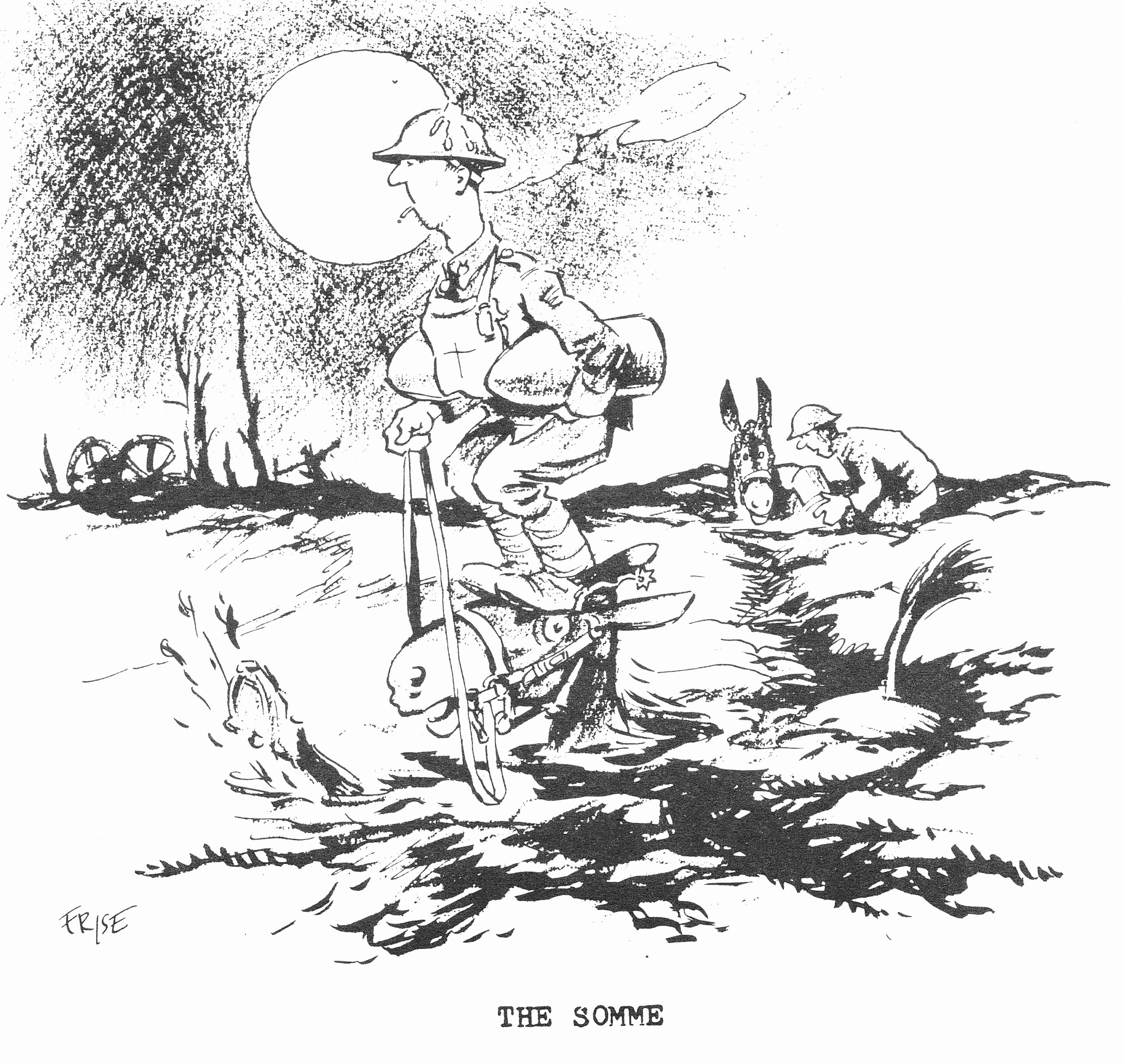 An early Frise. The First Great War As Seen By Jimmy Frise. 1973.
 “Dunlop Advertisement.” Canadian Heroes, 3-6, May 1944: 57.
A rare instance of Frise’s work appearing in in a Canadian graphic periodical even as an advertisement.
 The seated figure is a caricature of Greg Clark. The standing figure is a caricature of James Frise.
 Greg Clark & Jimmy Frise Outdoors, 1979. Front Cover. Taken from the Frise illustrations in the Star Weekly.
 Goblin, IV-9, March 1924. Front Cover. A bit of a different Frise style.
 This image of a Coleman advertisement was generously shared with me by Jaleen Grove.
 Photo, François Desaulniers, La Vie C’est Mourant. Back cover.
 L’Agenda Croc 1986, Front cover.
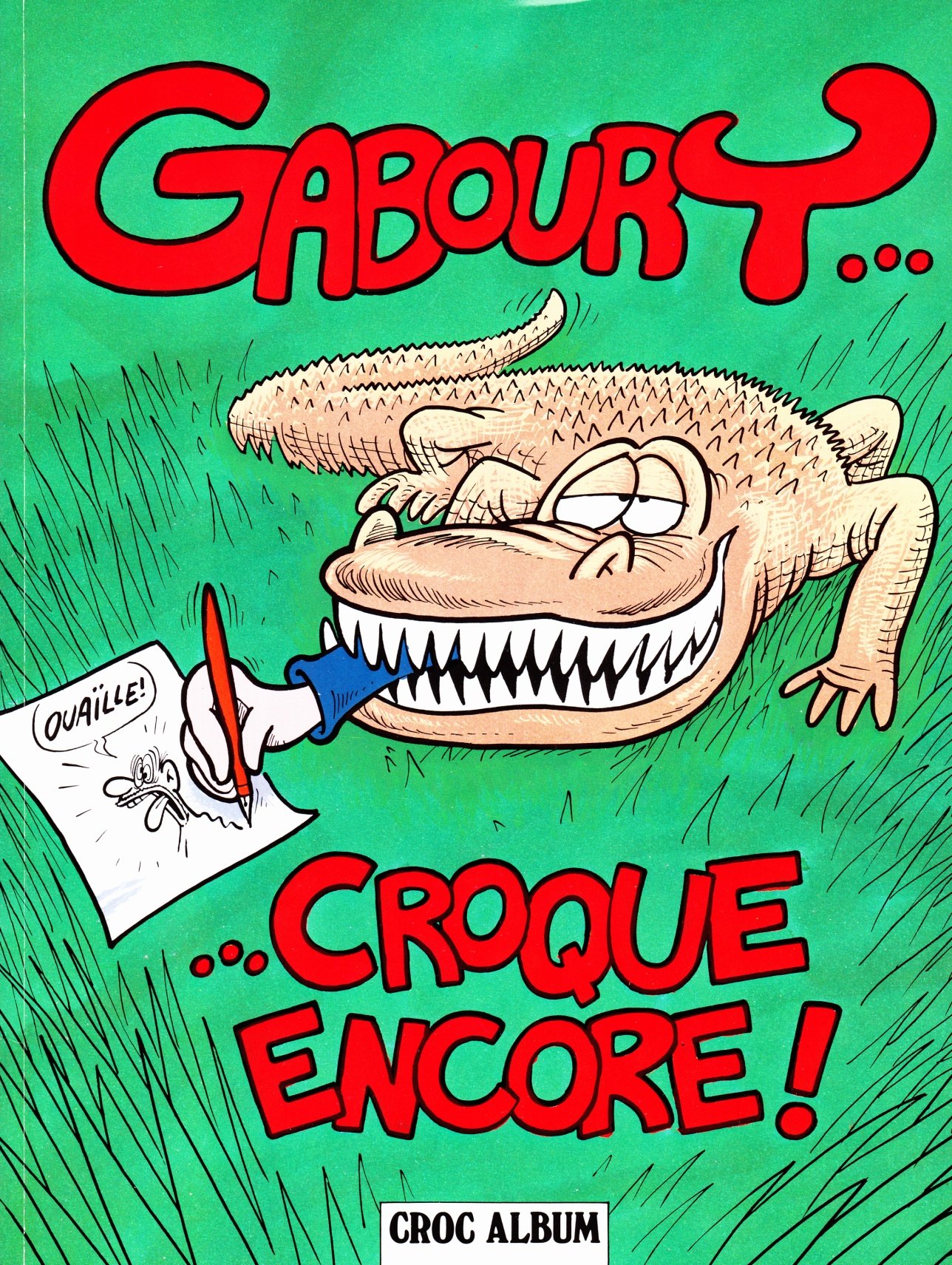 Gaboury: Croque Encore! Front cover.
 1988 Portfoolio: The Year In Canadian Caricature: 184.
 Portfoolio 21: The Year’s Best Canadian Political Cartoons: back cover.
 Globe & Mail, 9 August 2014: F9.
 Globe & Mail, 23 April 2016: F8.
 GABLE; The Editorial Cartoons of Brian Gable, front cover.
 Kayak, #34, v. 4, 2010: 26.
 Ottawa Citizen, 3 June 1987.