MIGLIORE John

MIGLIORE John

Creator of “The Grad”, and “Dinky”, he belonged to the Lethargic Comics group.

WRITER:

BOOK GRAPHIC ANTHOLOGY:                                                                                    Published by Blind Bat Press.

Content story:

The Comic Eye, December 2007:                                                                                               “A Comic Life”. Illus., Larry Blake: 22-27.                                                                           “One Fine Day At The Snail” Illus., S.A. McClung: 113.                                                       “Whatever you do do it with Pizzazz”.Illus.,Gp:134-135.

PERIODICAL GRAPHIC ANTHOLOGY:                                                                    Published by Blind Bat Press.

Content story:

The Romantic Eye, 1, Summer 2006: “The Dark Sinister House of Secret Forbidden Love”. Illus., Larry Blake: 13-19.

CREATOR, WRITER, PENCILLER:

PERIODICAL GRAPHIC:                                                                                                    Published by Blind Bat Press.

Content story:

Dinky on The Road, 1, June 1994: “Dinky on the Road”. In., Greg Hyland: 1-24. Cover see HYLAND Greg.


WINTER William

WINTER William

Born 1909 in Winnipeg.

Although known as a “post-war modernist” William spent a good part of his life as a commercial artist and illustrator.

From 1923 to 1929, he studied art under Group of Seven member Frank (later called Franz) H. Johnson and Lionel LeMoine Fitzgerald a Winnipegger renowned for his painting of the prairies. From 1930 to 1935 while continuing to study art, he worked as a commercial artist at Brigden’s in Winnipeg a branch of art producer Brigden’s in Toronto. He moved to Toronto in 1937. In 1942, he established Wookey, Winter, Bush an advertising company with partners Lesley Wookey and Jack Bush. Jack Bush was to become famous as an abstract artist and member of Painters Eleven. In this capacity, William did illustrations for Maclean’s Magazine and New World Illustrated among others. In the evenings he sketched and painted inner Toronto, in oil, acrylic, watercolour, pencil and coloured chalk, and engaged in conversations with its citizens. Paul Duval art critic and historian has commented that in this period it was common for artists to use “commercial art” to support their “fine art” activities. Eventually these evening activities became dominant and in 1955 he left his commercial art career.

Paul Duval has also stated that William’s “… most telling canvases were done during the 1940’s and early 1950’s when he painted penetrating studies of the inner city of Toronto. These capture the colour and conflict of downtown life …”. It is interesting that William’s most effective canvases, according to Duval, were done while he was still illustrating for magazines suggesting a cross fertilization between the two.

In the late 1950’s he did murals for the Canadian Pacific, a rail lounge car, The Robert S. McLaughlin Public Library in Oshawa, Standard & Steel Company, Children’s Aid Society in Toronto and Seagram’s Ltd. In the 1960’s he taught drawing and painting at the Ontario College of Art and the Artists Workshop also in Toronto.

In 1994 he moved to live with his daughter in England and died in 1996.

WORK:

ILLUSTRATOR:

PERIODICAL TEXT:

Content advertisement:

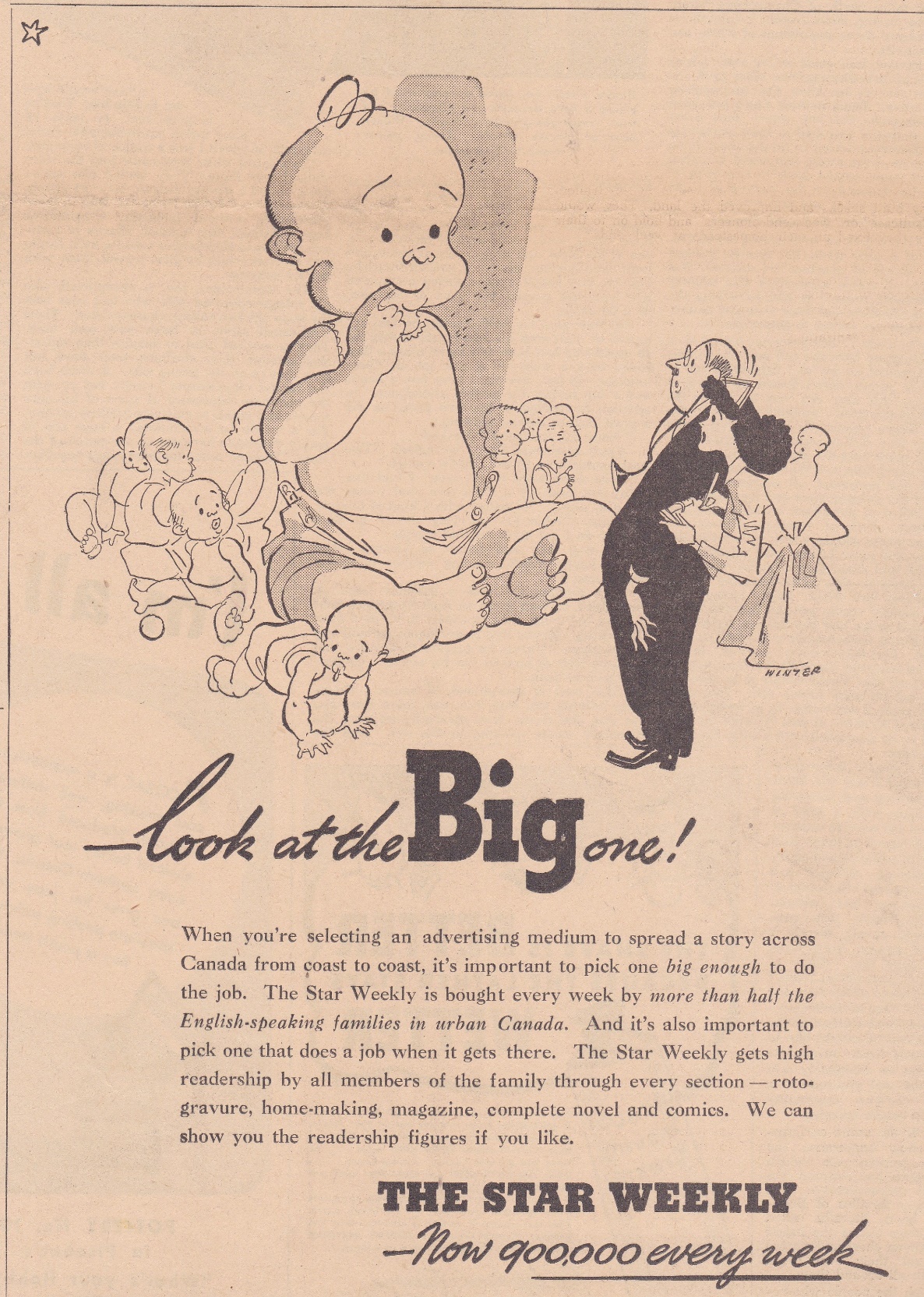
Star Weekly, 23 March 1946: Ad for Star Weekly: 10.

Maclean’s, 14 March 1959: Ad for Seagram’s V.O. Canadian Whiskey:33.

Content essay:

Maclean’s, 1 March 1951: “What TV Will Do To You”. Writ., Don Magill: 22, 23, 24.

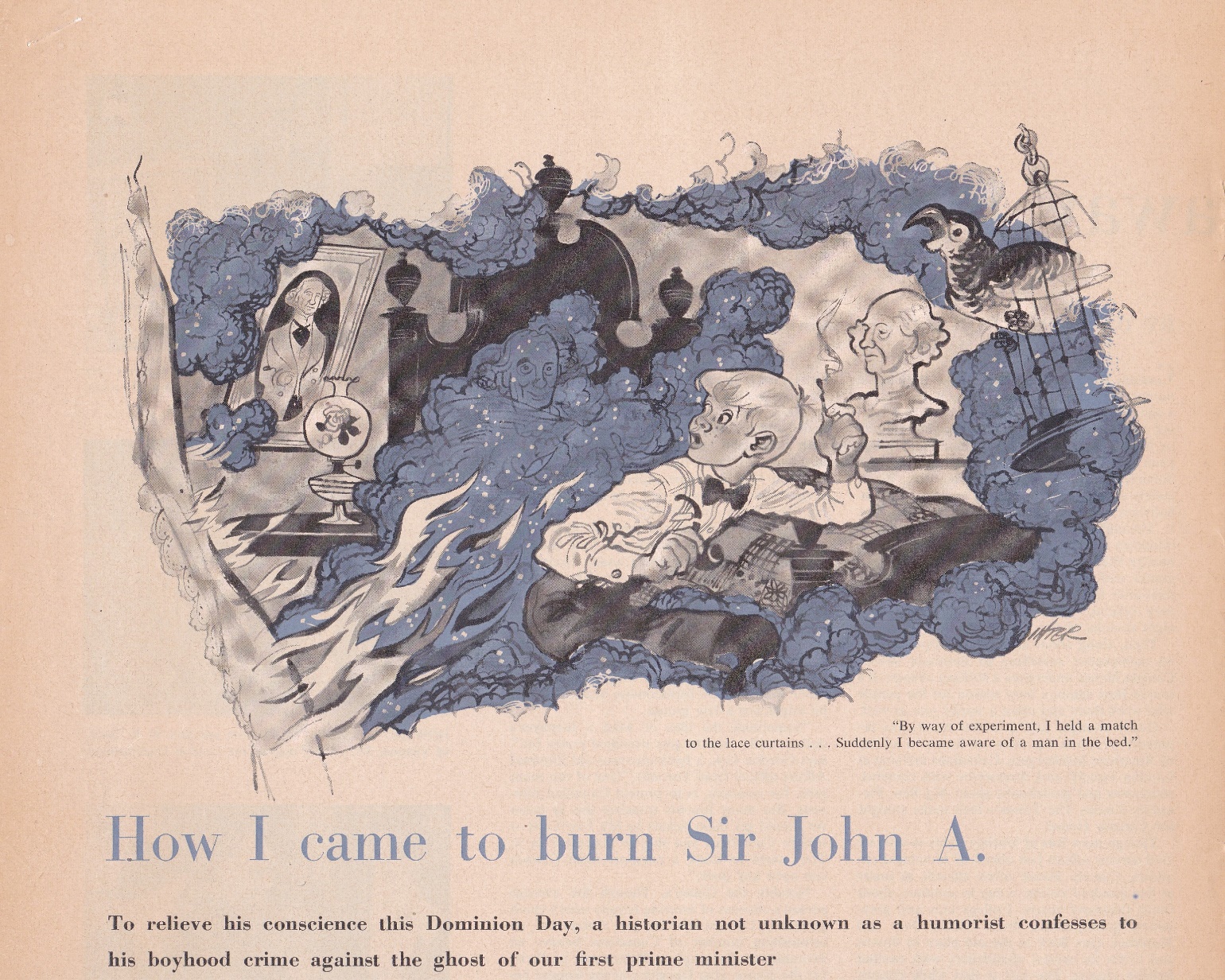
Maclean’s, 4 July 1959: “How I came to burn Sir John A.”. Writ., Bruce Hutchison: 26.

Content memoir:

Maclean’s, 4 July 1959: “How I came to burn Sir John A.”. Writ., Bruce Hutchison: 26.

Content story:

Maclean’s, 1 November 1952: “Keep away from Laura”. Writ., Morley Callaghan: 12, 13.

Maclean’s, 15 February 1953: “The Forty-inch Panhandler”. Writ., Chenoweth Hall: 18-19.

Maclean’s, 15 January 1954: “My Adventures In Basic English”. Writ., Steve Laszkiewicz: 28.

Maclean’s, 15 June 1954: “Ever see a girl with a painted guitar?”. Writ., Muriel Spanier: 20, 21.

Maclean’s, “Who was the Woman of the Glove”. Writ., John Gray: 13, 13.

Content essay & Cover front (not related):

Maclean’s, 15 August 1953: “I’m The Invisible Man”. Writ., Stuart Trueman: 24.

Content story & Cover front (not related):

Maclean’s, 1, August 1947: “Why You Fight With Your …” Writ., George Kisker: 7.

Content cover:

Maclean’s, ….
…, 1 June 1945.

…, 1 January 1948.

…, 15 January 1953.

…, 15 March 1953.

…, 1 December 1953.

…, 1 January 1954.

…, 1 April 1954.

…, 15 July 1954.

…, 15 September 1954.

…, 15 February 1958.

…, 15 January 1959.

…, 14 March 1959.

SOURCE:

Article book:

Fours Decades: The Canadian Group of Painters and their contemporaries, 1930-1970. Writ., Paul Duval. Clarke Irwin, 1972: 120, 128-129.

Internet:

koymangalleries.com/artist/William-winter/

GALLERY:

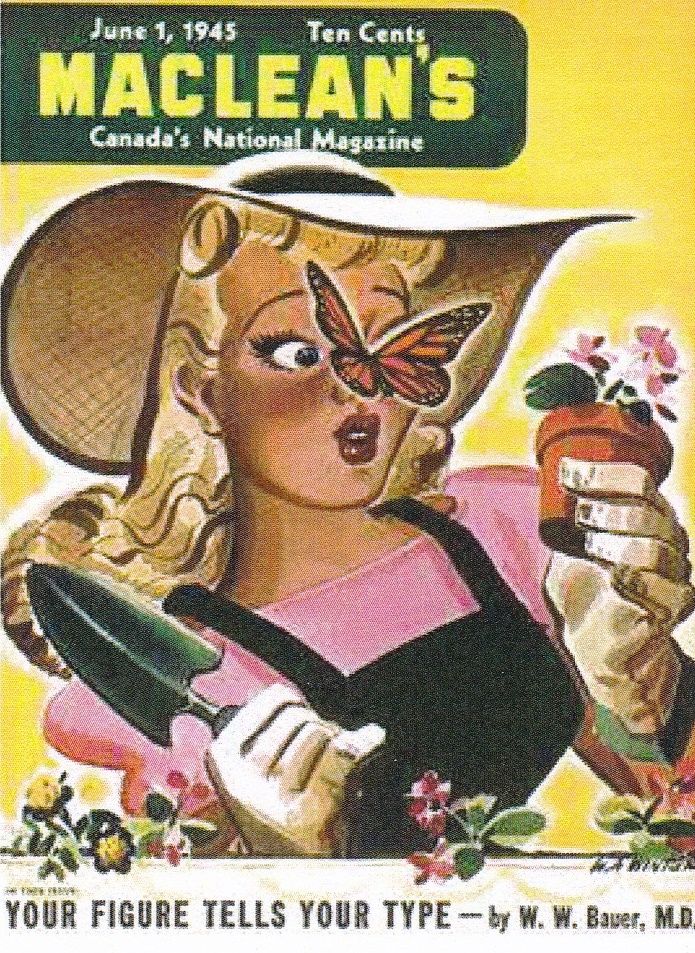
A person holding a plant and a butterfly Description automatically generatedMaclean’s Magazine, 1 June 1945: Front cover.

A close-up of a paper Description automatically generatedStar Weekly, 23 March 1946: 10.

A close-up of a drawing Description automatically generatedMaclean’s Magazine, 4 July 1959: 26.


BLIND BAT PRESS

BLIND BAT PRESS

A black and white drawing of a bat Description automatically generated                                                                                      Wavemakers, 7, April 1990, Contents page.

Location: 21 Duke Street, Suite 401                                                                                                   Hamilton, Ontario

Owner/publisher/editor: Mark Innes

Blind Bat Press was owned by Mark Innes who was also its publisher and editor. In addition, he was editor of The Hamilton Comic Club’s fanzine periodical Humidity Warp, issues 1, Fall 1999 to 5, Summer 2001. Blind Bat Press also distributed Mark Petlock’s Pulp Tattoo.

It is interesting to watch the progression of its publications from mini to regular sized periodicals and ultimately to book format. This press was an important bridge between the emerging artists of the 1980’s/1990’s and their potential audience.

PRODUCT:

BOOK GRAPHIC ANTHOLOGY:

The Comic Eye, 2007. Colour cover. Black & white content.

BOOKLET GRAPHIC REGULAR PERIODICAL SIZE:

Dinky on The Road, 1, June 1994: “Dinky on the Road”. Writ., & Pen., John Migliore. In., Greg Hyland: 1-24. Black & white. Cover colour wrap around: Greg Hyland. Cover colours: Angela Migliore.

PERIODICAL GRAPHIC REGULAR SIZE:

Dreamtime [In 3 parts]: …. Car: Henrik Rehr. Colour cover. Black & white content.
… 1, May 1995: Ch. 1-5: 1- 26. Cover wraparound.

… 2, June 1995: Ch, 6-10: 1-24. Cover front.

… 3, July 1995: Chapters: 11-15: 1-26. Cover front.

Oatmeal …: “…” …: … Colour cover. Black & white content.
… November 1994: “Oatmeal”. Writ., Henrik Rehr. Illus., Lars Horneman: 1- 46.                                            “Freida”. Car., Lars Horneman: 47.                                                                                   Cover front: Henrik Rehr. & Lars Horneman                                                                     Cover back: Henrik Rehr.
Oatmeal II …: “…” …: … Colour cover. Black & white content.
V2, June 1996: “Oatmeal”. Writ., Henrik Rehr. Illus., Lars Horneman: 1- 46.                                            “Freida”. Car., Lars Horneman: 47- 48.                                                                             Cover wrap around: Lars Horneman.                                                                               Cover back: Henrik Rehr.

PERIODICAL GRAPHIC ANTHOLOGY MINI:

Wavemakers …. Cover black on colour or white paper . Issue 7 colour. Black & white content.
… 2, July 1988. … 3, October 1988.

… 4, February1989.

… 5, Summer 1989.

6, Fall 1989.

… 7, April 3, 1990.

PERIODICAL GRAPHIC ANTHOLOGY REGULAR SIZE:

The Romantic Eye, 1 Summer 2006: Colour cover. Black & white content.

Wavemakers …. Colour cover. Black & white content.
… 1, January 1990 … 2, Summer 1991.

PERIODICAL FANZINE MINI:

Glass Eye, 1 May 1997:1-47. Black & white cover & contents.

PERIODICAL FANZINE REGULAR SIZE:

Glass Eye, V. 2, Summer 2004: Black & white cover & contents.

Glass Eye, 1, Summer 2005: Colour cover. Black & white contents. [Note renumbering]

PERIODICAL GRAPHIC REGULAR SIZE:                                                                      Authored & published by Mark Petlock (Eggplant Inc.). Distributed by Blind Bat Press.

Pulp Tattoo … Colour cover. Black & white contents.
… 1, November 1994. … 2, 1994. … 3, March 1995. … 4, May 1995.


A cartoon of a dinosaur and a cartoon of a person Description automatically generatedWavemakers, 7, April 3, 1990: Wraparound cover. Illus: Larry MacDougall.

A person with a goat on her head Description automatically generatedWavemakers, 1, January 1990: Front cover. Illus., Brad W. Foster.

A cover of a comic book Description automatically generatedOatmeal, November 1994: Front cover. Illus., Henrik Rehr. & Lars Horneman.

A person and person on a couch Description automatically generatedThe Romantic Eye, 1 Summer 2006: Front cover. Illus., Bernie Mireault.

A comic book cover with a red face and blue text Description automatically generatedThe Comic Eye, 2007. Front cover. Illus., Dave Sim


RABAGLIATI Michel

RABAGLIATI Michel

C:\Users\Robert\Documents\CARTOONING ILLUSTRATION ANIMATION\IMAGE OF PERSON\R\RABAGLIATI Michel, Taddle Creek, 46, Winter 2020,21, 47.jpg                                              Photo by, Richmond Lam. Taddle Creek, 46, Winter 2020/21: 21.

“You can’t pretend to be international. You have to be local. It’s Michel Tremblay who said that: The best way to have international success is to stay local. I’m from Montréal and I’m not someone who travels a lot, so my stories are rooted in Québec and the language I use is also very Québécois. The narration is proper international French but the dialogue is more Québécois and Montréalaise.”        Michel Rabagliati, Globe & Mail, 12 Sept. 2015: E6.

Born 1961 in Montréal.

Initially a graphic designer and illustrator, he did not begin cartooning until his thirties when He was inspired by the work of Gregory Gallant (Seth) and Chester Brown.

His central character “Paul” is semi-autobiographical. It narrates of the everyday experiences of a Québécois and through it celebrates Québec culture. In 2001, Michel won the Harvey Award for “Best New Talent”. He received the 2006 Doug Wright Best Book Award for Paul Moves Out, an English translation of Paul en appartement.

His 2009 graphic novel Paul à Québec earned the Prix du Public at the Angoulême and was turned into a live action motion picture which opened September 2015.To accompany the film, the Musée national des beaux-arts opened a exhibition of Michel’s art. He won the 2013 Doug Wright Award Best Book of The Song Of Roland an English translation of Paul à Québec. and the 2015 Doug Wright Best Book Award for Paul Joins the Scouts, an English translation of Paul au Parc. The 2017, He was made a Compagnon des arts et des lettres du Québec.

WORK:

CARTOONIST:

BOOK GRAPHIC:

Content novel & Cover book front:                                                                                    All French editions published by Les Éditions de la Pastèque and all English translations published by Drawn & Quarterly except where otherwise noted..

Paul à la champagne. Col., Catherine Drolet., 2013. 15e anniversaire.

Paul à la maison, 2019. English translation Paul at Home. Trans., Helge Dascher & Rob Aspinall. 2020.

Paul dans le Nord. November 2015.

Paul à la champagne. English translation Paul in the Country. Trans., Helge Dascher. Let., Dirk Rehm., 2000.

Paul au Parc, 2011. English translation Paul Joins the Scouts.. Trans., Helge Dascher. Conundrum Press, 2013

Paul en appartement, English translation Paul Moves Out. Trans., Helge Dascher. Let., Dirk Rehm. May, 2005.

BOOK GRAPHIC ANTHOLOGY:

Content story:

Drawn and Quarterly: Twenty-Five Years …. Drawn & Quarterly, May 2015: “Paul Goes Fishing”: 349-357.

PERIODICAL GRAPHIC ANTHOLOGY:

Content story:

Drawn & Quarterly v. 3. May 2000: “Paul apprentice typographer”: 130-144.

Drawn & Quarterly v. 5: August 2003: “Paul in the Metro”: 76-90.

PERIODICAL TEXT & GRAPHIC ANTHOLOGY:

Cover front:

Taddle Creek, 39, Summer 2017. “Paul Goes West”.

Content novel excerpt:

Taddle Creek, 34, Winter 2014-2015: “Paul dans le Nord”: 27-33. An excerpt from the novel.

ILLUSTRATOR:

PERIODICAL TEXT ANTHOLOGY:

Content essay:

Maclean’s, 3 December 2001: “The nation’s Hippest station”. Writ., John Geddes: 10.

Maclean’s, 14 October 2002: “Life As An ‘Astronaut’”. Writ., Lena Sin: 64.

PERIODICAL TEXT & GRAPHIC ANTHOLOGY:

Content game:

Owl, 26-7, September 2001: “Dinner at Café Bizarre”: 14-15.

SOURCE:

Article book:

BDQ: Essays & Interviews On Quebec Comics. Ed., Andy Brown. BDang/Conundrum, 2017: “Michel Rabagliati.” Interview Conan Tobias. Trans., Michelle Winters. 190-193. An email interview conducted as background for a profile that appeared in the Quill & Quire, May 2016.

The Canadian Alternative: Cartoonists, Comics, and Graphic Novels. Ed., Dominick Grace & Eric Hoffman. University Press of Mississippi. 2018: “Michel Gets A Comic Job.” Writ., Paddy Johnston: 70-82.

Paul at Home, 2020: Back page.

Paul in the Country. 2000: Back page.

Drawn & Quarterly v. 5: August 2003: 76.

Article periodical:

Canadian Review Of Comparative Literature, 43-1, March 2016: “‘Paul À Québec’, Le Génie Des Lieux Comme Patrimoine Identitaire.” Writ., Sylvie Dardaillon & Christophe Meunier. 87-102.

Taddle Creek, XX1-1, 40, Winter 2017/18: “The Ephemera: Man About Town.” Writ., S. Gilbert: 5-6.

Taddle Creek, 46, Winter 2020/21: “Solitary Man.” Writ., Conan Tobias: 20-25.

Article newspaper:

Globe & Mail, 12 Sept. 2015: “Comic book captures ‘quintessential Quebec’.” Writ., Allen Woods: E6.

GALLERY:

A newspaper article with a person walking Description automatically generatedMaclean’s, 14 October 2002: 64.

C:\Users\Robert\Documents\CARTOONING ILLUSTRATION ANIMATION\IMAGE BY CARTOONIST\R\RABAGLIATI Michel, Taddle Creek, 34,Winter 2014,15, 32.jpgTaddle Creek, 34, Winter 2014-2015: 32. An excerpt from Paul dans le Nord.

C:\Users\Robert\Documents\CARTOONING ILLUSTRATION ANIMATION\IMAGE BY CARTOONIST\R\RABAGLIATI Michel, Taddle Creek, 34,Winter 2014,15, 33.jpgTaddle Creek, 34, Winter 2014-2015: 33. An excerpt from Paul dans le Nord.

C:\Users\Robert\Documents\CARTOONING ILLUSTRATION ANIMATION\IMAGE BY CARTOONIST\R\RABAGLIATI Michael, Taddle Creek, 39, Summer 2017, fc.jpgTaddle Creek, 39, Summer, 2017: Front cover.
 

STEPHENSON Ken

STEPHENSON Kenneth James

A person with white hair and beard Description automatically generated                                                                dignitymemorial.com/en-ca/obituaries/Guelph
Ken worked in animation for thirty-five years. He contributed to Nelvana specials, Romie-0 and Julie-8 (1979), and Easter Fever (1980) and was Director of Take Me Up To The Ball Game (also 1980). He worked on Heavy Metal (1981), He was a storyboard artist on Carebears In The Land Without Feelings  (1983) produced by Atkinson Film Arts. He was a co-director on Star Wars:Droids (1985), a Lucasfilm/Nelvana co-production. He contributed to Nelvana co-productions Inspector Gadget (1982), and Eek The Cat (1992-1997) and Nelvana production Sticking Around (1996 – 1998).

He was involved in Strawberry Short Cake (debut 2003) probably through Cookie Jar Entertainment.

He died in Guelph 5 September 2014.

SOURCE:

Internet:

https://www.dignitymemorial.com/en-ca/obituaries/guelph-on/kenneth-stephenson-11199225

https://mubi.com/en/cast/ken-stephenson

https://en.wikipedia.org/wiki/Star_Wars:_Droids


TAKE ME UP TO THE BALL GAME

TAKE ME UP TO THE BALL GAME

This was Nelvana’s sixth and last television special. It premiered on CBC television, 14 September 1980. The producers were Michael Hirsh and Patrick Loubert, the Director Ken Stephenson. The Screenplay was written by Ken Sobol an American Emmy Award winning writer who moved to Canada in 1973. Don Ferguson of Royal Canadian Air Farce made a return to Nelvana as a voice actor for this production. Like the previous Nelvana specials this has a large music component this time written and performed by Rick Danko of The Band.

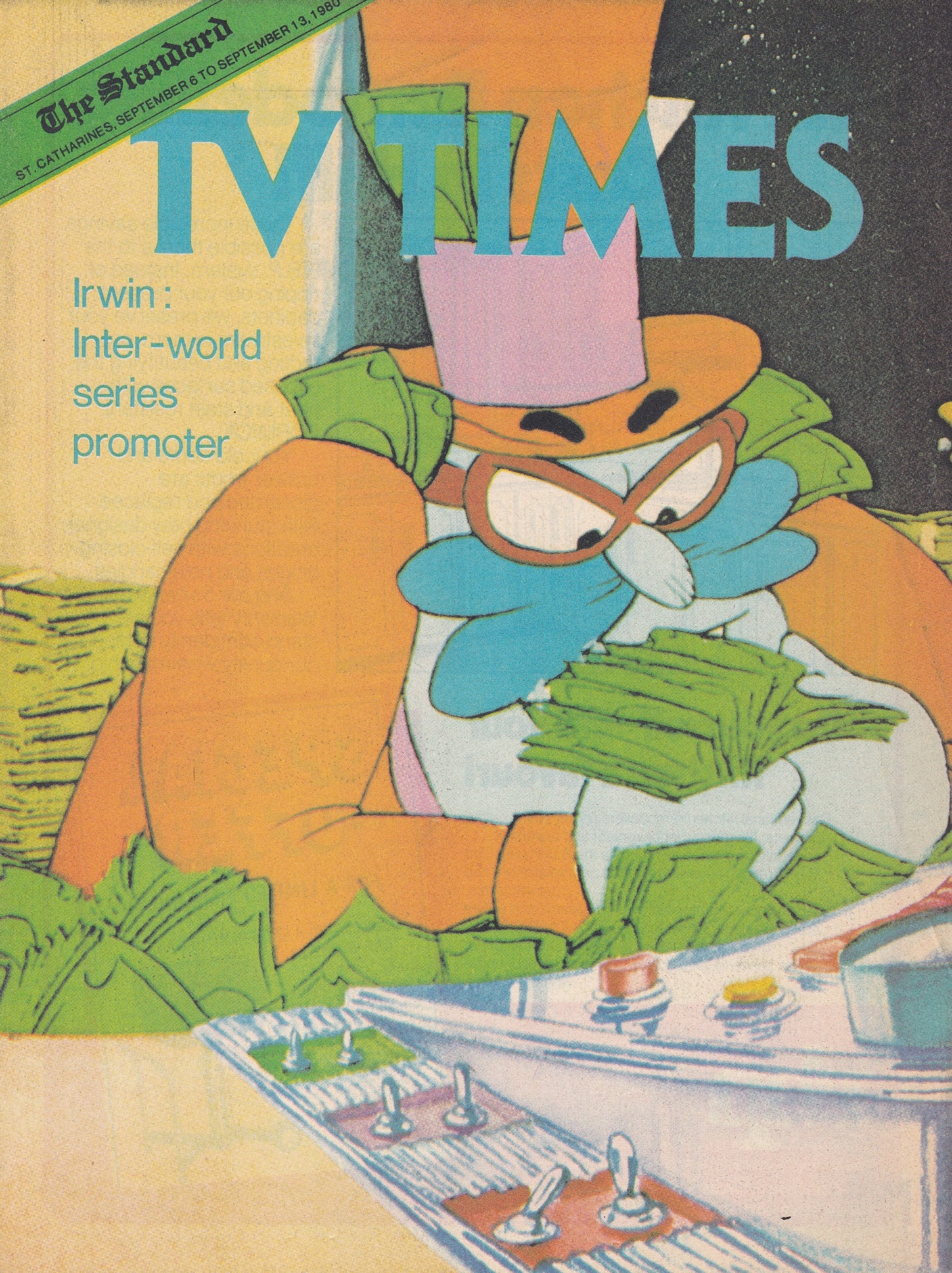
The show opens when we see from a spaceship a baseball game in progress. Closer up the players become a beaver, an eagle, a cat, a mole, a turtle, a kangaroo and a bear. “Cat” a nature lover has just missed catching a fly ball because he was smelling a flower. “Eagle” and “Beaver” are arguing. “Eagle” wants to get rid of “Cat” because they will never win with him involved while “Beaver” insists on keeping him because he is part of the team. The spaceship occupants one of whom is “Irwin” a promoter asks them who they are. “Beaver” quickly makes up the name “The Giants”. Irwin asks if they want to play in another game. He is vague about what and where the game is, but they agree, ”Kangaroo” insists they have to be back by supper.

The scene switches and we find that the game is an intergalactic game in which no team wants to play against “The Champs” because they have won all the games for the last 800 years – by cheating. “Irwin” presents “The Giants” as a formidable team that can beat “The Champs”

The game begins and through the first part of it, “The Champs” rack up a hefty score while “The Giants” through their own incompetence and “The Champs” cheating, score nothing. By this time “The Giants” realize “The Champs” are cheating and complain to the commissioner. Everyone including the fans are stunned. Cheating has been part of the game for the last 800 years. “Eagle” suggests that since cheating is part of the game they should cheat as well. “Beaver” who is captain refuses because “cheaters never prosper”. The fans find this comment hilarious, but it is the turning point. “The Giants” buckle down and start outwitting “The Champs” in their cheating efforts. Their score rises and at the bottom of the ninth they are leading “the Champs” 500 to 499 but “The Champs” have the bases loaded. They also have two batters out. At this point “Irwin” reveals his true colours. He has been secretly betting that “The Giants” would lose. Now he is faced with the prospect they will win. He enters the game himself as the last batter. After he has two strikes against him, he tears up the bench “The Champs” are sitting on and uses it for a bat. He hits the ball high into the stadium. “The Giant’s scramble to catch it. It bounces out of mole’s nose. Meanwhile “Cat” has discovered a flower in the field; like before he bends over to smell it. His glove arm extends horizontally behind him, the glove facing up. The ball falls into the glove. “The Giants” win. “Beaver” points out to “Eagle” they won without cheating. “Eagle” agrees, and they reconcile. “The Giants” are the celebrated by the aliens who get them home in time for supper.

The film is entertaining and Nelvana makes its social comments as it traditionally does. It is hard not to see “Beaver” and “Eagle” symbolizing Canada and the United States”. The animation is not as accomplished as in previous efforts. It is likely that being squeezed between Easter Fever and the Rock & Rule project, the bulk of the resources were devoted to them.

SOURCE:

Article periodical:

The Standard: TV Times, September 6-13, 1980: “Bottom of the Ninth with the score 362-361”. Writ., Wesley Hicks: 30-31, cover.

Star Week, September 13-20, 1980: “Earth’s Giants are a hit on the diamond”. Writ., Jeremy Ferguson: 8

Internet:

https://en.wikipedia.org/wiki/Take_Me_Up_to_the_Ball_Game

https://www.youtube.com/watch?v=FOdoS_hrEQc

GALLERY:

A cartoon of a person holding money Description automatically generatedThe Standard: TV Times, September 6-13, 1980: Front cover (“Irwin”).

Cartoon characters playing a baseball game Description automatically generatedStar Week, September 13-20, 1980: 8. (“Cat”)
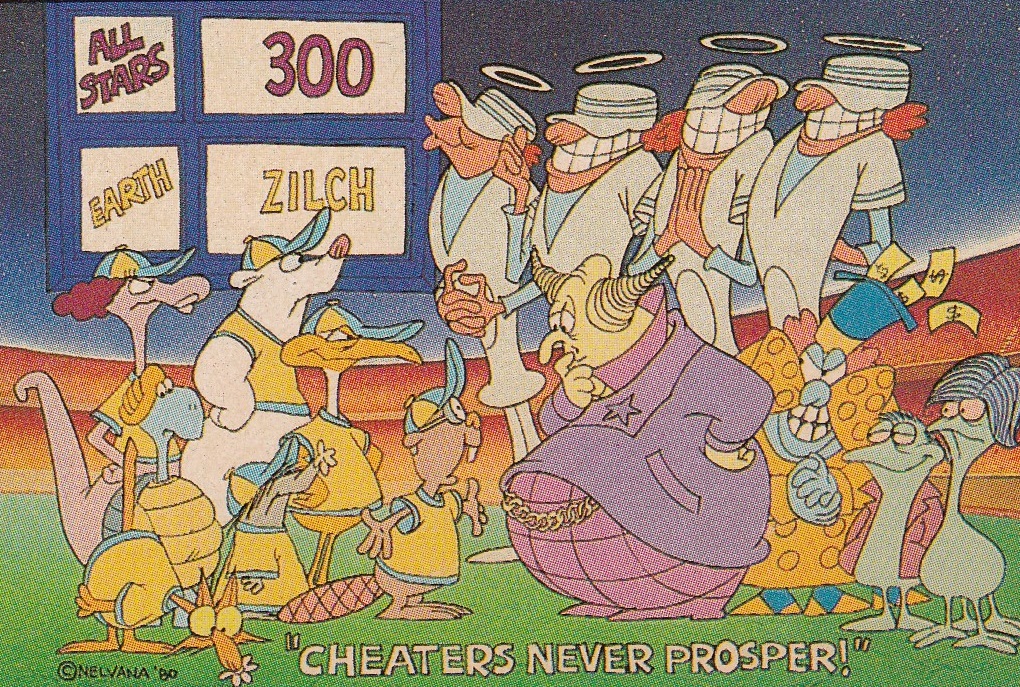
Cartoon characters in a room Description automatically generatedStar Week, September 13-20, 1980: 8

CULLEN Patricia

CULLEN Patricia

Born 10 October 1951 in Toronto.

During her short life Patricia was a significant contributor to the music of some of Nelvana’s most important movies. Starting with Intergalactic Thanksgiving (1979), she composed the music for Easter Fever, (1980), Rock & Rule, 1983), The Care Bears Movie (1985), Care Bears the television series, (1986-1988), Care Bears Movie II: A New Generation (1986) and Care Bears: Adventure in Wonderland, (1987). She also contributed to a number of minor Nelvana films like Rocket Boy. Outside of Nelvana she contributed to the NFB film Unfinished Business (1984), sequel to And Nobody Waved Goodbye (1964)

She died 18 April 1991.

SOURCE:

Internet:

https://www.imdb.com/name/nm1068416/


INTERGALACTIC THANKSGIVING

INTERGALACTIC THANKSGIVING – PLEASE DON’T EAT THE PLANET

This was the Nelvana founders’ fourth effort and like the two that preceded it, had a large musical component. It appeared on the Canadian Broadcasting Corp. 3 October 1979. The story was by Michael Hirsh, Clive Smith and Frank Nissen, and Screenplay by Greg Duffell, Don Arioli and Martin Lavut who also worked on Heavy Metal. The Director was Clive Smith and the Producers Michael Hirsh, Patrick Loubert and J. Gordon Arnold. Songs were by John Sebastian while the Musical Score was composed by Patricia Cullen and played by Canadian Brass. Voices included Chris Wiggins (The Best Damn Fiddler from Calabogie to Kaladar), Catherine O’Hara (Schitt’s Creek), and Al Waxman (King of Kensington).

The story opens with a wagon train of farmers journeying through space, looking for a new place to settle. One of the wagons driven by “Pa Spademinder” and occupied by his wife and daughter “Victoria” crashes on a planet and is spotted by one of the inhabitants who rushes off to tell the others that aliens have landed. Here we are introduced to the inhabitants called “Laffalotians” because they spend all their time joking around.  Their “King Goochi” is their leader because he is best at making them laugh. His son Notfunnyenuff wishes his compatriots would be more serious. Previously we have learned that “Victoria” wishes her parents were less serious. It is natural that the two are attracted to each other.

Things start off well enough the “Spademinders” are given land to set up their farm and the “Laffalotians” are entertained because they find the “Spademinders’” farming the soil quite funny, but here is where conflict begins. “King Goochi”, in a scene reminiscent of Snow White, is told by a mirror on the wall that he no longer qualifies as “King of Laffalot” because his citizens now find the “Spademinders” funnier. Thus competition at least on the part of “King Goochi” is born.  “Pa Spademiner” has been hammering into the ground, stakes labelling the different vegetables.  The “Laffalotians” have found this hilarious. “King Goochi” in an attempt to show he is funnier grabs the mallet and drives a stake into the ground with such force that he creates a large crack. “Victoria” and “Notfunnyenuff” fall into this crevasse and underground with them we discover that the planet is in deep trouble. It has been hollowed out by “bugs” with giant machines in order to provide food for those on the surface. Apparently, the interior of the planet is edible. There follows quick work by “Notfunnyenuff”, “Victoria” and the “bugs” to reinforce the planet’s weakened structure.

Meanwhile, on the surface, the planet’s fertile soil has created vegetables the size of trees. By working together, the “Laffalotians” and the “Spademiners” pull up these vegetables and are able to bring “Notfunnyenuf” and “Victoria” back to the surface. There follows movement toward balance on both sides. The “Laffalotians” become more serious and the “Spademiners” less so. The film ends with “Notfunnyenuf” and “Victoria” working together. Here, Nelvana has followed its tradition of inserting messages into its story, this time about taking care of the planet and keeping a balance between irresponsibility and being humourlessness.

The film reviewers agree the strength of this film and what makes it worth watching is its animation. Let’s leave the last word to Betty Zyvatkauska:

“The success of the show hinges on the whacky animation of a planet populated  by a host of irresponsible laughmongers ….”

SOURCE:

Article periodical:

Globe & Mail Broadcaster Week, 30 September – October 5, 1979: “What Makes a great Laffalotian

animator?”. Writ., Betty Zyvatkauskas: 6.

Sunday Sun Television, September 30-October 6, 1979: 1, cover.

Article newspaper:

Globe & Mail, 5 October 1979: “Thanksgiving on Laffalot is worlds of galactic fun”. Writ., Rick Groen.

Toronto Sun, 2 October 1979: Nelvana’s ‘Thanksgiving’ is Out Of This World”. Writ., George Anthony.

GALLERY:

A cartoon of a group of people Description automatically generatedSunday Sun Television, September 30-October 6, 1979: Front cover.

A cartoon of a person Description automatically generated                                                    Globe & Mail, 5 October 1979. (Notfunnyenuf )