HOEDEMAN Jacobus (Co)
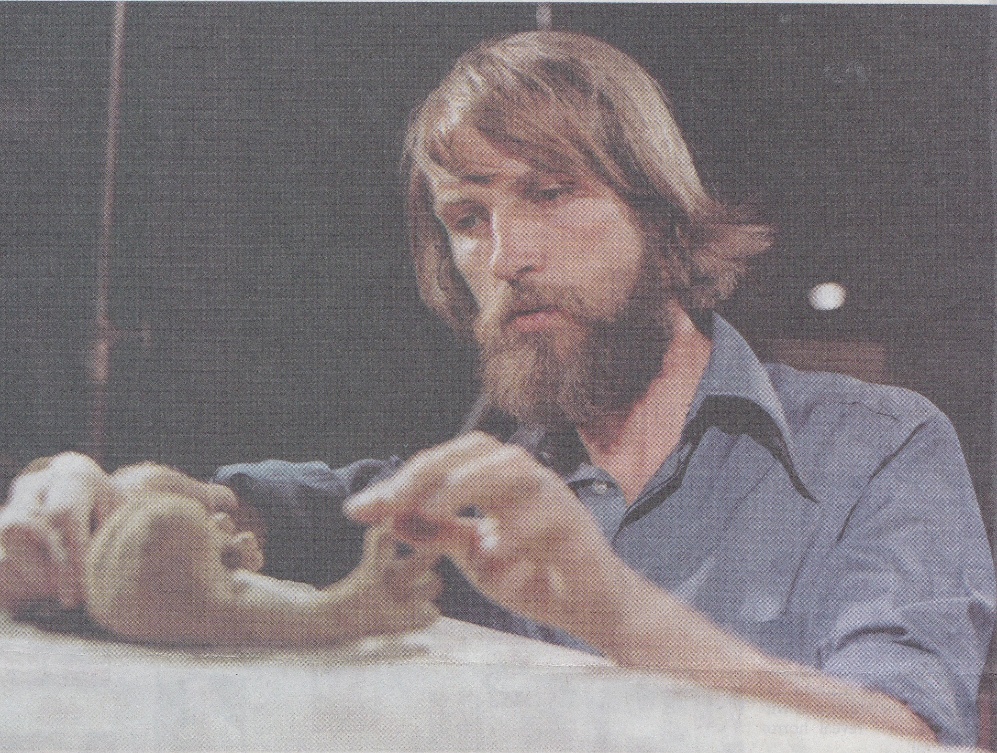 Co Hoedeman working on one of the characters for Chateau de sable/Sand Castle Globe & Mail, 14 June 2025, O12, Courtesy National Film Board.
Born 1 August 1940, in Amsterdam Holland, he lived through the German occupation and the Great Hunger of 1944/45. To avoid this, he, at 4 years of age, and his siblings were taken from Amsterdam 85 kilometers into the countryside to live with relatives. They did not return to Amsterdam until 1945 when it was liberated by Canadians. Hongerwinter would later be the subject of one of his later animated films.
As a youngster, he worked in his father’s and grandfather’s tailor shops. This experience later helped him when he designed puppets and built props. At 15 years he left school and became a junior animator at Multifilm which later grew into Cinecentrum. Here he learned stop motion animation.
He had discovered the National Film Board while studying its films when he was a student. Wanting to do the kind of experimental animation coming out of the N.F.B. He, his wife, and a reel of his animated clips landed in Montréal in November 1965. He was hired by the N.F.B. where he worked in model animation and puppets in the English unit until transferred by Wolf Koening to the French unit, even though he didn’t speak French. However, this unit focused on music and sound effects rather than dialogue.
Continental Drift (1968) is his first film. It is a nine-minute documentary, partly live action with voice over, explaining the theory of continental drift. The set of films that followed it are totally different. Music and sound effects replace dialogue and the attitude changed. Whimsey and imagination replace instruction. Their goal becomes the joy of watching changing images and listening to the music. In Oddball (1969), Co created a twisted wire puppet which chooses and rejects various coloured balls, but the star of the film is a white ball which the puppet initially ignores but then selects. When he plays with it, it dissolves into its primary colours then absorbs the colours back into itself. The result is a kaleidoscope of spheres and colours. One is reminded of some of the work of Norman McLaren. His next film Matrioska (1970), involved the manipulation of Russian dolls, beautifully painted wooden figures of decreasing sizes nestled inside each other. Here the dolls come out of each other and dance to Russian tunes. Tchou-tchou (1972), a thirteen minute film came next. For it Co manipulated child building blocks some of which had figures painted on them, but the figures weren’t static on the blocks. They moved as well. The story centers around a boy and a girl and a destructive dragon which terrifies them. Ultimately, while the dragon is sleeping they change it into a train by altering the blocks that compose it. Then they and the other characters ride it. The climax of this series is the thirteen minute film Chateau de sable/Sand Castle (1977), which Co called “my perfect film”. Others agreed he was awarded an Oscar for it in 1978. As in the earlier films, it uses music, sound effects and physical material, in this case sand and latex. The story begins with a sandstorm. After the wind dies down, a creature emerges and begins to sculpt sand creatures some of whom create other creatures. All of these characters set about building a sandcastle. As the castle is completed the wind begins again. As it increases in intensity the creatures seek shelter in the castle as it is eventually buried.
After being awarded the Oscar, Co received worldwide invitations to attend conferences, give workshops and judge competitions.
While doing these films, he became interested in Innuit culture and travelled to the arctic where he researched traditional stories and enlisted Innuit printmakers and carvers to create characters for his films including Lummaq (1975), an Innuit legend and The Sniffing Bear (1992). A cautionary tale where a polar bear experiences hallucinations after sniffing gasoline from a can.
In later experiments he inserted 2 dimensional puppets into 3 dimensional environments. A successful result of these experiments was Charles et François (1987) a film about aging and death.
In the 1980’s Co divorced then later married Joyce Ryckman, a writer and art consultant, with whom he partnered for most of the films after 1989.
Crossing the century divide, he animated a trilogy of films called the ‘Seasons of Ludovic”, The Snow Gift (1998), A Crocodile in My Garden (2000) and Magic in the Air (2002). The rights to this popular trilogy were purchased by private interests but the project became an unhappy time for Co. Convinced that “Ludovic” was losing his charm to commercial interests Co battled with script writers, producers and broadcasters, he resigned from his director role early in the production. Although the 26 episode series was popular it lasted only one season.
In 2003, Cinémathèque québécoise exhibited a retrospective of his films.
He was laid off from the N.F.B. in 2004 but continued to work with them as a freelancer and independent producer.
Another project was 55 Chouette’s/Socks (2011) where he animated the poem by Marie Jacobs about the earlier mentioned Hongerwinter in the Netherlands during 1944 to 1945. For this Canada/Netherlands production he worked with black silhouettes from the Dutch tradition of shadow play called schimmenspel.
His final film was The Cardinal (2016). He financed it himself. It is a poignant film exploring the effects of Post Traumatic Stress Disorder. A man deployed abroad returns with PTSD which disrupts his family particularly his relationship with his daughter. It is their common love of birds and particularly a cardinal that brings them back together.
Retiring the following year when he was diagnosed with multiple myeloma. He died 26 May 2025.
SOURCE:
Article book:
Cartoon Capers, Wri., Karen Mazurkewich. McArthur & Co., 1999: 83-85.
a handbook of Canadian film. Writ., Eleanor Beattie. Peter Martin Associates Ltd/Take One, 1973: “Co
Hoedeman”: 179.
Take One’s Essential Guide to Canadian Film. Ed., Wyndham Wise. University of Toronto Press 2001:
“Hoedeman Co.”: 100.
Article newspaper:
Globe & Mail, 14 June 2025: Obituary: “Oscar Winning Stop-Motion Filmmaker Devoted His Life To Storytelling”. Writ., Frank Edwards: O12.