STIG’S INFERNO
“I fell in love with them [Dante Aligheri’s, The Divine Comedy] as stories. It took a bit to get past the language translations, but for a year or so, I was reading different versions, off and on, as my reading on subways and buses, getting to and from school.” Back Issue, 21, March 2007: 71-76.
According to Ty, “Stig’s Inferno” based on The Divine Comedy by Dante Aligheri which he had read, was created by himself and Klaus Schönefeld his roommate. They were both attending the Ontario College of Art and Design. They sketched out plots and character designs. At that time, it was conceived as a cartoon strip for their school newspaper but never reached publication. They both moved on to other things. Sometime later, Bill Marks was visiting Ty looking for ideas his company Vortex Comics Inc. could publish. He saw the sketches of “Stig” and thought this was an idea he could use. Ty talked it over with Klaus and although Klaus could not participate as he had an active career in commercial art, Ty resurrected it and added it to the Vortex line of periodicals. The first five issues were published by Vortex. This arrangement ended in 1986 when Vortex reduced operations. The following year in January it reappeared under the Eclipse imprint although it appears that it was a co-production between Eclipse and Ty. It ended after two issues.
Stig’s Inferno gives us the clearest glimpse of Ty the artist. His work on Batman and other corporate titles shows us his pictorial capabilities but “Stig” reveals what he could do as a creator, his preferred subject matter, storytelling abilities, imagination and absurdist sense of humour. “Stig” is about as far as one can get from the masterful in control character that one sees in so many cartoon stories. At the same time, he is not a stumble bum to be sneered at found in many funny comics. He is very much an everyman trying to make the best of the situation he is in and clearly doesn’t understand. Ty’s storytelling is more complex than one usually finds. One can’t help but admire his choice of developing three parallel narrative lines, one centred on “Stig”, another on his girlfriend “Beatrice” and a third on “The Director” aka Satan, and his ability to handle them. He is also innovative. Twice, faced with the need to acquaint a reader with preceding episodes he likely had not read, Ty devises a story with a main character “Enoch” which surrounds his synopses. Ty’s absurdist sense of humour is clearly at play here. Dante’s Divine Comedy is about as grim as one can get. In Ty’s hands Hell, Hades or the “Inferno” is a place rife with incompetence and with a leader that is to put it mildly less than commanding. This is not to suggest that Ty is mocking Divine Comedy but rather he has taken a part of it and shaped it to his own vision in which the concepts of Hell and Satan are absurd.
As previously stated, Stig’s Inferno gets its inspiration from The Divine Comedy a narrative poem by 14th century Italian writer Dante Aligheri or more specifically from the first part of the poem called “Inferno”. Both narratives are a journey through Hell. Many of the characters, or at least the character’s names are common to both narratives. Ty makes no secret of the connection between the “Inferno” and his creation in fact he often brings it to the forefront. But the differences between the two could not be more extreme. Whereas Dante portrays himself as a visitor and observer being guided through Hell by the Roman poet Virgil, Ty has created a character “Stig” who was killed by a falling piano lid and is therefore a shade wandering through Hell wondering where he is. Dante’s poem is a cautionary tale warning of the woe and misery that awaits those who act evilly. Ty’s character is in Hell for no particular reason other than he’s dead. Dante’s Hell itself is terrifying. Ty’s Hell is laughable reflecting the many of the absurdities of our own everyday behaviour. Satan with his round face and knoblike horns is less ominous and more like a petulant child. Ty retains character’s names from the Inferno but again where Dante’s “Beatrice” is an allegorical figure for “Divine Love”, in Ty’s version she is “Stig’s” girlfriend, where Virgil, is the Roman poet who guides Dante through Inferno in Ty’s version “Virgil” is a demon condemned to Hell’s dungeons for writing bad poetry. Ty himself dismisses any connection between this “Virgil” and Dante’s Virgil by having “Beatrice” exclaim that this “Virgil” is not anything like the handsome Roman poet who wrote Aeneid. But the largest difference is that Dante’s poem has been described as an allegorical journey toward God. Although Ty’s narrative is unfinished, it appears that “Stig” is journeying towards replacing Satan as Ruler of Hades, with as Ty adds all of its administrative headaches. His humour comes mainly from his juxtaposition of visually grotesque monsters with their conversation and behaviour that runs from mundane to absurd. Much of this behaviour reflects without comment Ty’s observations everyday life. Ty the narrator is also clearly visible in this story. He inserts asides directed at the reader imagining replies that don’t agree with him and making comments about them or he jokingly tells the reader about his cartooning decisions. There’s a sense of enjoyment in Ty’s telling of this tale which makes it a delight to read.
Synopsis:
The first issue opens with “Stig” taking his girlfriend “Beatrice” to the house he built on the top of a mountain remote from any settlement. The house is haunted by disembodied voices and a “Demonic Netherworld Wretched Spirit Talisman” that appeared after “Stig” built the house and cannot be removed or destroyed. Upon playing his grand piano for “Beatrice”, “Stig” discovers in it voices. He attempts to evict them and when he’s leaning into the piano the voices bring the lid down on his head accidently killing him. “Stig” finds himself in an unfamiliar landscape wearing only his shirt and tie. Our hero does not know he’s dead and will not realize it for the rest of the serial. In a first acknowledgement to his source Ty has “Stig” observe painted on a rock “Canto 2”. Dante divided his narrative into Cantos. At this point Ty begins a second story line involving “Beatrice” The scene shifts back to “Stig’s” house which is now occupied by the police called by “Beatrice”. They decide the Piano is a prime suspect in “Stig’s” alleged murder and plan to take it to the station for questioning. This requires taking the piano out by helicopter which requires blowing the roof off the house. Another scene shift in which “Stig” is being observed on a monitor by two individuals shown only as two hands exchanging popcorn. A third story line has begun.
Issue two uses a different structure, “Stig’s” story is embedded within “Secret Tales From The Chamber of Scares”. This bookend structure appears to have been introduced later. It opens with a top hatted creepy character “Enoch” keeper of the “Chamber of Scares” attempting to frighten two young people with a scary story which turns out to be “Stig” in the inferno. “Stig’s” story resumes. The two disembodied voices are still with him. When he asks them how he can get back to his house, they decide it’s time to leave. He chases them ignoring the signs of cliff ahead and runs off the cliff. As he plunges downward, “Enoch” uses the falling time to give a short recap of issue one. The recap ends and “Stig” hits the bottom of the cliff next to an escalator. Still very much unaware that he’s dead and thinking the escalator leads to a basement clothing department where he can buy a pair of pants and shoes he starts down. During the long descent with the basement department still not in sight, the escalator breaks down. “Stig” shouts for repairs which brings the foreman “Cagnazzo” and his helper “Scarmiglione”. In Dante’s inferno these two demons inhabit the Eighth Ring and torment fraudsters, and corrupt politicians. In “Stig’s” inferno they are two repairmen continually bickering with each other. “Cagnazzo” won’t do any lifting because he has lumbago, and he complains that “Scarmiglione” has nicer wings than him. The story switches to “Beatrice” and the police in the house on the peak of the mountain. An explosion demolishes the roof of the house. The helicopter flies away with the piano. The house tumbles from its mountain perch. Another switch, this time to a “…foul room in a putrid tower overlooking the repulsive marsh of Styx”. We get our first complete look at “The Director” and his assistant “Bob”. They are talking about the upcoming party for Attila The Hun. “The Director” frets that he hasn’t bought a gift for Attila. He leaves with instructions for “Bob” to turn up the heat in the sixth ring. He heard a giggle there. He then settles down to watching “Stig” and the two repair demons on his monitor. This brings us back to the demons repairing the escalator. “Cagnazzo” grouses that “Stig” has been given a shirt and tie while he hasn’t, another example he isn’t given the respect he deserves. Finished repairs, the demons decide to take “Stig” to “The Director” since he’s not supposed to be on the escalator. They argue which of them is going to carry “Stig”. Meanwhile, “Stig” still unaware he’s dead thinks he’s on a movie set and the two demons are costumed actors. The demons continue to squabble. “Cagnazzo’s” sense of being underappreciated increases till he quits his job as foreman and drops “Stig” who plunges into a polluted river where tentacles grab him by the leg and pull him down. “Stig” thinks he must be in a Spielberg movie. “Enoch” reappears to tell us that the story will be continued in the next issue. “That’s right Fear Fans. It’s one of the true horrors of the Comics World … A Story That’s … To Be Continued!!” But this issue does not end there. Instead, there’s an argument between “Enoch” and his young listeners who complain the story wasn’t scary at all. In response “Enoch” tells an unrelated backup story called “The Plasma Monkeys of Zaton IV” penciled by Anthony van Brugger which we need not go into here. This story doesn’t satisfy his young audience either, but all is not lost when he finds what really scares his young audience is growing up.
The cover of issue three is a tip of the hat by Ty to the foremost illustrator of Divine Comedy the engraver Gustave Doré. The bookends are gone, and it opens with “Stig” flying through the air apologizing to the water demon “Buer” for escaping and to “Scarmiglione” for nearly colliding with him. “Stig” falls back into the water and calls for a time out. In the conversation that follows “Stig” informs “Buer” that people don’t like to be attacked by underwater slim creatures to which “Buer” protests that’s his job. However, he will reconsider and try to reform. “Stig” mentions that he wants to get back to “Beatrice”. The story switches to “Beatrice” and the police officers at the bottom of the cliff amid the wreckage of the house. The police investigate their surroundings and come across a doorway with the overhead inscription which ends: “Abandon all hope ye who enter here”. A Mounted Policeman with a Canadian Flag in his Stetson remembers that in Dante’s Divine Comedy the inscription was over the entrance to Hell. “Beatrice” realizes they’re dead. The scene switches back to “Stig” and “Buer” swimming toward a beach. “Buer” suddenly realizes that “Stig” doesn’t know he’s dead and is about to tell him when he sees two tasty shades and unable to control his hunger swims off after them. “Stig” meanwhile lands on the beach. The scene switches to “The Director’s” residence where he is getting ready for the party. An argument concerning the hat he’s decided to wear occurs between him and his female companion, “Helene”. He loses. Back to the beach where surfers and other beach types are waiting eagerly for “Charon” to arrive. “Charon” in Divine Comedy transports souls across the river Acheron to the first circle of Hell. In contrast here, they are eagerly awaiting “Charon”. They get upset with “Stig” They think he has an attitude problem when he says he wants to go home. The scene ends with one of the party excitedly shouting “Caron’s finally here! He’s finally here!” One final switch to a scene in a graveyard where two guys are looking for “Enoch” and his two listeners. They come across “Stig’s” gravestone but of course they’ve never heard of him and he means nothing to them.
Issue 4 opens with “Charon” arriving and telling the eager crowd to get back so that he can dock his power boat. Clearly, he’s tired of this job and wants to retire probably because the beach “shades” repeat everything he says. Although he doesn’t have “coin”, “Stig” is hauled on board along with the other shades and they set off for the other side. “Stig” continues to search his pocket for “coin” and finds a bottle of visine which he thinks will be good for “Charon’s” eyes which look enflamed. “Charon” is shocked. “Visine?!? The legends spoke of a shade bearing visine but I never believed it possible!” He grabs the bottle, drinks it and collapses overboard. The shades not knowing what to do follow him overboard. “Stig” is left alone on the drifting boat. To start the boat, he randomly pushes a button that is clearly labelled “Don’t Push” and the boat rockets off into the air. The story shifts to “Beatrice”, “Detective Murdoch” and the police detachment at the gate to hell. Most of the force does not want to go through the gate and so volunteer to stay behind as a rear guard. Over to “The Director” and “Bob”. There is no chauffer for the car and “Bob is too big to fit behind the wheel. “The Director”, although he finds it undignified, decides to drive to the party. He breaks the speed limit and is stopped by a demon police officer who plays the tough man till he discovers it’s “The Director” he’s giving a ticket to. Back to “Stig” and the flying boat in order that, as Ty remarks, the reader can avoid watching a gory scene in which the demon officer tears his head off to oblige “The Director”. The story jumps to Hell’s gate through which only “Beatrice”, “Detective Murdoch” and “Patrolman Pelligrini” enter. On the other side things aren’t so bad. There’s a discount mall. “Beatrice” insists on entering one of the clothing shops to buy a new outfit for travelling in “The Inferno”. The demon shopkeeper tells “Beatrice” shoplifting is encouraged. The scene ends with the shopkeeper apologizing that the shop is in a mess because of shopping for Attila’s party which brings us to “The Director’s” arrival at the party. Also arriving is “Stig” who crashes the party in his flying boat. Finally, “Stig” and “The Director” and two of the narrative lines meet.
Issue 5 opens with “Stig” on trial before “The Director” on several charges including ruining “The Director’s” party for Attila. The trial is derailed when “Helene” enters asking if Tacos are alright for dinner. “Helene” notices “Stig” with interest. “The Director” is upset that the ominous mood he has created for the trial is now spoiled. “Bob” agrees “It was going awfully well too … real spooky”. “Helene” asks if “Stig” will be staying for dinner. “Stig” interjects that “Actually Tacos sound great …” “The Director” in a sulk dismisses “Stig” to “… somewhere uncomfortable for now until I decide what to do with him.” Stig is put in a cell where he meets “Virgil” a squat demon who was put in the dungeon for writing bad poetry. Meanwhile, “The Director” receives an interesting memo. He is ordered “Hands Off” concerning “Stig”. He is “Not allowed to make him suffer at all …”. It appears that although “The Director” rules “Hades” he is not all powerful. Back in the dungeon “Stig” using “Virgil” makes his escape while “Virgil” who doesn’t want to leave his prison screams to the guards to stop “Stig”. What follows is a discussion between the two guards concerning whether it’s in their job description to intervene and whether they might get a bonus if they do. “Stig” is captured when he runs into one of the guards. They take him back to “The Director”. Ty again draws our attention to Divine Comedy, and Gustave Doré’s illustrations when “The Director” says this “Virgil” can’t be the “Virgil” who “… was this tall Roman guy with striking features and a wonderful complexion … go look in any of Doré’s illustrations.” Back to how to deal with “Stig”. “The Director” or rather “Bob” discovers that among its can’t does the list has overlooked including the “Cavern of a Million Screams”. That is where “The Director” decides to send “Stig”. There is one hitch, he assigns the task of transporting “Stig” to two Palace Guards “Calcabrina” and “Ciriatto” two more demons from Divine Comedy, but who in Ty’s hands have become self-described “frighteningly stupid” individuals. While on the way to the “Chamber of Screams” they forget where they’re supposed to be taking him. “Stig” suggests they take him to a phone. The only phone in Hades is in “The Director’s” Pleasure Spa. They take him there. The story makes a brief switch to “Beatrice”, “Detective Murdock” and “Patrolman Pelligrini” probably to remind us they are still in the story. Back to “Stig”, in the Pleasure Spa he is discovered by “Helene” who drags him off. Switch to “The Director” questioning “Calcabrina” and “Ciriatto” who assure him “Stig” is suffering in the “Chamber of Screams”. “The Director” then orders them to take him to his Pleasure Place where he can watch “Stig” in agony on his video. “Calcabrina” and “Ciriatto” know they’re in trouble. Back to “Stig”, after excusing himself from the citizens of the Pleasure Spa searches for a way out, wandering through labyrinthine hallways till he stumbles into a room with a throne. He settles down on the throne for a sleep. Switch to “Calcabrina” and “Ciriatto” in the guard room. A bell signals that someone is on the throne. The reaction of the two guards reveals that they had thrown “The Director” in the dungeon and now they think he has escaped and is on the throne. They rush to the throne room and discover “Stig” is on the throne. They assume he is the new ruler of “The Inferno”.
Between issues 5 and 6 of Stig’s Inferno the periodical was shifted from Vortex Comics Inc. to a co-production between Eclipse Comics and Ty. Issue 6 is a synopsis of the five Vortex issues. In it we learn specifically that “Calcabrina” and “Ciriatto” deposited “The Director” in “The Chamber of Screams”.
With issue 7, the story resumes. The dimwitted “Calcabrina” and “Ciriatto” wake up Stig and insist he is the Dark Lord (“The Director”) because he sat/slept on the throne without being harmed. “Stig” insists he is not a Dark Lord. He doesn’t even tan well. They insist he is because only the Dark Lord (“The Director”) can sit on the throne without being harmed by the curse he placed on it. In order to settle this argument “Stig” orders “Ciriatto” to sit on the throne. “Ciriatto” turns into a bunny rabbit. “Stig” apologizes for ordering him to sit on the throne, but “Ciriatto” is not mollified. He now insists that “Stig” is not a Dark Lord that the throne’s curse is simply malfunctioning maybe a wire is loose. “Stig” gives the throne a “hefty kick” to fix it. This sets off another “ZOT” and the story switches to “Beatrice”, “Murdock” and “Pelligrini” watching an object falling toward them. The fallen object is “Virgil”. They can’t believe this is the Roman poet Virgil. “Virgil” can’t believe that if Virgil was Roman he could possibly write poetry. He recites one of his poems. “Beatrice” concludes he’s not the Roman Virgil . Back at “Helene’s” apartment door, “Calcabrina” and “Ciriatto” deliver “Stig” because they don’t know what to do with him and since “Helene” is the Dark Consort she might. First, she learns the two don’t know where they put Satan– she’s happy to know “The Director” is out of the way. Then she learns “Stig” sat on the throne without ill effect to which she reacts “This means something” and Ty adds a note to the panel, “Plot Twist”. A scene switch, to the Chamber of Screams where “The Director” has been imprisoned with “Leviathan” whom he imprisoned earlier because “Leviathan” spoiled the ending of the television show Clue for him. Leviathan is so powerful “The Director” built an especially powerful cell to contain him. Is the cell strong enough to withstand “The Director’s” attempt to escape? After a dramatic buildup of power in his arm “The Director” blasts the door. It doesn’t budge and the guard from the other side says “Don’t try that again buddy!!! That completely frazzled reception out here. You make me miss Judge Wopner and your butt is mine, pal.” We flip back to “Stig” and “Helene”. It’s again emphasized that “Stig” doesn’t realize he’s dead and thinks he’s with some kind of organization where the individuals dress in elaborate costumes. “Helene” insists he has to assume the role of Ruler of the Underworld. “Stig” refuses until “Helene” describes for him what’s likely to happen to him if “The Director” breaks out of prison. “Stig” accepts the new role and is immediately pestered by demons wanting him to take care of administrative and maintenance problems. He escapes into a bathroom for a nice warm bath only to be disturbed by another demon administrator reporting maintenance problems on the fourth and seventh rings. Stig loses his temper and from his pointing fingers come a burst of power. “Stig” is shocked.
Issue 7 is the last issue of Stig’s Inferno. It is clear Ty was nowhere near the conclusion of his story. When will Stig finally discover he’s dead? When will “Stig” and “Beatrice” finally encounter each other? Is “Stig” really the new Ruler of Hell? Who was the Power behind the memo telling “The Director” what he can and can’t do? Does this Power want a new Ruler of Hell? When will “Stig” and “The Director” confront each other or is “The Director” permanently consigned to the “Chamber of Screams”. There were enough possibilities to have kept this series going for a very long time after its premature ending.
PERIODICAL GRAPHIC: Published by Vortex Comics Inc. Colour cover. Except where noted. Black & white content.
Content serial & Cover front:
| Stig’s Inferno …: “…”. Car., Ty Templeton unless otherwise noted: …. Covers by Ty unless otherwise noted. |
| …’ 1-1 1984: “Stig’s Inferno”: 1-13. Cover by Paul Rivoche
…, 1-2, 1984: “Stig’s Inferno”. …: 1-13. Cover assist., Klaus Schonefeld. …, 1-3, 1985: “Stig’s Inferno”. …: 1-15. Cover: a Gustave Doré etching from Dante’s Inferno. Black & white. …, 1-4, 1985: “Stig’s Inferno”. …: 1-18. “when Stig was a boy”. Co-car., Ty Templeton & Anthony van Bruggen: 19-21. …, 1-5, 1986: “Stig’s Inferno”. …: 3-21. |
PERIODICAL GRAPHIC: Published by Eclipse Comics Inc. Colour cover. Black & white content.
SOURCE:
Article periodical:
Back Issue, 21, March 2007: “Stig’s Inferno or… Ty Templeton Takes You to Hell”. Writ., Brian K. Morris: 71-76.
GALLERY:
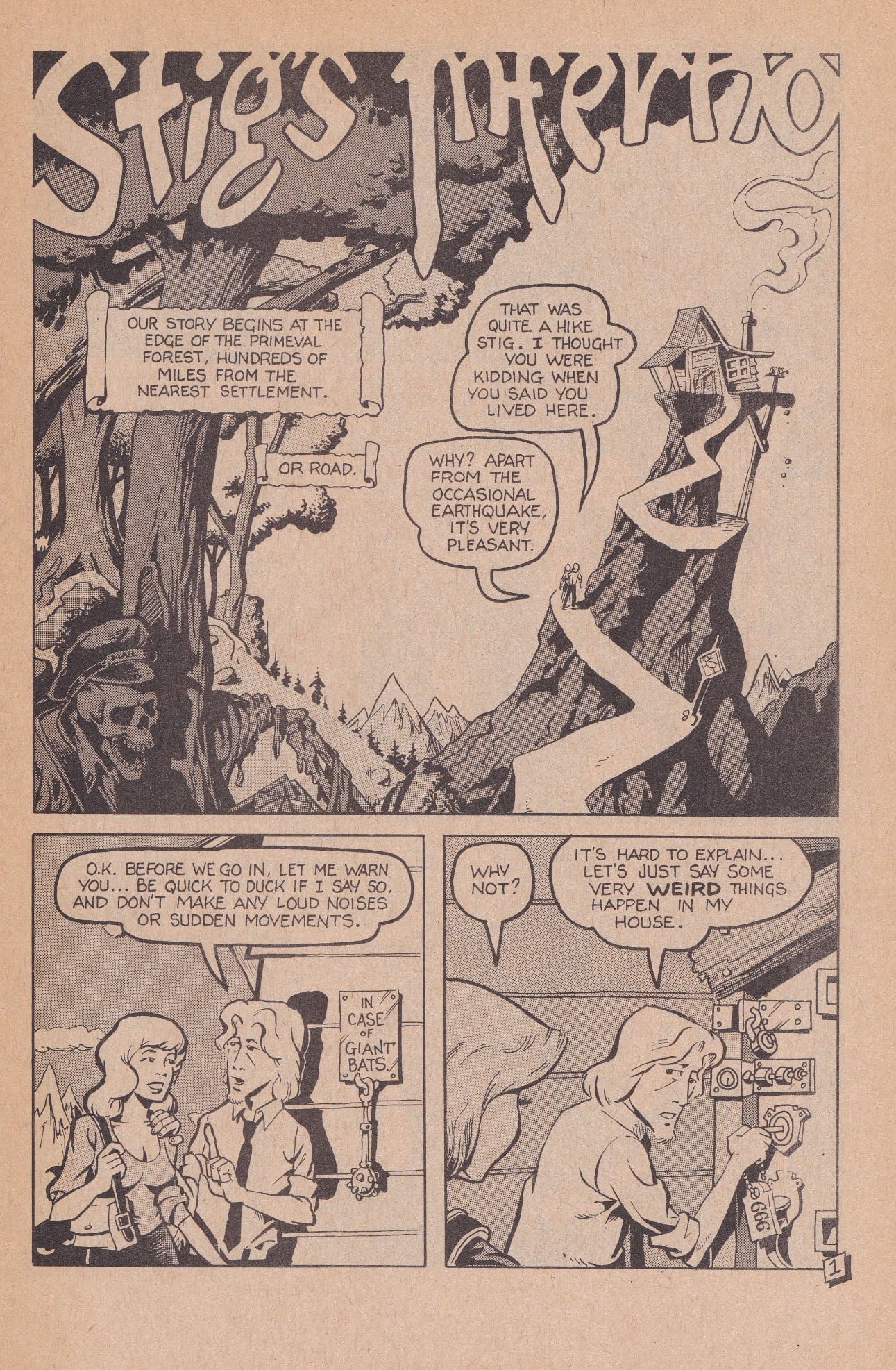 Stig’s Inferno, 1-1 1984: 1.
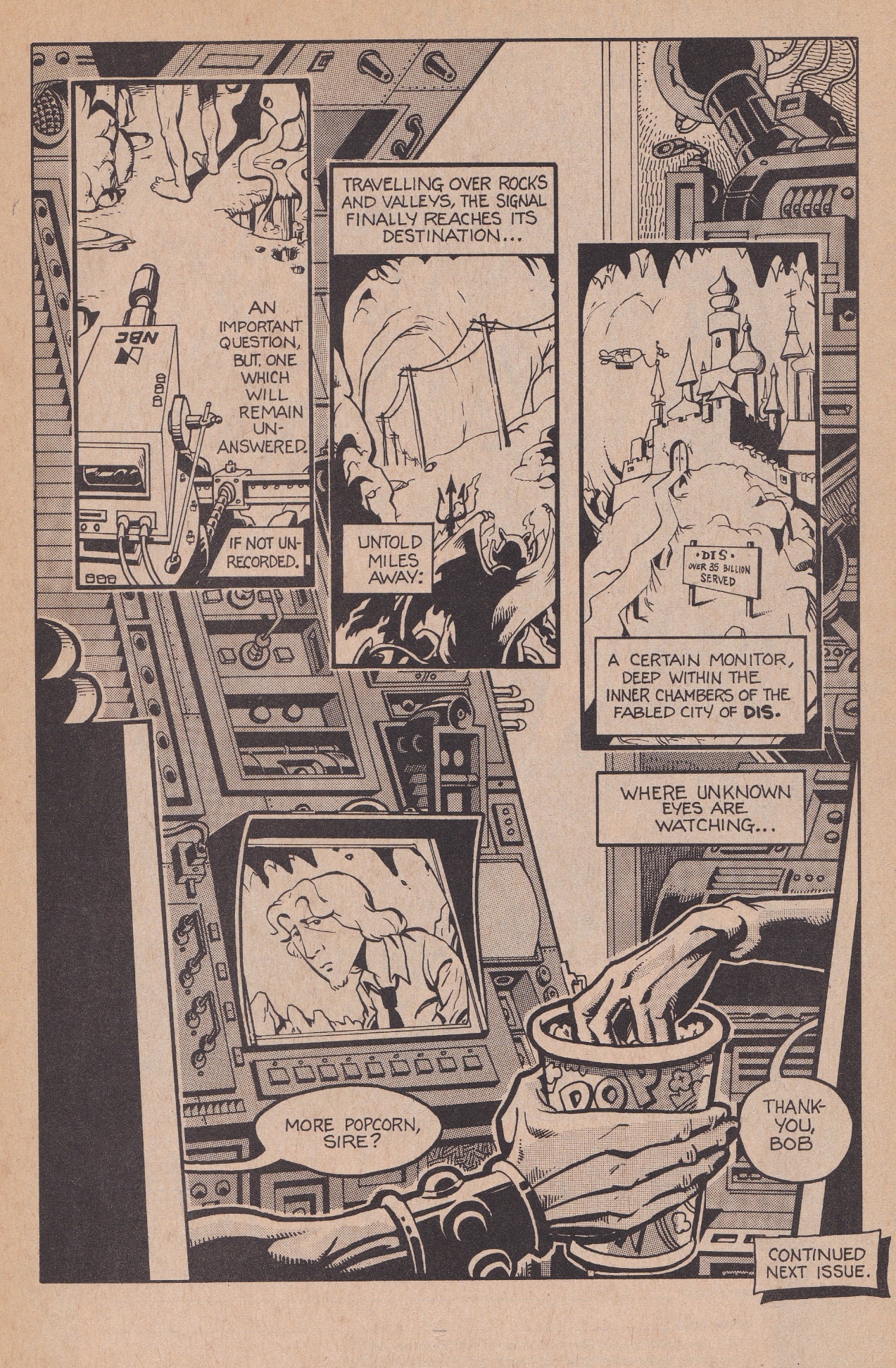 Stig’s Inferno, 1-1 1984: 13.
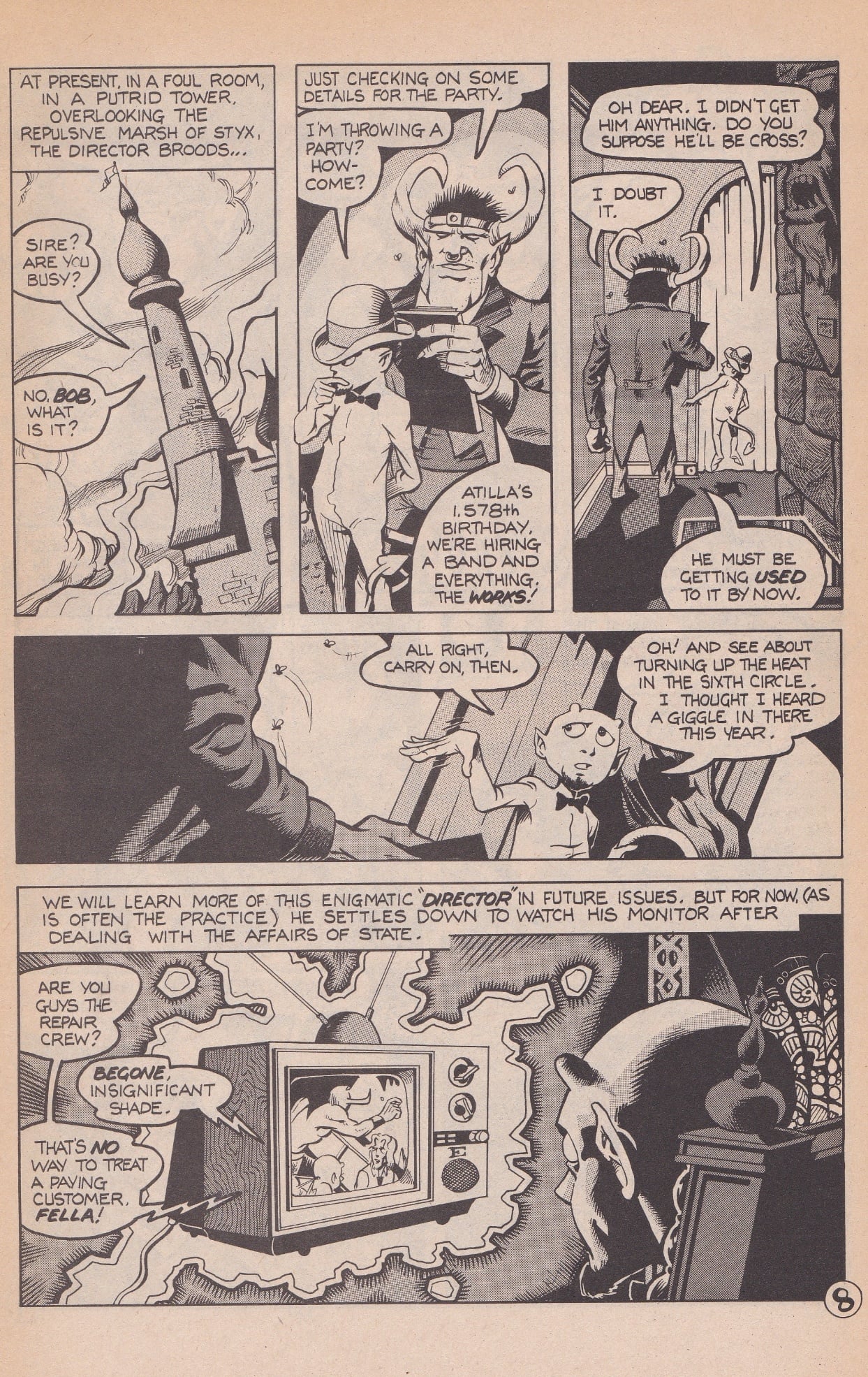 Stig’s Inferno, 1-2 1984: 9.
 Stig’s Inferno, 1-2 1984: 21.
 Stig’s Inferno, 1-2 1984: 22.
 Stig’s Inferno, 1-3 1985: Front cover. An engraving by Gustave Doré.
 Stig’s Inferno, 1-3 1985: 1.
 Stig’s Inferno, 1-5, 1986: 3.
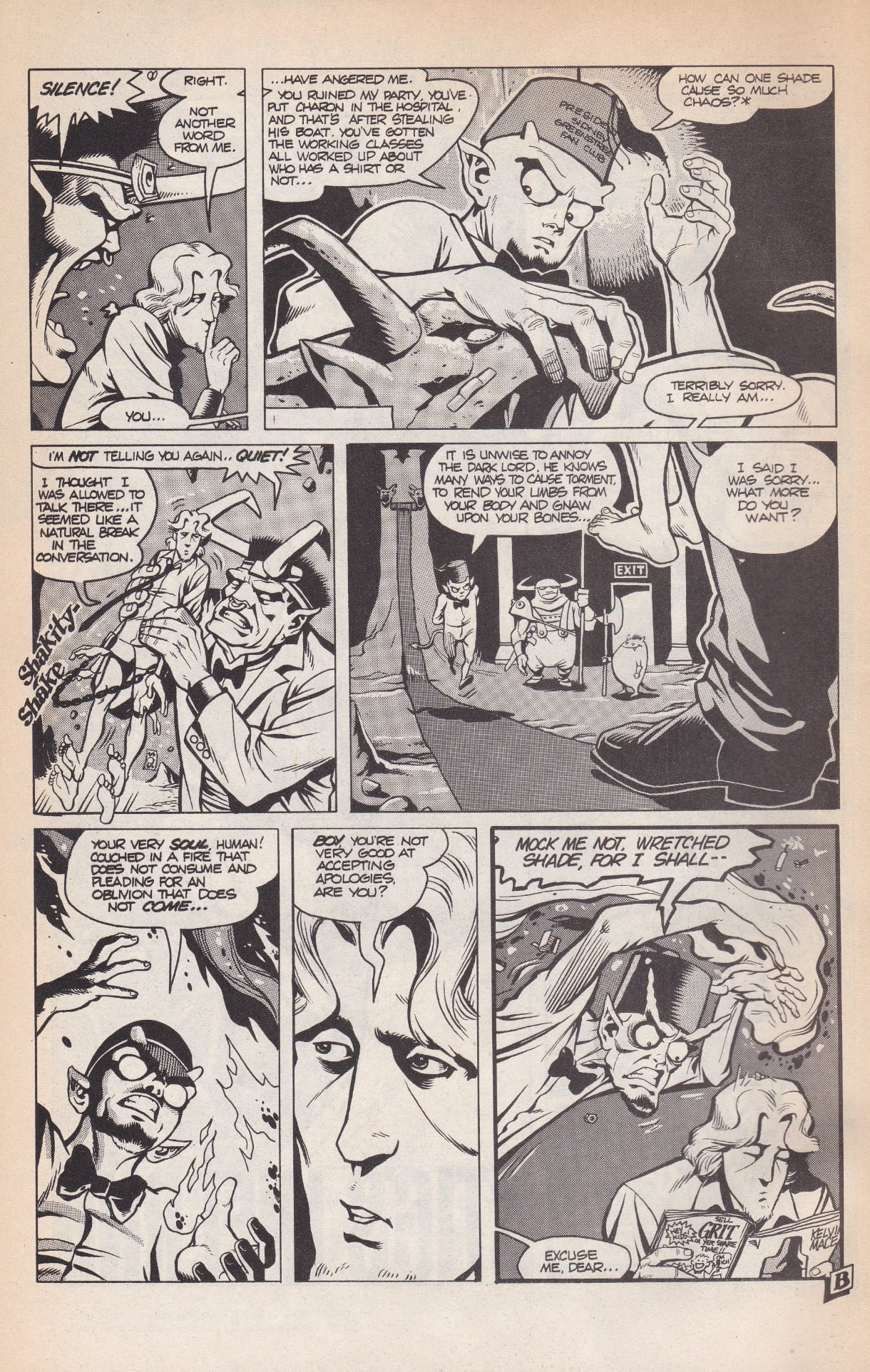 Stig’s Inferno, 1-5, 1986:4. Notice Stig is reading Kevin Mace the other character Ty was involved with.
 Stig’s Inferno, 1-5, 1986:5.
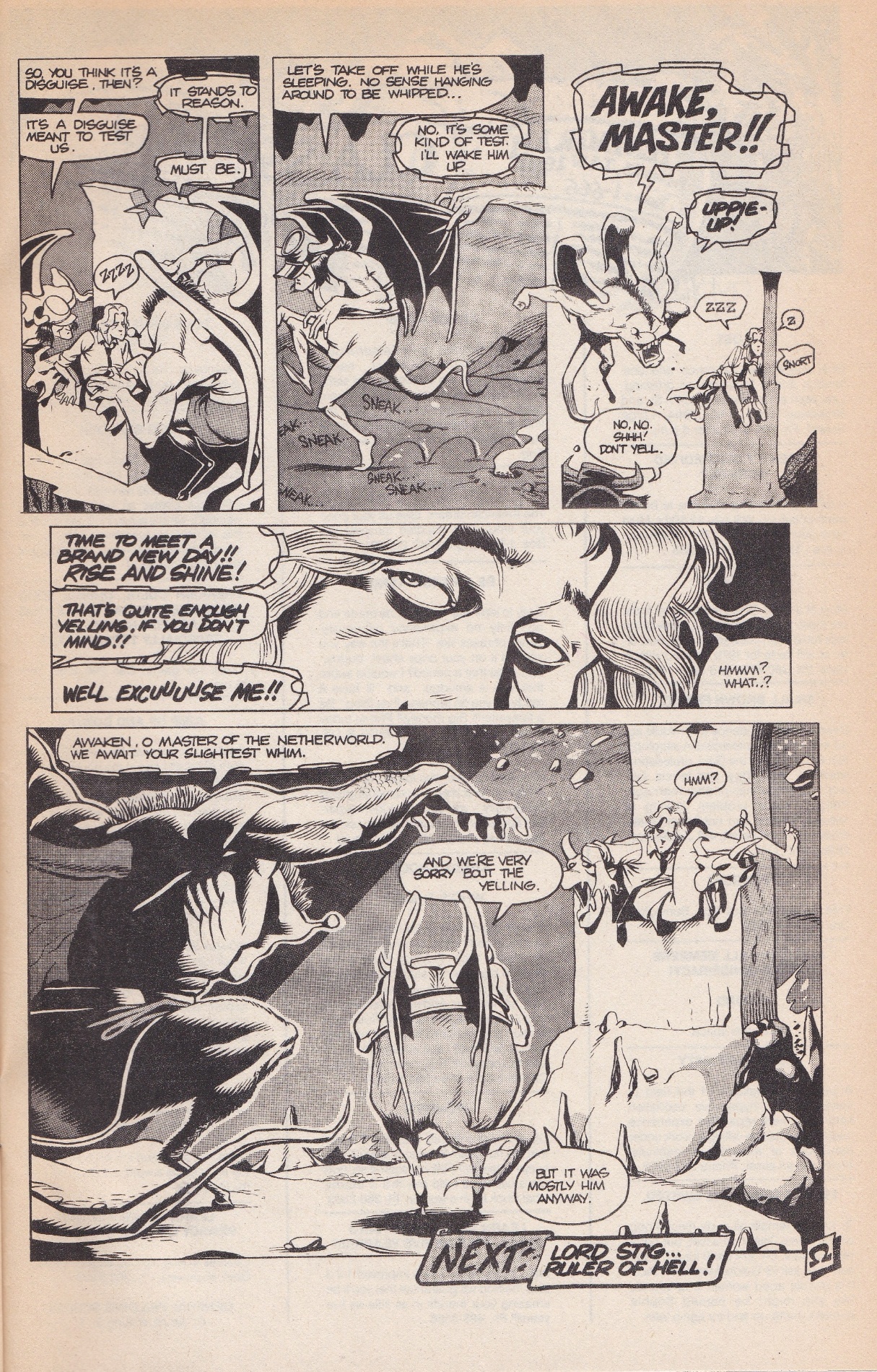 Stig’s Inferno, 1-5, 1986: 23.
 Stig’s Inferno, 1-7, March 1987: Front cover.
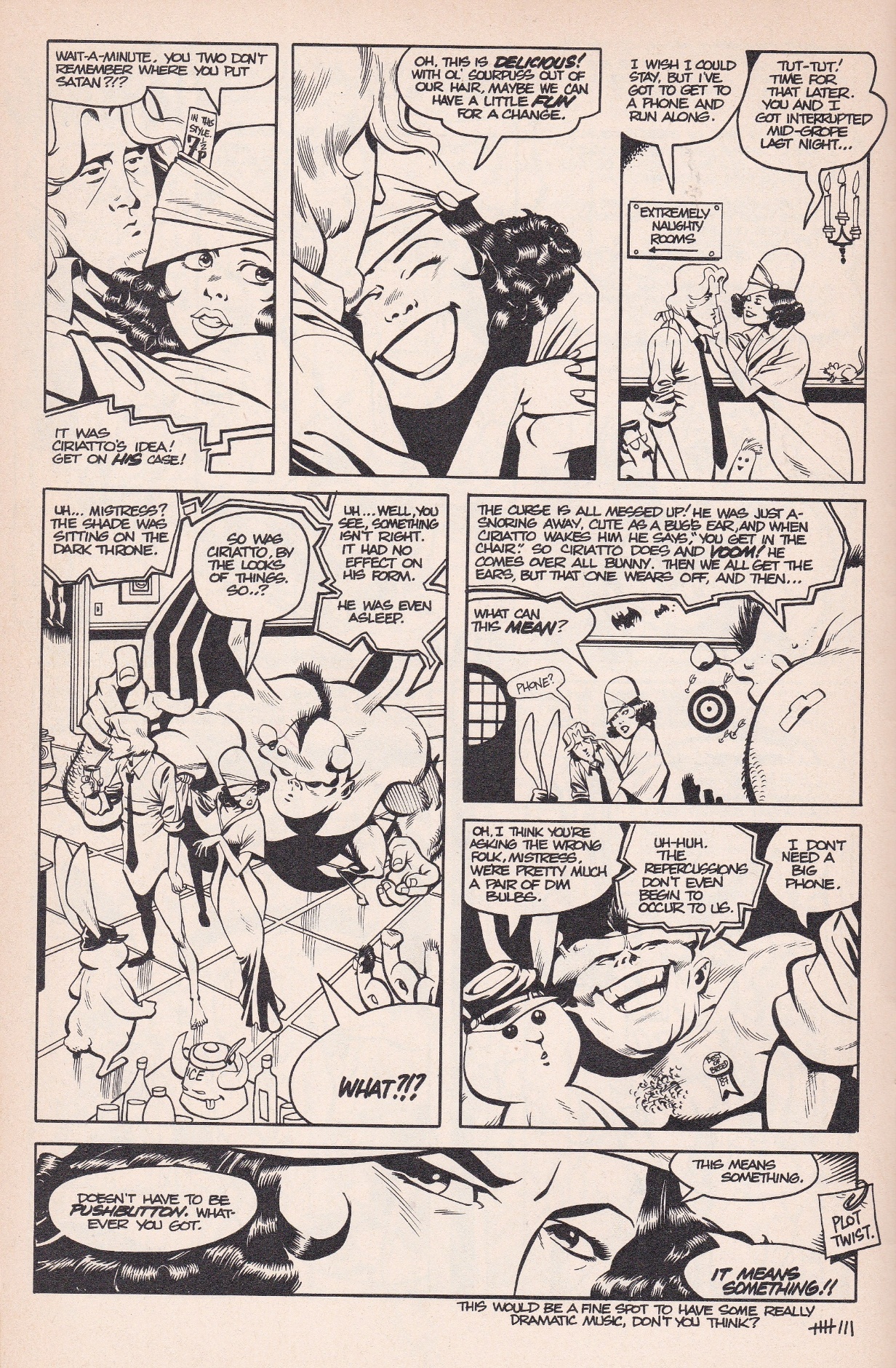 Stig’s Inferno, 1-7, March 1987: 8. Calcabrina and Ciriatto the two self admitted dim witted Palace guards bring Stig to Helene. Note Ty’s comment to the reader and the page numbering system.
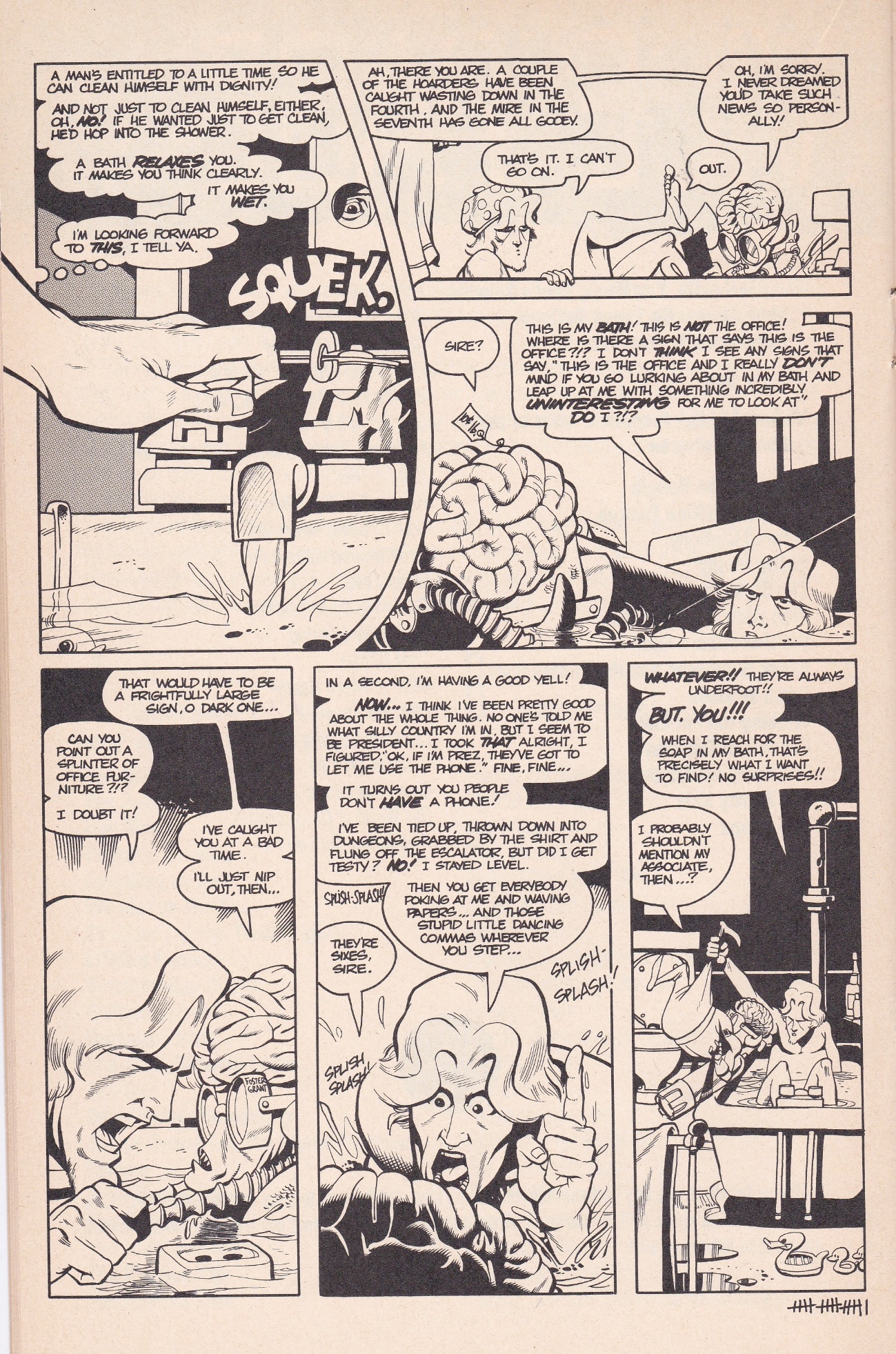 Stig’s Inferno, 1-7, March 1987: 18.
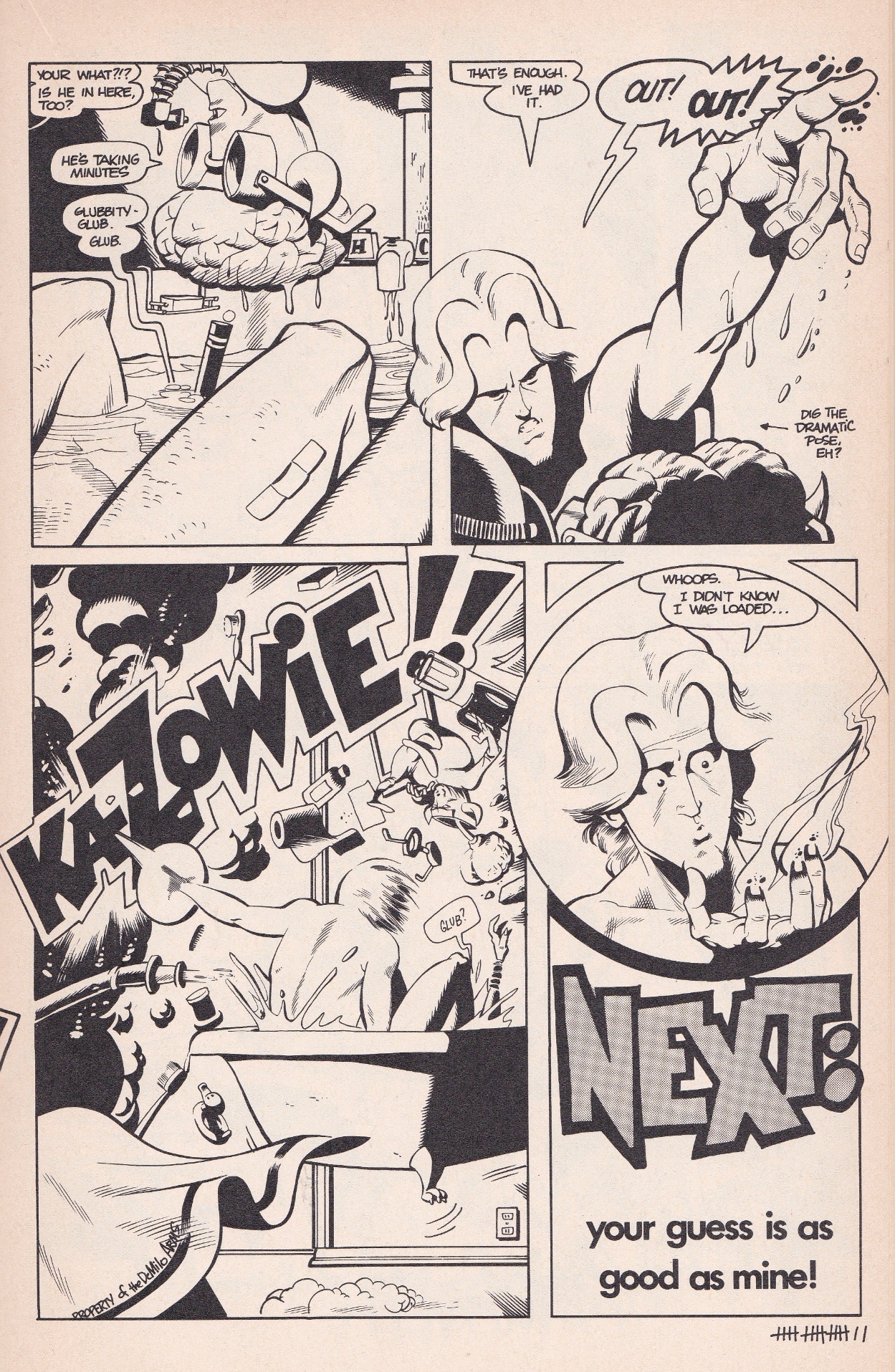 Stig’s Inferno, 1-7, March 1987: 19. Another example of Ty joking addressing the reader.